
Hair Loss Blood Tests: When Are They Medically Useful?
Hair Loss Blood Tests: When Are They Medically Useful?
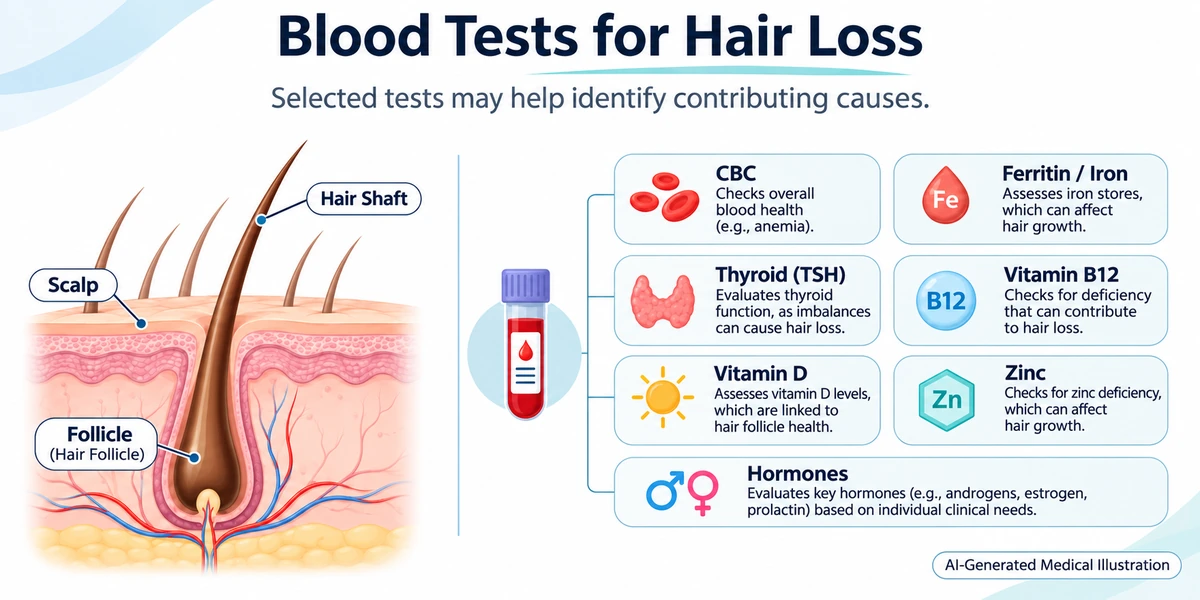
Blood tests for hair loss may be useful when a medical professional suspects that hair shedding or thinning is associated with an underlying condition, such as iron deficiency, thyroid dysfunction, nutritional deficiency or hormonal imbalance. However, blood tests are not necessary for everyone experiencing hair loss.
Hair loss can develop for several reasons, including genetic susceptibility, temporary changes in the hair growth cycle, medications, medical conditions and scalp disorders. Identifying the underlying cause usually begins with a medical history and scalp examination.
This article explains when blood investigations may help, which tests may be considered and why results must be interpreted alongside clinical findings.
What Is the Purpose of Blood Tests for Hair Loss?
Blood tests help identify certain medical conditions that may contribute to hair shedding or affect normal hair growth.
Hair follicles undergo repeated cycles of growth, transition, resting and shedding. Changes in nutrition, general health or hormone function can sometimes disrupt these cycles.
However, not all hair loss is caused by an abnormality detectable in blood.
For example, androgenetic alopecia, commonly called male or female pattern hair loss, is often diagnosed through the pattern of thinning, medical history and scalp assessment.
Blood investigations are therefore supporting diagnostic tools rather than universal tests for every form of hair loss.
The main objectives of testing may include:
Identifying iron deficiency or anaemia.
Evaluating suspected thyroid dysfunction.
Investigating possible nutritional deficiencies.
Assessing hormonal abnormalities when symptoms suggest them.
Identifying relevant systemic conditions.
Key point: Blood tests are most useful when they address a specific clinical question.
When Are Blood Tests for Hair Loss Medically Recommended?
A clinician may consider blood investigations when hair loss is unexplained, unusually persistent or accompanied by symptoms suggesting an underlying medical condition.
1. Persistent or Diffuse Hair Shedding
Diffuse shedding refers to increased hair loss across a large area of the scalp rather than one clearly defined patch.
One possible cause is telogen effluvium, a condition in which more hairs than usual enter the shedding phase.
Potential triggers include:
Significant physical illness or fever.
Major surgery.
Childbirth.
Rapid weight loss.
Nutritional deficiency.
Certain medications.
Significant physiological or emotional stress.
A medical professional may recommend selected blood tests if the history suggests iron deficiency, thyroid dysfunction or another contributing condition.
2. Hair Loss Associated With Fatigue or Other Symptoms
Hair shedding accompanied by unexplained fatigue, reduced exercise tolerance, changes in weight or other systemic symptoms may warrant additional evaluation.
For example, anaemia or thyroid dysfunction can sometimes occur alongside hair loss.
These symptoms do not establish a diagnosis on their own. Laboratory investigations are selected according to the complete clinical picture.
3. Hair Loss Associated With Menstrual or Hormonal Changes
Hormonal evaluation may be relevant in women experiencing hair thinning alongside symptoms such as:
Irregular menstrual periods.
Increased facial or body hair growth.
Persistent or significant acne.
Other signs of androgen excess.
These findings can sometimes be associated with conditions such as polycystic ovary syndrome (PCOS).
Hormonal blood tests should be selected and interpreted by an appropriately qualified medical professional.
4. Hair Loss With Possible Nutritional Deficiency
People with restricted diets, poor nutritional intake, malabsorption disorders or significant recent weight loss may require assessment for nutritional deficiencies.
Testing is based on the person’s dietary history, symptoms, examination and other risk factors rather than hair loss alone.
Which Blood Tests May Help Identify Causes of Hair Loss?
Several investigations may be considered during a medical assessment. Their usefulness varies according to the suspected diagnosis.
| Blood Test | What It Evaluates | When It May Be Useful |
|---|---|---|
| Complete Blood Count (CBC) | Haemoglobin and blood cell measurements | Suspected anaemia or associated systemic symptoms |
| Serum Ferritin | Stored iron levels | Suspected iron deficiency |
| Iron Studies | Iron availability and related measures | Further evaluation of iron deficiency or abnormal iron status |
| Thyroid-Stimulating Hormone (TSH) | Thyroid function | Symptoms or risk factors suggesting thyroid dysfunction |
| Vitamin B12 | Vitamin B12 status | Dietary restrictions, anaemia, neurological symptoms or malabsorption risk |
| Vitamin D | Vitamin D status | Selected patients with clinical indications or deficiency risk |
| Zinc | Zinc status | Suspected nutritional deficiency or malabsorption |
| Androgen Profile | Selected androgen hormone levels | Clinical signs suggesting androgen excess |
Important: This table is not a recommended routine testing panel. An individual may need only one or two investigations, several tests or no blood tests at all.
Complete Blood Count (CBC)
A complete blood count measures several components of blood, including haemoglobin and red blood cells.
It may help identify anaemia, which can have various causes, including iron deficiency.
A CBC does not directly diagnose the cause of hair loss. Abnormal findings may require additional evaluation.
Serum Ferritin and Iron Studies
Ferritin is a protein associated with iron storage. Measuring serum ferritin can help assess the body’s iron reserves.
Iron deficiency may contribute to hair shedding in some individuals.
A clinician may consider ferritin testing when there is a history of heavy menstrual bleeding, inadequate dietary iron intake, anaemia or unexplained diffuse shedding.
Ferritin levels must be interpreted carefully because inflammation and some medical conditions can affect results.
Importantly, there is no universally accepted ferritin target that guarantees hair regrowth. Treating confirmed iron deficiency is medically appropriate, but improvement in hair density cannot be promised.
Thyroid Function Tests
The thyroid gland produces hormones involved in metabolism and many bodily functions, including processes relevant to hair growth.
Both underactive and overactive thyroid conditions may be associated with changes in hair quality or shedding.
TSH is commonly used as an initial investigation when thyroid disease is suspected. Additional tests, such as free T4, may be appropriate depending on the findings.
Testing may be particularly relevant when hair loss occurs alongside unexplained weight changes, temperature intolerance, fatigue or altered bowel habits.
Vitamin B12 Testing
Vitamin B12 is necessary for normal red blood cell formation and neurological function.
Testing may be appropriate in people with suspected deficiency, certain dietary patterns, anaemia or conditions affecting nutrient absorption.
However, low vitamin B12 is not the explanation for every case of hair loss. Supplementation should address a confirmed deficiency or another established medical indication.
Vitamin D Testing
Vitamin D contributes to several biological functions, and research has explored associations between vitamin D status and certain forms of hair loss.
Nevertheless, an association does not establish that vitamin D deficiency is the cause of an individual’s hair loss.
Routine vitamin D testing for everyone experiencing hair loss is not automatically necessary.
A clinician may recommend it when additional risk factors or clinical indications are present.
Zinc Testing
Zinc plays a role in cellular growth and normal tissue function.
Significant zinc deficiency can be associated with hair changes, but zinc testing is not routinely required for all patients with thinning hair.
It may be considered when there is suspected malabsorption, poor nutritional intake or other clinical evidence of deficiency.
Taking excessive zinc supplements without medical guidance may cause adverse effects, including copper deficiency.
Hormonal Blood Tests
Hormonal investigations may be useful when hair thinning occurs alongside signs of androgen excess or another endocrine disorder.
Selected tests may include total testosterone, calculated or measured free testosterone, sex hormone-binding globulin (SHBG) and DHEAS.
The appropriate investigation depends on symptoms, age, medication use, menstrual history and clinical examination.
Hormonal testing is not a universal requirement for all patients with hair loss. In women with female pattern hair loss, specialist assessment for androgen excess may be appropriate, with laboratory testing guided by established clinical recommendations.
Do All People With Hair Loss Need Blood Tests?
No. Blood tests are not necessary for every person experiencing hair thinning or shedding.
Some forms of hair loss have characteristic clinical patterns.
For example, gradual recession of the frontal hairline or thinning around the crown may suggest androgenetic alopecia. A clinician can often identify this pattern through history and scalp examination.
Similarly, patchy hair loss or inflammatory scalp disorders may require focused examination rather than broad laboratory screening.
Unnecessary investigations can increase costs and may identify incidental abnormalities unrelated to the actual cause of hair loss.
A targeted approach is therefore preferable to ordering the same comprehensive panel for every patient.
How Is Hair Loss Diagnosed Apart From Blood Tests?
A detailed hair loss assessment involves more than laboratory testing.
Medical History
A clinician may ask about the onset, duration and pattern of hair loss, along with recent illnesses, medications, family history, diet and other relevant symptoms.
Scalp Examination
The scalp is examined for changes in hair density, distribution, redness, scaling, inflammation and signs of scarring.
These findings may suggest different causes of hair loss.
Hair-Pull Test
A clinician gently examines how readily hairs are shed from selected scalp areas.
The findings may help assess active shedding, although the test cannot independently establish every diagnosis.
Trichoscopy or Scalp Dermoscopy
Trichoscopy uses magnification to examine hair shafts, follicular openings and scalp structures.
It can help distinguish certain patterns of hair loss, including follicular miniaturisation and inflammatory conditions.
Scalp Biopsy
In selected cases, a small scalp tissue sample may be needed to clarify an uncertain diagnosis or investigate possible scarring alopecia.
A biopsy is not necessary for most individuals with hair loss.
Can Blood Tests Be Normal Even When Hair Loss Continues?
Yes. Normal blood results do not necessarily mean that hair loss is absent or medically insignificant.
Several common forms of hair loss may occur without detectable abnormalities in routine blood investigations.
These include:
Androgenetic alopecia.
Certain cases of telogen effluvium.
Alopecia areata.
Traction-related hair loss.
Some inflammatory or scarring scalp disorders.
In these situations, diagnosis depends mainly on clinical findings and, when necessary, additional examination.
Normal blood results should therefore be considered alongside the person’s symptoms and scalp assessment.
What Happens if a Blood Test Shows an Abnormal Result?
An abnormal test result requires interpretation rather than automatic treatment.
A medical professional may consider:
Whether the result is genuinely outside an appropriate reference range.
Whether it is clinically significant.
Whether it relates to the hair loss.
Whether further investigation is necessary.
Whether treatment or monitoring is appropriate.
For example, confirmed iron deficiency may require an assessment of dietary intake, blood loss or an underlying medical condition.
Treating a deficiency may help address a contributing factor, but hair regrowth depends on the overall diagnosis and individual response.
Self-prescribing iron, hormone preparations or high-dose vitamin supplements without medical evaluation can be harmful.
Are Hair Loss Blood Tests Different for Men and Women?
Some investigations may differ because the possible underlying causes and relevant clinical findings can vary.
In men with a typical hereditary pattern of hair loss, routine blood testing is often unnecessary unless other symptoms suggest an additional condition.
In women, diffuse shedding, menstrual history, nutritional factors and symptoms of endocrine disorders may influence the decision to investigate.
However, gender alone does not determine which tests are required.
A clinical assessment remains the starting point for selecting appropriate investigations.
When Should Someone Seek Medical Advice for Hair Loss?
Medical assessment is appropriate when hair loss is sudden, unexplained, progressive or associated with other concerning symptoms.
Particular attention is warranted when there is:
Rapid development of bald patches.
Significant unexplained shedding.
Persistent scalp pain, redness or inflammation.
Scalp scaling, pustules or discharge.
Loss of eyebrows or eyelashes.
Associated fatigue, unexplained weight changes or other systemic symptoms.
Evidence of scalp scarring or loss of follicular openings.
Painful inflammation or suspected scarring alopecia warrants prompt assessment because some conditions can lead to permanent follicular damage if diagnosis and treatment are delayed.

Frequently Asked Questions About Blood Tests for Hair Loss
1. Which blood test is most important for hair loss?
There is no single most important blood test for everyone. CBC, ferritin and thyroid investigations may be useful in selected situations, but the choice depends on symptoms, medical history and scalp examination.
2. Can a blood test identify the exact cause of hair loss?
Sometimes blood tests identify a contributing condition, such as iron deficiency or thyroid dysfunction. However, many types of hair loss are diagnosed clinically and may occur despite normal blood results.
3. Should everyone with hair loss check vitamin D and B12?
No. These tests may be appropriate when there are clinical indications or deficiency risk factors, but routine testing is not necessary for every individual experiencing hair loss.
4. Can low ferritin cause hair shedding?
Iron deficiency can contribute to hair shedding in some individuals. However, not everyone with hair loss has low ferritin, and ferritin levels alone cannot establish the cause of hair loss.
5. Are hormone tests necessary for female hair loss?
Hormonal investigations may be relevant when female hair loss is associated with signs of androgen excess or other endocrine concerns. The need for testing should be determined through clinical evaluation.
6. Can hair loss continue despite normal blood test results?
Yes. Hereditary pattern hair loss, alopecia areata and some scalp disorders can occur with normal routine blood investigations.
7. Should supplements be started before blood test results are available?
High-dose supplements should not be started simply because hair loss is present. A medical professional can determine whether a deficiency is suspected, whether testing is needed and whether supplementation is appropriate.
Conclusion
Blood tests for hair loss can provide useful information when an underlying nutritional, thyroid, hormonal or systemic condition is suspected. However, they are not necessary for every person experiencing hair thinning or shedding.
The most appropriate diagnostic approach begins with a careful medical history and scalp examination. Blood investigations are then selected according to specific symptoms, risk factors and clinical findings.
Normal test results do not exclude all forms of hair loss, and abnormal findings do not always explain the condition.
A medically guided, targeted approach helps avoid unnecessary investigations while supporting accurate diagnosis and appropriate management.
Medical Disclaimer:
This article is intended for general educational purposes only and does not replace individual medical advice, diagnosis or treatment. Blood investigations and treatment decisions should be based on professional clinical evaluation. Do not start or discontinue medicines or high-dose supplements solely on the basis of information presented here.