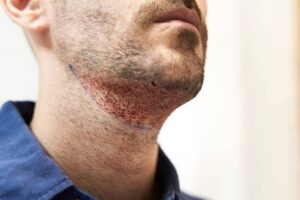
Hair transplant in Navi Mumbai is a surgical hair-restoration option that may be considered for selected individuals experiencing permanent hair thinning or baldness.
Hair transplantation involves transferring healthy hair follicles from a donor area, usually the back or sides of the scalp, to an area affected by hair loss. The procedure redistributes existing follicles rather than creating new ones.
Dr. Vinod Vij provides plastic and cosmetic surgery consultations in Navi Mumbai. Assessment may help establish the cause of hair loss, suitability for transplantation, donor-hair availability, possible complications and alternative treatments.
A hair transplant is not suitable for every type of hair loss, and a particular hair density or appearance cannot be guaranteed.
Hair transplant surgery involves removing follicular units from a suitable donor area and placing them into selected areas of hair thinning or baldness.
A follicular unit is a naturally occurring grouping of hair follicles that may contain one or more hairs.
Transplantation may be considered for:
Selected cases of androgenetic alopecia, also called pattern hair loss.
Certain areas of permanent hair loss following injury.
Selected stable scars with suitable surrounding tissue.
Some facial hair or eyebrow reconstruction concerns.
The procedure does not stop the progression of hair loss in untreated areas.
The diagnosis of hair loss should be established before surgery is considered.
Discuss hair transplant surgery in Navi Mumbai, including FUE, FUT, individual suitability, risks and recovery.
Hair loss has several possible causes, and not all respond to transplantation.
Androgenetic alopecia is associated with genetic susceptibility and hormonal influences.
It commonly involves progressive thinning in characteristic areas of the scalp.
Alopecia areata is an immune-mediated condition that can cause patchy hair loss.
Active disease usually requires medical management rather than immediate transplantation.
Telogen effluvium involves increased hair shedding that may occur after illness, stress, nutritional problems or other triggers.
Transplantation is generally not the primary treatment.
Some inflammatory conditions permanently damage hair follicles and cause scarring.
Transplantation may be inappropriate during active disease and requires specialist evaluation.
Hair loss may also be associated with scalp infections, medication effects, nutritional deficiencies or underlying medical conditions.
Identifying the cause is important before selecting treatment.
Hair transplantation may be considered when the pattern and cause of hair loss have been appropriately assessed.
Factors include:
Diagnosis and stability of hair loss.
Adequate donor-hair density.
Hair thickness and characteristics.
Extent of the recipient area.
Scalp condition.
Age and anticipated future hair loss.
General health and medical history.
Previous hair restoration procedures.
Smoking and wound-healing factors.
Understanding of surgical risks and realistic expectations.
Some individuals may benefit from medical treatment or observation instead of surgery.
Two established approaches to harvesting scalp follicular units are Follicular Unit Extraction (FUE) and Follicular Unit Transplantation (FUT).
Follicular Unit Extraction involves removing individual follicular units from the donor area using small punch instruments.
The harvested grafts are prepared and placed into the planned recipient sites.
FUE generally creates multiple small donor-site scars rather than one linear scar.
It may be considered depending on donor-hair characteristics, scalp anatomy and the treatment plan.
Follicular Unit Transplantation involves removing a strip of hair-bearing scalp from the donor area.
Follicular units are prepared from the strip and transplanted into the recipient area.
FUT generally leaves a linear donor scar.
The choice between FUE and FUT depends on clinical factors; neither is universally suitable or superior for every individual.
| Feature | FUE | FUT |
|---|---|---|
| Donor harvesting | Individual follicular units | Strip of hair-bearing scalp |
| Donor scars | Multiple small scars | Linear scar |
| Sutures | Generally not required for punch sites | Usually required for strip closure |
| Donor management | Requires planning to avoid overharvesting | Requires planning around scalp laxity and scar |
| Recovery | Depends on surgical extent | Depends on surgical extent |
| Suitability | Individual assessment | Individual assessment |
Both techniques involve risks, healing requirements and limitations in available donor hair.
The method should be selected according to individual anatomy rather than marketing claims.
The doctor examines the scalp, hair-loss pattern, donor density and medical history.
The recipient area, approximate graft requirements and expected limitations are discussed.
Hair transplantation is generally performed under local anaesthesia, with additional measures when clinically appropriate.
Follicular units are harvested using the planned FUE or FUT technique.
Harvested grafts are examined and prepared for transplantation.
Small sites are created in the planned recipient area, taking account of hair direction, angle and available scalp space.
Follicular units are placed into the prepared sites.
The patient receives instructions concerning scalp washing, medicines, activity restrictions and follow-up.
The duration and details of surgery depend on the technique and number of grafts.
The donor area is the part of the scalp from which follicles are harvested.
Hair from the back and sides of the scalp is often considered because some follicles in these regions may be more resistant to the processes responsible for pattern hair loss.
However, donor hair is limited.
Excessive harvesting can lead to visible thinning, scarring or an uneven donor-area appearance.
Donor management is especially important in people whose hair loss may progress over time.
The number of grafts required depends on:
Size of the thinning or bald area.
Donor-hair availability.
Hair shaft thickness.
Hair texture and colour.
Existing hair density.
Scalp characteristics.
Proposed hairline.
Likely future hair-loss progression.
A graft may contain one or several hairs.
Therefore, graft count is not the same as hair count.
No fixed number of grafts can guarantee complete coverage or a particular density.
Hair transplantation may be considered in selected men and women.
Pattern hair loss in men may involve the frontal hairline, temples or crown.
Treatment planning depends on the extent of thinning and predicted progression.
Women may experience diffuse thinning, patterned loss or other causes of hair loss.
Diffuse thinning can affect donor suitability, so careful diagnosis is particularly important.
The same surgical approach is not appropriate for every person with hair thinning.
Hair transplantation is a surgical procedure with recognised risks.
Possible complications include:
Bleeding.
Infection.
Swelling or discomfort.
Temporary crusting.
Folliculitis.
Scarring.
Temporary or persistent changes in scalp sensation.
Poor wound healing.
Temporary shedding of existing hair.
Inadequate graft growth.
Uneven density.
Unnatural hair direction or hairline appearance.
Donor-area overharvesting.
Continued loss of non-transplanted hair.
Anaesthesia-related complications.
Possible additional surgery.
Graft survival and final appearance vary according to individual factors.
Patients should understand the potential complications before surgery.
Follicular Unit Transplantation (FUT) involves removing a strip of hair-bearing scalp from the donor area. The strip is divided into follicular units, which are then transplanted into the recipient area.
FUT generally leaves a linear donor scar. It can still be considered for selected patients depending on donor characteristics, hairstyle preferences and the surgical plan. FUE and FUT can both provide useful grafts when appropriately selected.
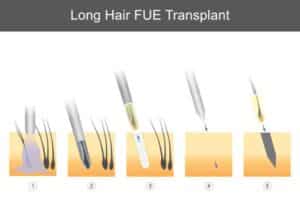
Follicular Unit Extraction (FUE) involves removing individual follicular units from the donor area using small punch instruments. The grafts are prepared and then placed into planned recipient sites.
FUE produces multiple small donor-site scars rather than the linear donor scar associated with FUT. Recovery, scarring and suitability vary between patients, and FUE should not be presented as universally superior to FUT.

Recovery requirements depend on technique, graft number and individual healing.
Mild swelling, tenderness, redness and small crusts may occur.
Patients should follow specific instructions about scalp protection and medicines.
Crusting gradually resolves as the scalp heals.
Direct rubbing, scratching and activities that may disturb grafts should be avoided as advised.
Some transplanted hairs may shed temporarily.
This shedding does not necessarily indicate that every transplanted follicle has been lost.
New hair growth develops gradually.
Density and appearance change over time as transplanted follicles enter growth cycles.
Increasing pain, spreading redness, fever, unusual discharge, substantial bleeding or unexpected swelling requires medical assessment.
Hair transplant results develop gradually.
| General period | Possible changes |
|---|---|
| First 1–2 weeks | Healing, redness and crusting |
| Weeks 2–8 | Temporary shedding of some transplanted hairs |
| Months 3–4 | Early new growth may begin |
| Months 6–9 | Additional growth and visible changes may develop |
| Months 9–12 and beyond | Further growth and hair maturation |
These timelines are approximate and vary between individuals.
Some patients require more than 12 months for later changes to become apparent.
No particular amount of growth or density can be guaranteed.
Transplanted follicles may continue producing hair over the long term.
However, hair transplantation should not be described as a guaranteed permanent solution for every patient.
The final appearance may change because of:
Continued loss of non-transplanted hair.
Changes in donor-hair characteristics.
Ageing.
Underlying medical conditions.
Variable graft growth.
Scarring or complications.
Ongoing assessment or medical treatment may be required.
No. Platelet-rich plasma (PRP) treatment and hair transplantation are different procedures.
PRP involves processing a sample of the patient’s blood to prepare platelet-rich plasma, which may then be injected into selected tissues.
Hair transplantation involves surgically relocating follicles.
Evidence for PRP in different forms of hair loss is variable, and individual outcomes cannot be guaranteed.
Learn about PRP treatment and hair restoration for further general treatment information.
Not every person with hair loss requires surgery.
Depending on diagnosis and clinical suitability, treatment may involve:
Medical assessment and monitoring.
Identifying and managing underlying causes.
Prescription medicines for selected types of hair loss.
Treatment of inflammatory scalp conditions.
Nutritional assessment when indicated.
Hair camouflage or cosmetic hair systems.
Choosing not to undergo treatment.
Some prescribed medicines have contraindications and potential side effects.
Treatment should be selected after appropriate medical evaluation.
Hair transplant cost in Navi Mumbai varies according to graft requirements, donor characteristics, surgical technique and healthcare facility charges.
Factors affecting cost include:
FUE or FUT harvesting technique.
Approximate number of follicular-unit grafts.
Recipient-area size.
Donor-area characteristics.
Surgical complexity.
Surgeon and clinical team fees.
Anaesthesia and monitoring.
Operating theatre and facility charges.
Medicines and postoperative follow-up.
Need for additional sessions.
Patients should request a written estimate explaining the charges included and any additional expenses.
Hair transplantation performed solely for cosmetic hair restoration is generally excluded from standard health insurance.
Selected reconstructive cases may be evaluated differently depending on the diagnosis and insurance policy.
Coverage should be confirmed directly with the insurer.
| Feature | Hair Transplant | Hair-Loss Medication |
|---|---|---|
| Primary approach | Surgical relocation of follicles | Medical management of selected hair-loss conditions |
| Main purpose | Address selected areas using available donor hair | Reduce progression or support growth in eligible cases |
| Limitations | Limited donor supply and surgical risks | Requires appropriate diagnosis; side effects may occur |
| Ongoing care | Follow-up and possible additional treatment | Monitoring and continued treatment may be needed |
| Suitability | Depends on donor and recipient areas | Depends on diagnosis and contraindications |
Surgery and medical management may sometimes be considered together, but treatment should be individualised.
Learn about hair transplant surgery in Navi Mumbai, including treatment suitability, potential risks and expected recovery.
A hair transplant is a surgical procedure that transfers follicles from a donor area to selected regions affected by hair loss.
Suitability depends on the diagnosis, donor-hair availability, scalp health, medical history and extent of hair loss.
FUE removes individual follicular units, while FUT removes a strip of scalp from which follicular units are prepared.
Yes. FUE generally produces multiple small donor-site scars.
FUT may be considered for selected patients, but suitability depends on donor characteristics, scalp laxity, scarring considerations and the proposed procedure.
The number depends on the treatment area, donor supply, hair characteristics and individual surgical planning.
Local anaesthesia is commonly used. Temporary discomfort during injections and postoperative tenderness may occur.
New growth may become noticeable after several months, with further changes developing over six to twelve months or longer.
Temporary shedding of transplanted hair shafts is common during early recovery.
Transplanted follicles may provide long-term growth, but a particular lifetime result cannot be guaranteed.
Disclaimer: Website content and visuals are for general informational, educational and representational purposes only, may not reflect individual patient conditions or outcomes, and do not replace personalised medical advice, diagnosis or clinical assessment.