
Hair Transplant Cost in Navi Mumbai – Graft Pricing, FUE, FUT and Treatment Expenses
Hair transplant cost in Navi Mumbai varies according to the number of follicular-unit grafts required, surgical technique, donor-hair availability, treatment complexity and healthcare facility charges.
Hair transplantation is a surgical procedure that relocates existing hair follicles from a donor area to selected regions of hair loss. It does not create new follicles or prevent future thinning in untreated areas.
Dr. Vinod Vij provides plastic and cosmetic surgery consultations in Navi Mumbai. A clinical assessment can help determine the cause of hair loss, whether transplantation is appropriate and the estimated expenses.
There is no single hair transplant price applicable to every patient. A procedure-specific written quotation should be based on individual findings and the proposed treatment plan.
How Much Does a Hair Transplant Cost in Navi Mumbai?
The total cost depends on the extent of hair loss, donor-hair characteristics, graft requirements and the surgical method selected.
An estimate may include:
Medical consultation and scalp assessment.
Surgeon and clinical team fees.
Follicular-unit harvesting and graft preparation.
Recipient-site preparation and graft placement.
Anaesthesia and monitoring.
Operating theatre or facility charges.
Required investigations.
Medicines and dressings.
Postoperative examinations.
Additional treatment, when necessary.
An exact price generally requires examination of the donor and recipient areas.
For information about surgical techniques, read about hair transplant surgery in Navi Mumbai.
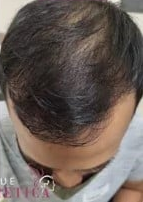
What Determines Hair Transplant Cost Per Graft?
Some facilities calculate fees using the number of follicular-unit grafts, while others provide a complete procedure quotation.
A follicular-unit graft may contain one or several hair follicles. Therefore, graft count is not the same as hair count.
The cost associated with a graft may reflect harvesting, preparation, implantation and the clinical resources required.
Patients should confirm whether a quoted graft rate includes anaesthesia, facility expenses, medicines and postoperative follow-up.
Understand how graft count, surgical technique and individual medical needs affect hair transplant cost in Navi Mumbai.
Graft-Wise Hair Transplant Cost
The number of grafts is determined through assessment rather than a fixed package.
| Proposed graft range | Main cost considerations |
|---|---|
| Up to 1,000 grafts | Limited treatment area, donor suitability and surgical setup |
| 1,000–2,000 grafts | Recipient-area size, graft preparation and procedural duration |
| 2,000–3,000 grafts | Donor capacity, harvesting method and surgical complexity |
| 3,000–4,000 grafts | Extended operative requirements and donor-area management |
| Above 4,000 grafts | Donor safety, feasibility, operative duration and potential staged treatment |
These ranges are illustrative planning categories, not treatment recommendations or quoted prices.
A higher graft count is not automatically appropriate. Excessive harvesting may cause visible donor-area thinning and scarring.
FUE Hair Transplant Cost in Navi Mumbai
Follicular Unit Extraction (FUE) involves harvesting individual follicular units with small punch instruments.
The total expense may depend on:
Number of grafts.
Donor density.
Hair characteristics.
Harvesting complexity.
Procedure duration.
Clinical team and facility requirements.
Postoperative care.
FUE produces multiple small donor-site scars and should not be described as a scarless technique.
Neither a higher price nor the use of FUE guarantees graft growth or a particular hair density.
FUT Hair Transplant Cost in Navi Mumbai
Follicular Unit Transplantation (FUT) involves removing a strip of hair-bearing scalp and preparing individual follicular units from it.
Cost factors include the amount of tissue harvested, graft preparation, wound closure and the overall operation.
FUT usually produces a linear donor scar.
The suitability of FUT depends on scalp characteristics, available donor hair, prior surgery and individual preferences.
FUE vs FUT: Which Costs More?
FUE and FUT involve different methods of harvesting donor follicles.
| Feature | FUE | FUT |
|---|---|---|
| Harvesting | Individual follicular units | Strip of hair-bearing scalp |
| Donor scarring | Multiple small scars | Linear scar |
| Procedure requirements | Individual-unit extraction | Strip removal and dissection |
| Pricing factors | Graft count, duration, equipment | Graft count, tissue dissection, closure |
| Suitability | Depends on donor assessment | Depends on donor assessment |
There is no universal rule that one technique must always cost more.
The operation should be selected according to clinical suitability rather than price alone.
Does DHI Affect Hair Transplant Cost?
Direct Hair Implantation (DHI) is a term commonly used for graft placement involving an implantation instrument.
It generally does not describe a completely separate source of donor follicles. Harvesting may still involve FUE.
Specialised instruments, procedural requirements and team arrangements may affect expenses.
The use of an implantation device does not guarantee better growth, greater density or fewer complications.
Patients should confirm the actual harvesting and implantation methods included in a quotation.
What Factors Affect Hair Transplant Surgery Fees?
Extent of Hair Loss
A larger recipient area may require additional grafts, although the appropriate number depends on available donor hair and long-term planning.
Donor-Hair Availability
The density, distribution and characteristics of donor hair influence surgical feasibility.
Limited donor supply may restrict the treatment plan regardless of the available budget.
Hair Characteristics
Hair thickness, texture, colour and natural growth direction influence graft planning and visible coverage.
Surgical Technique
FUE, FUT and graft-placement methods involve different equipment, labour and clinical requirements.
Previous Hair Transplant
Earlier harvesting may create scarring or reduce available donor follicles, increasing the complexity of further treatment.
Medical Requirements
Existing health conditions, required investigations and anaesthesia considerations can affect treatment expenses.
Postoperative Care
Follow-up examinations, medicines and management of complications may contribute to the overall cost.
Does Hair Transplant Cost Differ for Men and Women?
The cost of transplantation is based on clinical requirements, not gender alone.
Men and women may experience different patterns of hair loss, but individual diagnosis and donor suitability remain essential.
For example, diffuse hair thinning may require assessment of whether the donor area is also affected.
Some individuals may not be suitable for transplantation and may instead require medical treatment.
The number of grafts should not be assumed from gender.
What Is Included in a Hair Transplant Quotation?
An itemised estimate helps patients understand the proposed treatment expenses.
| Fee component | What to confirm |
|---|---|
| Consultation | Examination and scalp assessment charges |
| Graft planning | Proposed graft range and assessment method |
| Surgeon fees | Professional charges for the operation |
| Clinical team | Graft preparation and implantation support |
| Facility | Procedure room and required equipment |
| Anaesthesia | Medicines and monitoring |
| Investigations | Necessary laboratory or diagnostic tests |
| Postoperative medicines | Whether prescribed medicines are included |
| Follow-up | Number and cost of scheduled visits |
| Additional care | Potential charges for complications or another session |
The estimate should specify what is included and what may be charged separately.
Is Hair Transplant Surgery Suitable for Every Type of Hair Loss?
No. Hair transplantation is not appropriate for every hair-loss condition.
It may be considered for selected patients with pattern hair loss or stable areas of permanent hair loss.
Conditions such as active alopecia areata, ongoing inflammatory scarring alopecia or temporary diffuse shedding may require a different treatment approach.
Medical evaluation is important before planning a transplant or calculating the cost.
What Additional Expenses Should Patients Consider?
The procedure quotation may not include every cost associated with surgery and recovery.
Possible additional expenses include:
Preoperative blood tests.
Specialist assessment when indicated.
Prescribed postoperative medicines.
Travel and accommodation.
Time away from work.
Additional scalp examinations.
Treatment of complications.
Future medical management of hair loss.
Another transplant session if clinically appropriate.
Patients should ask how these potential expenses are handled.
Is Hair Transplant Covered by Health Insurance?
Hair transplantation performed solely for cosmetic restoration is generally excluded from standard health insurance policies.
Selected reconstructive cases may be assessed differently when there is a documented medical indication.
Coverage depends on the individual policy, exclusions and insurer requirements.
Patients should obtain confirmation directly from their insurer rather than assuming eligibility.
Does a Lower Hair Transplant Cost Mean a Better Option?
Price alone does not determine the suitability or safety of hair transplantation.
Important considerations include:
Verified qualifications and medical registration.
Appropriate diagnosis.
Availability of suitable donor hair.
Surgical planning and informed consent.
Facility and infection-control arrangements.
Understanding of potential complications.
Postoperative follow-up.
Clarity of the written quotation.
A high fee does not guarantee graft survival, while a low fee does not establish that surgery is medically appropriate.
What Are the Risks of Hair Transplant Surgery?
Hair transplantation carries recognised medical and surgical risks.
Possible complications include:
Bleeding and infection.
Swelling or postoperative discomfort.
Folliculitis.
Scarring.
Delayed wound healing.
Temporary or persistent changes in scalp sensation.
Graft failure or inadequate growth.
Donor-area overharvesting.
Uneven density or unnatural hair direction.
Temporary shedding of existing hair.
Continued loss of untreated hair.
Anaesthesia-related complications.
Possible need for further treatment.
These risks should be discussed before agreeing to surgery.
Hair Transplant Recovery and Related Costs
Recovery requirements can influence the overall treatment expense.
First Few Days
Swelling, redness, tenderness and small crusts may occur.
Scalp protection and medicines should follow the treating clinician’s instructions.
First Two Weeks
The scalp continues healing, and grafts require careful handling.
Some patients may need time away from work.
Following Weeks
Transplanted hair shafts may shed temporarily.
This can occur as part of the hair-growth cycle.
Following Months
New growth develops gradually. Visible changes commonly occur over several months, and later maturation may take a year or longer.
No specific amount of hair growth can be guaranteed.
When Is Medical Attention Required?
Increasing pain, fever, spreading redness, unusual discharge or substantial bleeding requires medical assessment.
Are Hair Transplant Results Permanent?
Transplanted follicles may continue growing over the long term, but results differ between individuals.
Surgery does not prevent the progression of hair loss in non-transplanted areas.
Additional medical management or future treatment may be considered, depending on diagnosis and clinical findings.
The availability of donor hair must also be considered when planning any future procedure.
PRP Cost vs Hair Transplant Cost
Platelet-rich plasma (PRP) treatment and hair transplantation are different procedures.
PRP involves processing a blood sample to obtain platelet-rich plasma, which may be injected into selected areas of the scalp.
Hair transplantation involves surgical relocation of existing follicles.
PRP expenses may be based on the number of sessions, whereas hair transplant expenses depend on surgery-specific requirements.
Evidence for PRP varies by hair-loss condition, and no particular benefit can be guaranteed.
Hair Transplant vs Non-Surgical Hair-Loss Treatment
| eature | Hair Transplant | Non-Surgical Management |
|---|---|---|
| Approach | Surgical relocation of follicles | Medical or other non-surgical treatment |
| Main consideration | Donor supply and recipient area | Diagnosis and response to treatment |
| Expenses | Surgery, facility and follow-up | Consultations, medicines and monitoring |
| Risks | Surgical and graft-related complications | Treatment-specific side effects |
| Ongoing care | May still be needed | May require continued treatment |
Not every patient needs surgery. Some forms of hair loss can be managed without transplantation.
Discuss graft requirements, FUE and FUT costs, and individual treatment suitability with Dr. Vinod Vij.
Frequently Asked Questions
There is no single cost applicable to every patient. Fees depend on graft requirements, technique, surgical complexity and what is included in the treatment estimate.
The cost may differ between the techniques, but the difference depends on the individual procedure and the facility's charges. Treatment selection should be based on clinical suitability rather than price alone.
A reliable estimate requires confirmation of the proposed graft count, surgical technique and included charges. A fixed online figure should not be treated as an individual quotation.
Transplanted hair can provide long-term growth, but density, graft survival and the appearance of surrounding hair can change. Permanent results cannot be guaranteed for every patient.
PRP is a separate, non-surgical procedure. It is not a type of hair transplantation, and its inclusion in any treatment plan or estimate should be stated separately.
Some procedures are completed in one session, while others may require staged treatment. The decision depends on graft requirements, donor availability, surgical planning and individual circumstances.
Patients should request a written estimate clarifying included and excluded services, such as investigations, medicines, facility charges, follow-up and any additional procedures.
People with insufficient donor hair, certain active scalp disorders, some forms of diffuse hair loss or medical conditions affecting surgical suitability may require alternative management or further assessment.
Disclaimer: Website content and visuals are for general informational, educational and representational purposes only, may not reflect individual patient conditions or outcomes, and do not replace personalised medical advice, diagnosis or clinical assessment.