
Brow lift surgery, also known as a forehead lift, is a cosmetic surgical procedure that repositions the eyebrows and adjusts selected tissues of the upper face. Depending on the technique, it may address a lowered brow position, excess tissue around the eyebrows or certain forehead lines.
Changes in eyebrow position can develop because of ageing, genetics, changes in skin elasticity and the supporting structures of the forehead.
Brow lift surgery in Navi Mumbai may be considered for selected adults following an individual medical assessment. However, the procedure involves recognised risks, including nerve injury, changes in skin sensation, hairline changes, permanent scars and anaesthesia-related complications.
This page provides educational information about brow lift techniques, eligibility, surgical steps, risks, recovery, expected results and factors affecting cost.
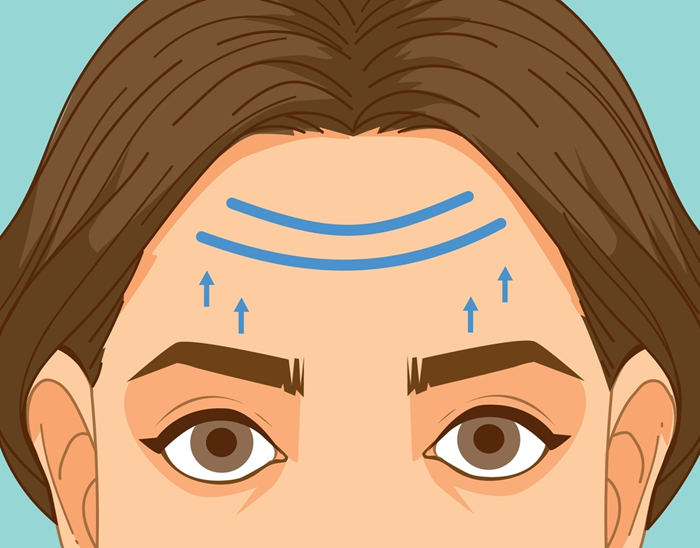
A brow lift is a surgical procedure that repositions the eyebrow region by adjusting the skin and underlying forehead tissues.
It may be considered when the eyebrows have descended or when the position of the brow contributes to tissue heaviness around the upper eyelids.
The procedure differs from eyelid surgery, which primarily addresses excess eyelid skin or tissue.
A brow lift can involve different incision patterns depending on the location and degree of brow descent, forehead anatomy and hairline position.
According to the American Society of Plastic Surgeons (ASPS), forehead lifting can address selected eyebrow-position changes and forehead creases.
A brow lift does not stop ageing, eliminate every forehead wrinkle or guarantee a particular facial appearance.
Brow ptosis refers to a lower-than-expected eyebrow position resulting from changes in the tissues supporting the brow.
Several factors can influence eyebrow position.
Age-related changes in collagen, elastin and other connective tissues may affect skin support and forehead contour.
The position of the brow depends partly on the relationship between forehead skin, soft tissues and underlying muscles.
Changes in these structures may contribute to brow descent.
Repeated contraction of forehead and frown muscles can contribute to expression lines.
However, forehead wrinkles do not always indicate that a surgical brow lift is needed.
Natural brow position, forehead height, facial proportions and tissue characteristics vary between individuals.
Some individuals may have brow asymmetry or drooping related to previous surgery, trauma or a medical condition.
Sudden new eyebrow drooping, especially with facial weakness or other neurological symptoms, requires medical evaluation rather than cosmetic treatment planning.
Brow lift surgery may be considered for selected adults after evaluating eyebrow position, forehead anatomy, general health and surgical risks.
The surgeon evaluates whether brow descent is present and how it relates to the upper eyelids.
Forehead and Hairline Anatomy
Forehead height, hairline position, hair density and scalp condition may influence the surgical approach.
Skin elasticity, tissue laxity and existing forehead contours affect treatment planning.
Current medical conditions, medications, allergies, previous procedures and anaesthesia risks should be reviewed.
Smoking and nicotine use can affect wound healing and tissue blood supply.
Dry eyes, eyelid closure problems, visual symptoms and previous eye procedures may need assessment.
Patients should understand potential complications, permanent scars, recovery restrictions, possible hairline changes and the limitations of surgery.
Some patients may not be medically suitable for an elective forehead lift. Individual assessment is necessary before proceeding.
Learn about brow lift surgery, including available techniques, potential risks and recovery. A consultation with Dr. Vinod Vij can help assess individual suitability.
Several recognised surgical techniques can be used to reposition the eyebrow region.
The appropriate method depends on individual anatomy, the extent of brow descent and surgical considerations.
An endoscopic brow lift involves small incisions, usually placed within the hair-bearing scalp.
A thin camera called an endoscope may be used to visualise the underlying tissues while the forehead and brow structures are adjusted.
This approach may be considered for selected patients depending on brow anatomy and tissue characteristics.
Smaller incisions do not eliminate the possibility of scarring, nerve injury or other complications.
A coronal brow lift generally involves an incision across the scalp, commonly within the hair-bearing region.
The forehead tissues are repositioned through the surgical incision.
Potential considerations include a longer scar, altered scalp sensation, hairline changes and hair loss near incision sites.
A temporal or lateral brow lift mainly addresses the outer portion of the eyebrows.
Incisions are generally made in the temple or hair-bearing region.
It may be considered when the anatomical concern is concentrated around the lateral brow.
It does not necessarily address changes involving the central forehead.
A hairline or pretrichial brow lift uses an incision close to the frontal hairline.
It may be considered for selected patients where forehead height and hairline position are important surgical considerations.
The incision may leave a visible scar along the hairline.
A direct brow lift involves an incision near or immediately above the eyebrow.
It allows more localised adjustment of brow position but can leave a noticeable scar.
In selected patients, direct brow lifting may also be considered for functional concerns rather than solely cosmetic reasons.
No. Botulinum toxin injections and certain other non-surgical interventions may temporarily alter muscle activity or eyebrow position in selected individuals.
These treatments do not remove significant excess tissue or provide the same anatomical repositioning as surgical brow lifting.
Their indications, limitations, duration and potential complications differ.
The specific approach and its clinical availability should be confirmed during an individual medical consultation.
The surgeon evaluates eyebrow position, upper eyelid anatomy, forehead skin, hairline, facial symmetry and relevant medical history.
The consultation includes discussion of surgical alternatives, potential complications, scar locations and recovery.
Depending on the proposed procedure and patient’s health, preparation may include blood investigations, anaesthesia evaluation and medication review.
Patients may receive instructions about smoking cessation, prescribed medicines and postoperative arrangements.
The ASPS brow lift preparation guide explains general preoperative considerations.
Brow lift surgery may be performed under general anaesthesia or intravenous sedation with appropriate monitoring.
The choice depends on the technique, medical assessment and anaesthesia plan.
Incisions are made according to the selected technique.
Possible incision sites include the hair-bearing scalp, temples, frontal hairline or eyebrow region.
Selected forehead and brow tissues may be released, repositioned or secured to adjust eyebrow position.
The extent of adjustment depends on the surgical approach and individual anatomy.
Incisions are closed using appropriate sutures, surgical clips or other suitable methods.
Dressings may be applied according to the procedure.
Following surgery, the patient is monitored for anaesthesia-related complications, bleeding and other immediate postoperative concerns.
Follow-up appointments help assess wound healing, eyebrow position, sensation and potential complications.
For further information, see the ASPS brow lift procedure steps.
Depending on the surgical technique and individual anatomy, a brow lift may:
Change the position of lowered eyebrows.
Reposition selected tissues of the forehead.
Address certain forehead creases associated with tissue descent.
Change the contour of the lateral eyebrow region.
Reduce some tissue heaviness associated with brow ptosis.
However, surgery does not guarantee complete symmetry, elimination of all wrinkles or a particular appearance.
A brow lift also does not directly correct every cause of upper eyelid drooping.
Some patients may require evaluation for eyelid ptosis, excess eyelid skin or other eye-related conditions.
Surgical incisions produce permanent scars, and future ageing can alter eyebrow position.
Brow lift surgery has recognised risks that should be discussed before informed consent.
Possible complications include:
Bleeding or haematoma.
Infection.
Poor or delayed wound healing.
Fluid accumulation.
Facial or forehead nerve injury.
Weakness of forehead muscles.
Temporary or permanent numbness.
Changes in scalp or forehead sensation.
Hair loss near incision sites.
Changes in hairline position.
Visible or unfavourable scarring.
Asymmetry or changes in brow position.
Eye irritation or dryness.
Persistent discomfort or pain.
Skin or tissue loss.
Anaesthesia-related complications.
Blood clots, including deep vein thrombosis and pulmonary embolism.
Need for further treatment or revision surgery.
Can a Brow Lift Cause Nerve Damage?
Yes. Nerve injury can affect sensation or muscle movement in the forehead and brow region.
Changes may be temporary or permanent.
Yes. Certain incision patterns and tissue repositioning techniques can alter hairline position.
The risk varies by technique and the patient’s anatomy.
Yes. All surgical brow lift techniques involve incisions and therefore leave permanent scars.
The location and visibility depend on incision placement, hair growth, skin characteristics and healing.
Some patients may experience eye irritation, dryness or changes affecting eyelid closure and comfort.
Pre-existing eye conditions should be discussed before surgery.
Increasing pain, significant swelling, persistent fever, unusual discharge or bleeding requires prompt medical assessment.
Sudden visual changes, severe eye pain, sudden facial weakness, breathing difficulty, chest pain or collapse requires urgent or emergency evaluation.
Read the ASPS information on brow lift risks and safety for further details.
Learn about brow lift surgery, including the procedure, potential risks and recovery. A medical consultation with Dr. Vinod Vij can help assess individual suitability.
Recovery varies according to the surgical technique, medical condition and individual healing.
Swelling, bruising, forehead tightness and temporary changes in sensation may occur.
Patients may require dressings, medication and activity restrictions.
Keeping the head elevated may be advised to help manage swelling.
Cold or hot packs should not be applied to the operated area without the treating surgeon’s instructions.
Initial wound healing often takes approximately 10–14 days, although the timeline varies.
Sutures or clips may be removed according to the surgeon’s assessment.
Some patients may return to light work and daily activities during this period.
Swelling and bruising may continue to resolve.
Forehead sensation, tightness and incision discomfort may gradually change.
Strenuous activity and heavy lifting should be resumed only when medically appropriate.
The forehead and eyebrow contour may continue settling as swelling decreases.
Scars also mature over time, and some sensory changes may take longer to resolve.
Some patients may return to light duties after approximately one to two weeks, depending on the surgical technique and individual recovery.
Physically demanding work may require a longer period.
Gentle walking may be encouraged when appropriate.
Strenuous exercise and activities that increase pressure around the surgical site should follow the treating surgeon’s recovery instructions.
More information is available in the ASPS brow lift recovery guide.
A brow lift may change eyebrow position and selected forehead contours.
However, the outcome depends on several factors:
Initial eyebrow position.
Forehead and hairline anatomy.
Skin elasticity.
Selected surgical technique.
Individual healing.
Scar formation.
Muscle activity.
Ageing-related tissue changes.
Surgical tissue repositioning may produce lasting changes, but ageing continues.
The eyebrow position and forehead contour may change over time.
Permanent or specific results cannot be guaranteed.
Yes. Natural eyebrow asymmetry is common.
Although surgery may alter brow position, complete symmetry cannot be guaranteed.
Further treatment may sometimes be considered because of complications, asymmetry, scar concerns or dissatisfaction with the result.
Revision surgery involves additional risks and requires a separate assessment.
The cost of brow lift surgery in Navi Mumbai varies according to the surgical technique, individual medical requirements, complexity and facility-related charges.
A personalised estimate requires an individual clinical assessment.
Surgical Technique: Endoscopic, coronal, temporal and other incision approaches differ in complexity.
Extent of Tissue Repositioning: The anatomical changes being addressed influence the operative plan.
Anaesthesia: Costs depend on the anaesthesia approach, duration and monitoring requirements.
Surgical Facility: Hospital or surgical facility charges may differ according to the services required.
Preoperative Investigations: Medical tests and other evaluations can affect overall expenses.
Additional Procedures: Combined eyelid or facial surgery may increase complexity, costs and medical risks.
Postoperative Care: Dressings, medications and follow-up requirements may influence total expenses.
Further Treatment: Complications or revision surgery may result in additional costs.
Patients should request a written estimate explaining the included services and possible additional expenses.
Brow lift surgery performed solely for cosmetic purposes is generally excluded from standard health insurance policies.
In selected circumstances involving documented functional impairment, insurance eligibility may depend on the medical indication and policy terms.
Coverage should be confirmed directly with the insurer.
These procedures address different anatomical structures.
A brow lift focuses on the eyebrow and forehead region.
It repositions selected upper-face tissues and may address brow descent.
Blepharoplasty in Navi Mumbai involves addressing selected excess skin or fatty tissue in the upper or lower eyelids.
A brow lift does not replace eyelid surgery when the main concern involves the eyelid itself.
Facelift surgery in Navi Mumbai primarily addresses selected changes affecting the lower face and jawline.
It differs from a brow lift in its anatomical focus.
In selected patients, both procedures may be considered when separate anatomical concerns affect the forehead and eyelids.
However, combined surgery increases operative complexity and requires an individual risk assessment.
Some non-surgical treatments may temporarily alter eyebrow position or improve selected expression lines.
However, they are not equivalent to surgical brow lifting.
Botulinum toxin may temporarily reduce activity in selected facial muscles.
In some individuals, this can cause modest changes in eyebrow position.
Possible adverse effects include asymmetry, unwanted eyebrow or eyelid drooping and other injection-related complications.
Fillers may be considered for selected concerns involving facial volume rather than as a direct replacement for surgical brow repositioning.
They carry risks, including rare but serious vascular complications.
Certain treatments may address surface skin texture or selected wrinkles.
They do not reliably correct significant brow descent.
Treatment selection should be based on anatomy, medical suitability, available evidence and a discussion of risks.
A lowered eyebrow may contribute to skin heaviness around the upper eyelid.
However, eyelid heaviness can also result from excess eyelid skin, true eyelid ptosis or other medical conditions.
These problems may require different assessments and treatments.
Brow ptosis involves a lower eyebrow position and can contribute to tissue crowding above the eyelid.
Dermatochalasis refers to excess eyelid skin, which may be evaluated for blepharoplasty.
Eyelid ptosis involves drooping of the upper eyelid margin and may be related to the eyelid-lifting mechanism.
It is not the same as brow ptosis.
Where eyelid heaviness affects vision, appropriate medical or ophthalmological assessment may be necessary.
Learn more about eyelid surgery and blepharoplasty.
Dr. Vinod Vij practises plastic and cosmetic surgery in Navi Mumbai.
A medical consultation regarding brow lift surgery involves assessing eyebrow position, forehead anatomy, eyelid characteristics, hairline, previous treatments and relevant medical history.
Topics that may be discussed include:
Whether brow lift surgery is appropriate.
Possible surgical and non-surgical alternatives.
Available incision techniques.
Expected scarring and hairline changes.
Risks including nerve injury and altered sensation.
Possible eye-related complications.
Anaesthesia and preoperative requirements.
Recovery and postoperative restrictions.
Limitations of possible results.
Estimated costs and follow-up arrangements.
Patients should verify their treating surgeon’s qualifications, professional registration and relevant surgical training.
Consultation does not mean that surgery will necessarily be recommended.
Understand brow lift techniques, potential risks and recovery. A consultation with Dr. Vinod Vij can help assess individual suitability and available options.
Brow lift surgery is a procedure that repositions the eyebrow and selected forehead tissues. It may address brow descent and some forehead contour changes but carries surgical risks.
Selected adults with brow ptosis or related upper-face tissue concerns may be considered after evaluating anatomy, general health, expectations and potential complications.
Cost depends on technique, surgical complexity, anaesthesia, facility charges and postoperative care. An individual assessment is needed for a reliable estimate.
Brow lift surgery carries risks including bleeding, infection, nerve injury, scarring and anaesthesia complications. Suitability and risk must be evaluated individually.
The duration varies according to the technique, anatomical requirements and whether other procedures are performed.
Initial wound healing commonly takes approximately 10–14 days, but swelling and tissue recovery can continue for several weeks or months.
Yes. All surgical brow lift techniques leave permanent scars, although their location and visibility vary.
Yes. Some techniques may alter hairline position or cause hair loss near the incision site.
Yes. Nerve injury may cause changes in forehead sensation or muscle movement. Some effects may be temporary or permanent.
Sudden visual changes, severe eye pain, new facial weakness, significant bleeding, chest pain or breathing difficulty requires urgent medical assessment.
Disclaimer: Website content and visuals are for general informational, educational and representational purposes only, may not reflect individual patient conditions or outcomes, and do not replace personalised medical advice, diagnosis or clinical assessment.