
Hair Pull Test for Hair Loss: What It Shows
Hair Pull Test for Hair Loss: What Does It Show?
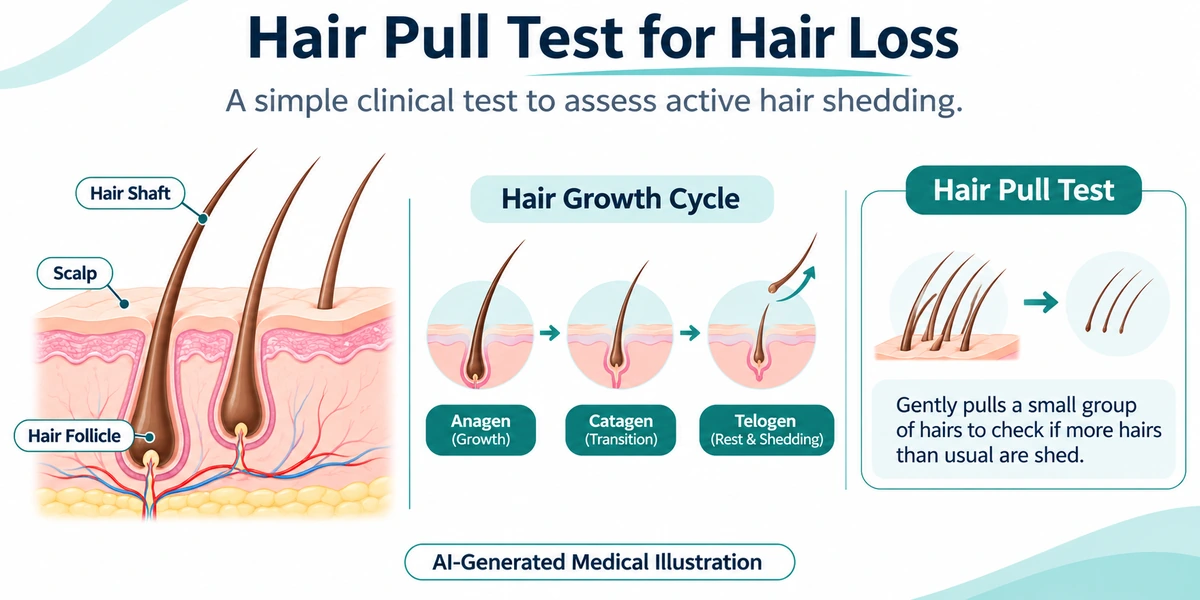
The hair pull test for hair loss is a simple clinical examination used to assess whether excessive hair shedding may be occurring. During the test, a healthcare professional gently pulls a small group of hairs and observes how many are released.
The test can provide information about active hair shedding and may help guide further investigation of conditions such as telogen effluvium or alopecia areata.
However, a positive hair pull test does not identify the exact cause of hair loss, and a negative result does not exclude an underlying scalp or hair disorder.
Understanding how the test works, what its findings indicate and why additional assessment may be necessary can help explain its role in hair loss diagnosis.
What Is a Hair Pull Test?
A hair pull test is a non-invasive examination used to assess how readily hairs are released from the scalp when gentle, controlled traction is applied.
Hair follicles normally undergo a growth cycle that includes three major phases:
Anagen: The active growth phase, during which the hair shaft continues to grow.
Catagen: A short transitional phase when active follicle growth slows.
Telogen: A resting phase that is followed by hair shedding, often described separately as the exogen phase.
Some degree of daily hair shedding is normal because individual follicles progress through these stages at different times.
When an increased proportion of hairs is shed, a clinician may use the hair pull test to assess whether shedding appears active during the examination.
The test provides information about shedding activity. It does not measure overall hair density, directly determine follicle health or independently diagnose a particular condition.
Why Is a Hair Pull Test Performed?
The main purpose of the hair pull test is to help distinguish active hair shedding from other changes in hair appearance, including gradual thinning or hair-shaft breakage.
A clinician may consider the test when someone reports:
Increased hair falling out during washing or brushing.
Noticeable diffuse hair shedding.
Sudden changes in the amount of hair being shed.
Hair loss following illness, childbirth or significant physiological stress.
Patchy hair loss where disease activity needs assessment.
Persistent shedding without an immediately clear explanation.
The findings can help determine whether further scalp examination or targeted investigations may be appropriate.
Importantly, the test should be interpreted alongside the pattern and duration of hair loss, relevant medical history and scalp findings.
How Is the Hair Pull Test Performed?
The hair pull test generally takes only a short time and does not require specialized equipment.
Step 1: Review the Hair Loss History
A medical professional asks about the onset, duration and distribution of hair loss.
Relevant information may include recent illness, medication changes, childbirth, dietary changes, family history and scalp symptoms.
Step 2: Select an Area of the Scalp
The examiner identifies a group of approximately 40–60 hairs.
Different scalp regions may be examined, including the frontal, temporal, crown and occipital areas, depending on the pattern of hair loss.
Step 3: Apply Gentle Traction
The clinician holds a small group of hairs near the scalp and applies controlled traction along the hair shafts.
The technique should be firm enough to assess loosely retained hairs without unnecessarily pulling or damaging the scalp.
Step 4: Observe Released Hairs
The examiner notes how many hairs are released and may examine their appearance.
The number and distribution of extracted hairs can provide clues about current shedding.
Step 5: Interpret the Findings
The results are reviewed together with the clinical examination and medical history.
In selected cases, trichoscopy, laboratory investigations or other assessments may be required.
Important: The hair pull test should preferably be conducted and interpreted by a trained healthcare professional. Repeated or forceful self-testing can cause unnecessary hair traction and may produce misleading findings.
What Does a Positive Hair Pull Test Mean?
A positive hair pull test suggests that more hairs than expected are readily released during the examination.
Traditionally, some clinical references consider a test positive when more than approximately 10% of the grasped hairs are extracted. For a group of around 50–60 hairs, this corresponds to roughly five or six hairs.
However, research has identified limitations in traditional thresholds, and some studies recommend lower cutoffs.
Therefore, there is no single universally applicable number that establishes a specific hair loss diagnosis.
A positive result may be associated with several conditions.
Telogen Effluvium
Telogen effluvium involves increased shedding of hairs that have entered the resting phase of the growth cycle.
It may follow significant illness, fever, childbirth, rapid weight loss, certain medications or other physiological triggers.
The hair pull test may be positive when shedding is active.
However, a positive test alone cannot confirm telogen effluvium.
Alopecia Areata
Alopecia areata is an immune-mediated condition that can cause patchy or more widespread hair loss.
A hair pull test performed near the edges of an active patch may sometimes release additional hairs.
The distribution of a positive result may assist assessment of disease activity, although additional scalp examination is important.
Other Forms of Active Hair Loss
Increased hair release may also occur in certain other forms of diffuse shedding or hair loss.
The clinical context is necessary to determine which diagnosis should be considered.
Key point: A positive hair pull test indicates possible active shedding; it does not automatically mean permanent hair loss or confirm a specific disease.
What Does a Negative Hair Pull Test Mean?
A negative hair pull test means relatively few hairs are released during that particular examination.
It may suggest that substantial shedding is not occurring at the time of testing.
However, a negative result does not necessarily indicate that the scalp and hair follicles are healthy or that hair loss is absent.
For example, gradual pattern hair loss can cause progressive thinning even when the hair pull test is negative.
Hair shedding can also fluctuate over time, and the test may not capture an intermittent episode.
A negative result should therefore be considered together with scalp examination, hair density, hair-shaft characteristics and the patient’s history.
Can a Hair Pull Test Diagnose Telogen Effluvium?
The hair pull test may support the clinical assessment of telogen effluvium, particularly when increased shedding is occurring across multiple scalp areas.
However, it cannot independently establish the diagnosis.
Telogen effluvium generally involves a change in the normal hair growth cycle, leading to increased shedding.
A clinician may consider possible triggers, including:
Recent illness or high fever.
Major surgery.
Childbirth.
Significant weight loss.
Nutritional deficiency.
Medication changes.
Other relevant physical or psychological stressors.
Diagnosis usually depends on the overall history, pattern of shedding and clinical examination.
Selected laboratory investigations may be recommended when an underlying medical condition is suspected.
The hair pull test is therefore one part of the diagnostic process rather than a replacement for a broader assessment.
Hair Pull Test vs Hair Tug Test: What Is the Difference?
The hair pull test and hair tug test are sometimes confused, but they assess different hair characteristics.
| Feature | Hair Pull Test | Hair Tug Test |
|---|---|---|
| Main purpose | Assess active hair shedding | Assess hair-shaft fragility |
| Method | Gentle traction applied to a group of hairs near the scalp | Opposing traction applied along a section of hair |
| Main observation | Number of hairs released | Whether hair shafts break |
| Possible interpretation | Increased shedding activity | Hair-shaft weakness or breakage |
| Diagnostic limitation | Cannot independently identify the cause of shedding | Cannot independently identify the cause of fragility |
Hair breakage and hair shedding are not the same process.
Hair shedding involves release of the hair from the follicle, while breakage involves disruption of the hair shaft.
Distinguishing these processes can help guide further examination.
What Are the Limitations of the Hair Pull Test?
Although convenient, the hair pull test has several limitations.
1. Results Depend on Examination Technique
The number of hairs collected, location examined and force applied can influence the result.
Inconsistent technique may reduce reliability.
2. Hair Shedding Changes Over Time
Hair loss activity may fluctuate.
A person with ongoing hair concerns may have a negative result when shedding is less active.
3. A Positive Result Is Not Disease-Specific
Different conditions can cause increased hair release.
The test cannot distinguish all causes without additional clinical information.
4. A Negative Result Does Not Exclude Hair Loss
Some conditions, particularly gradual pattern hair loss, may be present despite a negative hair pull test.
5. Hair Washing and Grooming Can Affect Assessment
Historical protocols sometimes recommended avoiding hair washing before the examination.
However, research has questioned the need for strict multi-day washing restrictions. The relevance of recent washing or brushing depends on the examination protocol and clinical circumstances.
Patients should follow the examining clinician’s instructions rather than adopting a universal preparation rule.
6. The Test Does Not Measure Future Hair Growth
A hair pull test cannot reliably predict the amount of future regrowth, treatment success or permanent follicle damage.
Its primary purpose is assessing hair shedding activity at the time of examination.
Is the Hair Pull Test Painful or Harmful?
A correctly performed hair pull test is generally brief and causes little or no discomfort.
Some people may experience a mild pulling sensation.
Because it uses traction, the examination should be performed carefully and without excessive force.
The test may not be appropriate in its usual form when the scalp is particularly painful, injured or significantly inflamed.
Repeated self-testing or forceful pulling should be avoided, as it can cause unnecessary discomfort or hair damage.
Can a Hair Pull Test Detect Male or Female Pattern Hair Loss?
Male and female pattern hair loss, also called androgenetic alopecia, commonly involves gradual miniaturisation of susceptible hair follicles.
Affected hairs become progressively finer, and visible scalp density may decrease over time.
The hair pull test is often negative in uncomplicated pattern hair loss, although increased shedding may sometimes coexist.
Diagnosis is generally based on the distribution of thinning, medical history, scalp examination and, when appropriate, trichoscopy.
Therefore, a normal hair pull test does not exclude androgenetic alopecia.

What Other Tests May Be Needed to Diagnose Hair Loss?
If the cause of hair loss remains unclear, a clinician may recommend additional examination.
Scalp Examination
The scalp is assessed for hair distribution, density, redness, scaling, inflammation and possible scarring.
Trichoscopy
Trichoscopy is a magnified examination of the scalp and hair shafts.
It may help identify features such as follicle miniaturisation, hair-shaft abnormalities or findings associated with specific scalp disorders.
Targeted Blood Tests
Selected blood investigations may be considered when medical history and examination suggest iron deficiency, thyroid dysfunction or other systemic causes.
Routine blood testing is not required for everyone with hair loss.
Microscopic Hair Examination
In selected circumstances, extracted hairs may be examined to assess characteristics of the roots or shafts.
Scalp Biopsy
A scalp biopsy may be considered when the diagnosis remains uncertain or when an inflammatory or scarring form of alopecia is suspected.
Not all patients require these investigations. The choice depends on the clinical findings.
When Should You Seek Medical Evaluation for Hair Shedding?
Hair loss should be assessed when it is sudden, persistent, progressive or accompanied by concerning scalp changes.
Medical evaluation is particularly important if you notice:
Rapidly developing bald patches.
Sudden, substantial hair shedding.
Progressive thinning over several months.
Scalp pain, redness, scaling or pustules.
Loss of eyebrows or eyelashes.
Signs of scalp scarring.
Hair loss with unexplained fatigue, weight changes or other systemic symptoms.
Some inflammatory and scarring hair disorders can cause permanent follicle damage if not identified and treated appropriately.
Prompt clinical assessment is particularly important when the scalp is painful, inflamed or showing signs of scarring.
Frequently Asked Questions About the Hair Pull Test
1. What does a hair pull test show?
A hair pull test helps assess whether increased hair shedding is occurring during a clinical examination. It may support further investigation but cannot independently identify the exact cause of hair loss.
2. How many hairs indicate a positive hair pull test?
Traditional methods may consider more than approximately 10% of grasped hairs significant. However, different research studies have proposed different thresholds. The result must be interpreted using the examination method and clinical findings.
3. Does a positive hair pull test mean permanent hair loss?
No. A positive result can occur with temporary shedding conditions as well as other hair disorders. It does not establish whether hair loss will be permanent.
4. Can I perform a hair pull test at home?
Home testing is not recommended as a diagnostic substitute for professional assessment. Pulling force, technique and interpretation can affect findings, and repeated testing may cause unnecessary hair traction.
5. Can a hair pull test detect telogen effluvium?
A positive result may support a suspected diagnosis of active telogen effluvium, but medical history and scalp examination are needed to evaluate the cause of shedding.
6. What if my hair pull test is negative but my hair is thinning?
A negative result does not exclude hair loss. Gradual pattern thinning and other scalp conditions may occur without increased hair release during the examination.
7. Is the hair pull test enough to diagnose hair loss?
No. The test is one part of the clinical assessment. Additional examination or investigations may be needed depending on the pattern of hair loss, symptoms and medical history.
Conclusion
The hair pull test for hair loss is a simple clinical method that can help assess active hair shedding.
A positive result may indicate increased hair release, while a negative result suggests that relatively few hairs were extracted during the examination. Neither finding provides a complete diagnosis on its own.
The test has limitations related to examination technique, variations in shedding and the different conditions that can affect hair growth.
A comprehensive assessment of hair loss includes medical history, scalp examination and selected additional investigations when indicated.
Understanding the role and limitations of the hair pull test can help patients interpret its findings without assuming that one examination determines the cause, severity or future outcome of hair loss.
Medical Disclaimer :
This article is intended for general educational purposes only. It does not replace personalised medical advice, diagnosis or treatment. The hair pull test should be interpreted by an appropriately qualified healthcare professional alongside relevant clinical findings. Avoid repeatedly pulling or testing your own hair as a substitute for medical assessment.