
Chin Implant vs Chin Filler: Which Is Better for Facial Balance?
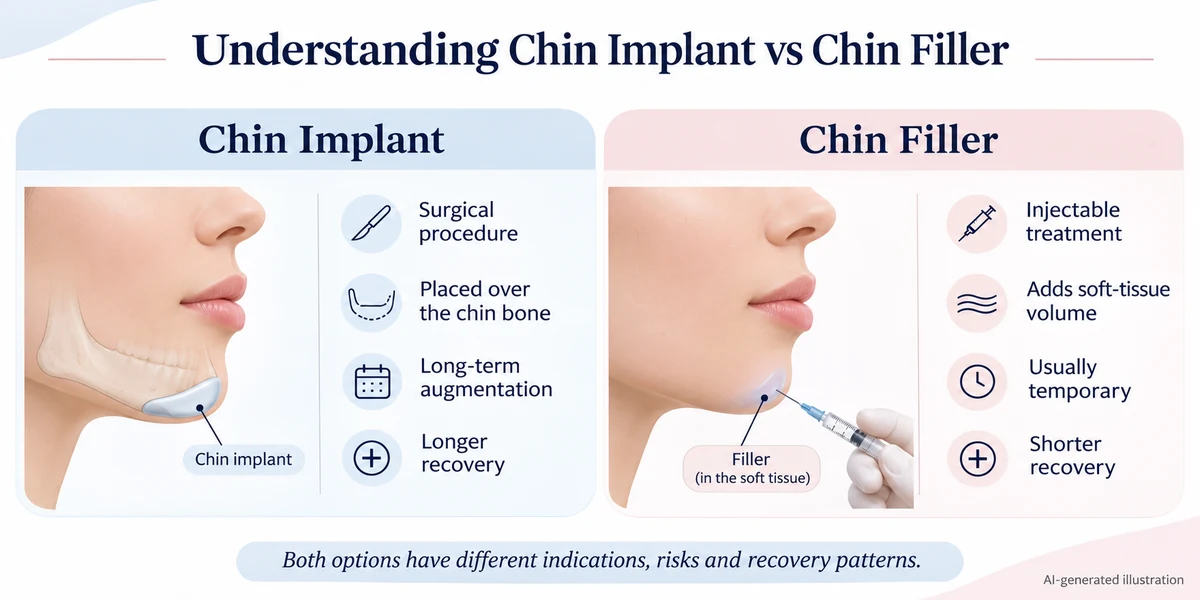
The main difference between a chin implant and chin filler is how they increase chin projection. A chin implant is surgically placed over the chin bone to provide long-term augmentation, while chin filler involves injecting a material, commonly hyaluronic acid, into selected soft tissues to change the contour of the chin.
Both approaches may alter the lower facial profile, but they differ in procedure, durability, recovery, possible complications and long-term management.
Neither treatment is automatically better or safer. The appropriate option depends on facial anatomy, medical suitability, treatment goals and acceptance of potential risks.
This article compares chin implants and dermal fillers, including their effects on facial balance, procedure details, recovery, complications and alternatives.
What Is Chin Augmentation?
Chin augmentation refers to procedures that increase the projection or alter the contour of the chin.
The appearance of the chin depends on several structures:
Chin bone and lower jaw position
Dental bite and jaw alignment
Surrounding facial muscles
Fat and other soft tissues
Skin thickness and elasticity
Relationship between the chin, nose and lips
A small-looking chin is not necessarily a medical problem.
Some individuals have a naturally less prominent chin, while others have an underlying skeletal jaw discrepancy.
Before considering augmentation, it is important to understand which structures contribute to the concern.
What Is a Chin Implant?
A chin implant is a solid medical implant positioned over the front of the lower jawbone to increase chin projection.
The procedure is also known as alloplastic chin augmentation.
Common implant materials include medical-grade silicone, although other materials may be used.
Implants are available in different dimensions and shapes.
The implant is positioned through a surgical incision, usually inside the lower mouth or beneath the chin.
How Does a Chin Implant Work?
The implant adds volume over the existing bony chin.
It may change the appearance of the lower facial profile, but it does not reposition the entire jawbone.
Chin implant surgery is generally intended to provide long-term augmentation.
However, implants can require removal or revision because of complications or changes in individual circumstances.
What Is Chin Filler?
Chin filler is an injectable treatment that adds selected amounts of material to the soft tissues of the chin.
Hyaluronic acid fillers are commonly used for certain facial volume and contour concerns.
Other filler materials have different properties, durations and risks.
How Does Chin Filler Work?
The injected material adds volume at planned locations.
Depending on the anatomy and product, this may change the appearance of chin projection or lower facial contour.
The degree of change varies.
A filler does not move the chin bone or correct a structural jaw abnormality.
Although it does not require surgical implant placement, filler treatment involves medical risks and should not be described as risk-free.
Chin Implant vs Chin Filler: Quick Comparison
| Feature | Chin implant | Chin filler |
|---|---|---|
| Treatment | Surgical implant placement | Injectable procedure |
| Material | Solid medical implant | Injectable filler material |
| Main effect | Adds projection over chin bone | Adds soft-tissue volume |
| Bone repositioning | No | No |
| Incision | Inside mouth or beneath chin | Injection punctures |
| Anaesthesia | Depends on surgical plan | Often topical or local anaesthesia |
| Recovery | Generally longer | Usually shorter initially |
| Longevity | Intended for long-term placement | Product-dependent; many are temporary |
| Scarring | Permanent surgical scar | No typical surgical incision scar |
| Main concerns | Infection, movement, nerve injury, bone changes | Vascular occlusion, nodules, infection, migration |
| Future treatment | Implant removal or revision may be needed | Repeat injections or complication management may be needed |
The table describes general differences rather than guaranteed outcomes.
Which Provides More Chin Projection?
A chin implant is designed to increase the projection of the bony chin region through a solid implant.
Chin fillers add volume to the soft tissues and may also produce visible projection.
However, the amount of suitable augmentation depends on:
Existing chin anatomy
Lower jaw position
Soft-tissue thickness
Proposed implant dimensions
Filler type and amount
Nearby anatomical structures
Individual risk factors
More projection is not automatically better.
Excessive augmentation can create an unnatural or disproportionate lower-face appearance.
Can Chin Implants or Fillers Improve Jawline Definition?
Both may influence the appearance of the lower facial profile.
Increasing chin projection can change the relationship between the chin, lips, jawline and neck.
However, neither automatically produces a sharply defined jawline.
A poorly defined jawline may also involve:
Submental fat
Skin laxity
Lower-jaw position
Facial bone structure
Soft-tissue changes
Natural variation in facial proportions
A chin implant cannot remove excess neck fat or correct an abnormal dental bite.
Likewise, filler cannot correct every anatomical cause of a weak-looking jawline.
Weak Chin vs Recessed Jaw: Why the Difference Matters
A weak-looking chin may result from limited chin projection or from the position of the entire lower jaw.
| Feature | Small or underprojected chin | Recessed lower jaw |
|---|---|---|
| Main concern | Local chin prominence | Position or development of the mandible |
| Dental bite | May be normal | May be abnormal |
| Chin implant | May be considered | Does not reposition the jaw |
| Chin filler | May add selected volume | Does not correct jaw alignment |
| Other assessment | Facial anatomy and chin projection | Dental, orthodontic or maxillofacial evaluation |
If the problem involves jaw position or bite abnormalities, sliding genioplasty, orthodontic treatment or orthognathic surgery may be discussed in appropriate circumstances.
These are different treatments with distinct indications and risks.
Who May Be Suitable for a Chin Implant?
A chin implant may be considered in selected adults with limited chin projection.
Medical assessment should review:
Facial proportions and chin position
Lower jaw and bite alignment
General medical health
Previous facial surgery
Existing implants or fillers
Smoking and nicotine use
Willingness to undergo surgery
Permanent scarring and healing risks
Understanding of long-term implant complications
A chin implant may not be appropriate when significant jaw recession, bite abnormalities, active infection or other medical concerns require evaluation.
For a broader discussion of surgical considerations, read Chin Implant Surgery: Weak Chin, Jawline Correction and Recovery.
Who May Be Suitable for Chin Fillers?
Chin filler may be considered in selected adults when the anatomical concern can reasonably be addressed by soft-tissue augmentation.
Relevant considerations include:
The amount and location of volume required
Type of filler proposed
Previous filler treatment
History of allergies or reactions
Relevant medical conditions and medications
Facial vascular anatomy
Expectations about duration
Understanding of possible complications
A temporary effect does not mean a treatment is automatically safe.
Some people may be unsuitable for filler treatment because of medical factors, previous complications or the anatomical nature of their concern.
How Is Chin Implant Surgery Performed?
The precise steps depend on the technique and implant.
Step 1: Medical Assessment
The surgeon reviews facial anatomy, medications, allergies, medical history and treatment goals.
Step 2: Implant Selection
An implant is selected according to the surgical plan.
Step 3: Anaesthesia
Local anaesthesia, sedation or general anaesthesia may be used according to clinical requirements.
Step 4: Surgical Incision
An incision is made inside the mouth or beneath the chin.
Step 5: Implant Placement
A surgical pocket is created over the chin bone.
The implant is placed and may be secured using an appropriate fixation method.
Step 6: Wound Closure
The incision is closed with sutures.
Step 7: Aftercare
The patient receives individual instructions regarding wound care, medication, diet, activity and follow-up.
How Is Chin Filler Treatment Performed?
Chin filler treatment generally involves fewer procedural steps than implant surgery.
Step 1: Assessment
The treating clinician evaluates the chin, facial anatomy, medical history and possible contraindications.
Step 2: Product Selection
A filler is chosen according to the intended treatment area and the product’s appropriate indication.
Step 3: Skin Preparation
The area is cleaned and anaesthesia may be used.
Step 4: Filler Injection
The material is injected into planned areas using an appropriate technique.
Step 5: Monitoring
The clinician assesses the treated area for immediate adverse reactions or complications.
Patients should understand the warning signs of vascular injury and how to obtain urgent assessment if symptoms occur after leaving the treatment facility.
Chin Implant vs Chin Filler: Which Lasts Longer?
Chin implants are intended for long-term placement.
Hyaluronic acid fillers generally produce temporary effects, but the duration varies by product and individual factors.
Chin Implant Longevity
An implant may remain in place for many years.
However, possible future problems include:
Infection
Implant displacement
Bone pressure changes or resorption
Persistent discomfort
Changes in sensation
Changes in surrounding tissues
Need for removal or revision
Natural facial ageing can change how the implant appears over time.
Chin Filler Longevity
Filler duration depends on:
The filler material
Injection location
Product characteristics
Individual tissue response
Previous treatment history
Other biological factors
Some hyaluronic acid filler material may remain longer than expected.
Therefore, a fixed treatment duration should not be promised.
For a discussion of longer-term implant considerations, read Chin Implant After 20 Years: Safety and Revision Considerations.
Can Chin Fillers Be Dissolved?
Certain hyaluronic acid fillers may be broken down using hyaluronidase when medically appropriate.
However, this has important limitations.
Not every filler material responds to hyaluronidase.
More than one treatment may be required.
Allergic reactions and other adverse effects can occur.
Dissolving filler does not guarantee restoration of the original appearance.
Serious vascular injuries may not be reversible.
In particular, blindness or tissue damage following vascular occlusion may be permanent.
The possibility of dissolving hyaluronic acid filler should not be interpreted as proof that the treatment is fully reversible.
Can a Chin Implant Be Removed?
A chin implant can sometimes be removed surgically.
However, removal does not necessarily restore the anatomy to its exact preoperative condition.
Implant placement can be associated with:
Scar formation
Changes in surrounding tissues
Bone pressure changes
Persistent sensory symptoms
Other anatomical changes
Implant removal is another operation and carries its own risks.
Neither chin implant surgery nor filler treatment should be described as completely reversible.
What Are the Risks of Chin Implant Surgery?
Chin implant surgery involves general surgical and implant-specific complications.
1. Infection
An infection may occur around the incision or implant.
Some infections require implant removal.
2. Implant Displacement
The implant may move or become misaligned.
This can affect contour or symmetry.
3. Nerve Injury and Numbness
Nearby nerves can be irritated or injured, potentially affecting sensation in the chin or lower lip.
4. Bone Resorption
An implant may place pressure on the underlying chin bone, sometimes producing bone changes.
5. Scarring
Both external and intraoral incisions create permanent scars.
6. Bleeding and Poor Wound Healing
Bleeding, hematoma, wound separation or delayed healing may occur.
7. Persistent Pain
Some individuals experience prolonged tenderness or discomfort.
8. Implant Exposure or Revision
Implant-related problems can require further surgery.
9. Anaesthesia Risks
The planned anaesthetic technique carries potential complications.
An implant cannot guarantee a particular facial appearance or a complication-free result.
What Are the Risks of Chin Fillers?
Dermal fillers can cause temporary and serious adverse effects.
Common Reactions
Possible early reactions include:
Swelling
Bruising
Redness
Tenderness
Local discomfort
Infection and Inflammation
Infection or inflammatory reactions may develop after treatment.
Nodules and Lumps
Some individuals experience persistent lumps, nodules or other tissue reactions.
Filler Migration
Filler material may shift from the intended location.
Asymmetry
Uneven placement, swelling or other tissue changes can produce differences in contour.
Vascular Occlusion
Accidental injection into a blood vessel may obstruct circulation.
Possible consequences include:
Severe pain
Skin blanching or abnormal colour
Tissue necrosis
Visual impairment or blindness
Stroke
These events are uncommon but potentially severe and may cause permanent injury.
Some filler complications can also develop weeks, months or years after injection.
Chin Implant vs Chin Filler: Recovery Timeline
| Recovery period | Chin implant | Chin filler |
|---|---|---|
| First 24–72 hours | Swelling, bruising, tenderness and surgical wound care | Swelling, bruising, tenderness or redness |
| Days 4–7 | Early symptoms may gradually improve | Many early reactions may begin settling |
| Weeks 1–2 | Healing continues; activity restrictions may apply | Most routine activities may already have resumed |
| Weeks 3–4 | Swelling and tissue tightness may continue improving | Longer-lasting reactions remain possible |
| Months 1–3 | Residual swelling and tissue settling may continue | Filler response and appearance may continue changing |
| Longer term | Implant monitoring and possible future complications | Product persistence, repeat treatment or delayed complications |
These are general timelines, not guaranteed milestones.
Complications may substantially alter recovery requirements.
What Is Normal After Treatment?
Some swelling, tenderness and bruising can occur following either procedure.
After implant surgery, a person may also experience temporary tightness, mild chewing discomfort or altered sensation.
After filler treatment, mild local swelling and tenderness may develop.
However, severe or progressively worsening pain, unusual skin colour changes or new visual symptoms must not be dismissed as routine recovery.
Warning Signs After Chin Implant or Chin Filler
| Symptom | Why medical assessment may be needed |
|---|---|
| Severe or increasing pain | May indicate a complication |
| Rapidly increasing swelling | Bleeding, infection or other tissue problems |
| Spreading redness, fever or pus | Possible infection |
| New or worsening numbness | Possible nerve involvement |
| Implant movement or exposed material | Implant complication |
| White, grey, blue or dusky skin after filler | Possible vascular injury |
| Sudden visual symptoms | Potential serious vascular complication |
| Facial weakness or difficulty speaking | Possible neurological emergency |
Emergency warning: Sudden visual loss, stroke-like symptoms, difficulty breathing or rapidly worsening swelling affecting the airway requires emergency medical care.
Chin Implant vs Chin Filler: Cost Considerations
The two procedures have different financial requirements.
Chin Implant Costs May Include
Medical assessment
Implant material
Surgical facility
Anaesthesia
Surgical care
Medications and follow-up
Possible future revision or removal
Chin Filler Costs May Include
Specific filler product
Amount used
Medical administration
Follow-up
Repeat treatment
Management of complications
A lower initial expense does not establish a treatment’s safety or suitability.
Likewise, a longer-lasting procedure is not automatically more cost-effective because future complications and treatment needs cannot be predicted.
What Are the Alternatives to Chin Implants and Fillers?
Depending on the anatomical concern, alternatives may include:
No Treatment
A naturally small chin is not necessarily abnormal.
Sliding Genioplasty
This operation repositions a portion of the chin bone.
It has different indications and risks from implant surgery.
Orthodontic or Orthognathic Assessment
A person with an underlying jaw-position or bite abnormality may need dental or maxillofacial assessment.
Treatment of Other Facial Concerns
In some individuals, the perceived weak jawline relates to skin laxity or submental fat rather than the chin itself.
Correctly identifying the cause is more important than assuming chin augmentation is necessary.
Chin Implant vs Chin Filler: Safety and Assessment Checklist

Before considering either treatment:
Confirm the anatomical concern: Determine whether the issue involves the chin, jaw position or surrounding soft tissues.
Review medical suitability: Discuss medical conditions, medicines, allergies and previous treatments.
Understand the materials: Ask about implant composition or the exact filler product.
Review alternatives: Include observation, genioplasty and jaw assessment when appropriate.
Discuss permanent changes: Understand scarring, implant removal and possible tissue changes.
Review filler vascular risks: Discuss tissue necrosis, blindness and other rare serious complications.
Understand recovery: Compare surgical healing with filler-related reactions.
Discuss long-term management: Implants may need revision; fillers may require future treatment.
Check emergency arrangements: Know how serious complications would be assessed.
Ask about realistic outcomes: No procedure guarantees facial symmetry or a particular appearance.
Attend follow-up appointments: Follow the treating clinician’s aftercare recommendations.
This checklist supports informed decision-making but cannot eliminate procedural risks.
Frequently Asked Questions
1. What is the main difference between a chin implant and chin filler?
A chin implant is surgically positioned over the chin bone to add projection. Chin filler involves injecting material into selected soft tissues to change chin volume or contour. The procedures differ in recovery, risks and duration.
2. Is a chin implant better than chin filler?
Neither treatment is automatically better. The appropriate option depends on facial anatomy, medical suitability, the proposed correction, personal preferences and acceptance of potential complications.
3. Which lasts longer: chin implant or chin filler?
Chin implants are intended for long-term placement, while many chin fillers are temporary. However, implants may require removal or revision, and filler persistence varies by product and individual factors.
4. Can chin fillers be dissolved?
Certain hyaluronic acid fillers may be dissolved using hyaluronidase when appropriate. However, not all filler types can be dissolved, and serious complications may not be reversible.
5. How long does chin implant recovery take compared with fillers?
Chin implant surgery generally requires several weeks of healing, with some swelling lasting longer. Chin fillers usually have a shorter initial recovery, although complications or delayed reactions may occur.
6. What are the main risks of chin implants and fillers?
Chin implant risks include infection, scarring, altered sensation, displacement, bone resorption and revision surgery. Filler risks include infection, nodules, migration and rare but serious vascular complications.
7. Can chin implants or fillers correct a recessed jaw?
Neither treatment repositions the entire lower jaw or corrects an abnormal dental bite. Significant jaw recession may require orthodontic or maxillofacial evaluation.
Conclusion
Chin implants and chin fillers are different approaches to increasing chin projection or altering lower facial contours.
A chin implant involves surgical placement of a solid material over the chin bone, while chin filler adds injectable volume to selected soft tissues.
Chin implants are intended for long-term augmentation but can require revision or removal. Fillers generally produce temporary effects, although some material may persist, and serious vascular complications are possible.
Neither procedure corrects every cause of a weak-looking chin or recessed jaw.
Understanding facial anatomy, medical suitability, risks, recovery and treatment alternatives is important before considering either option.
Disclaimer: All content and visuals on this website are for educational and informational purposes only. Images may be AI-generated or illustrative. Individual treatment results may vary. This information does not replace professional medical advice, diagnosis or consultation.