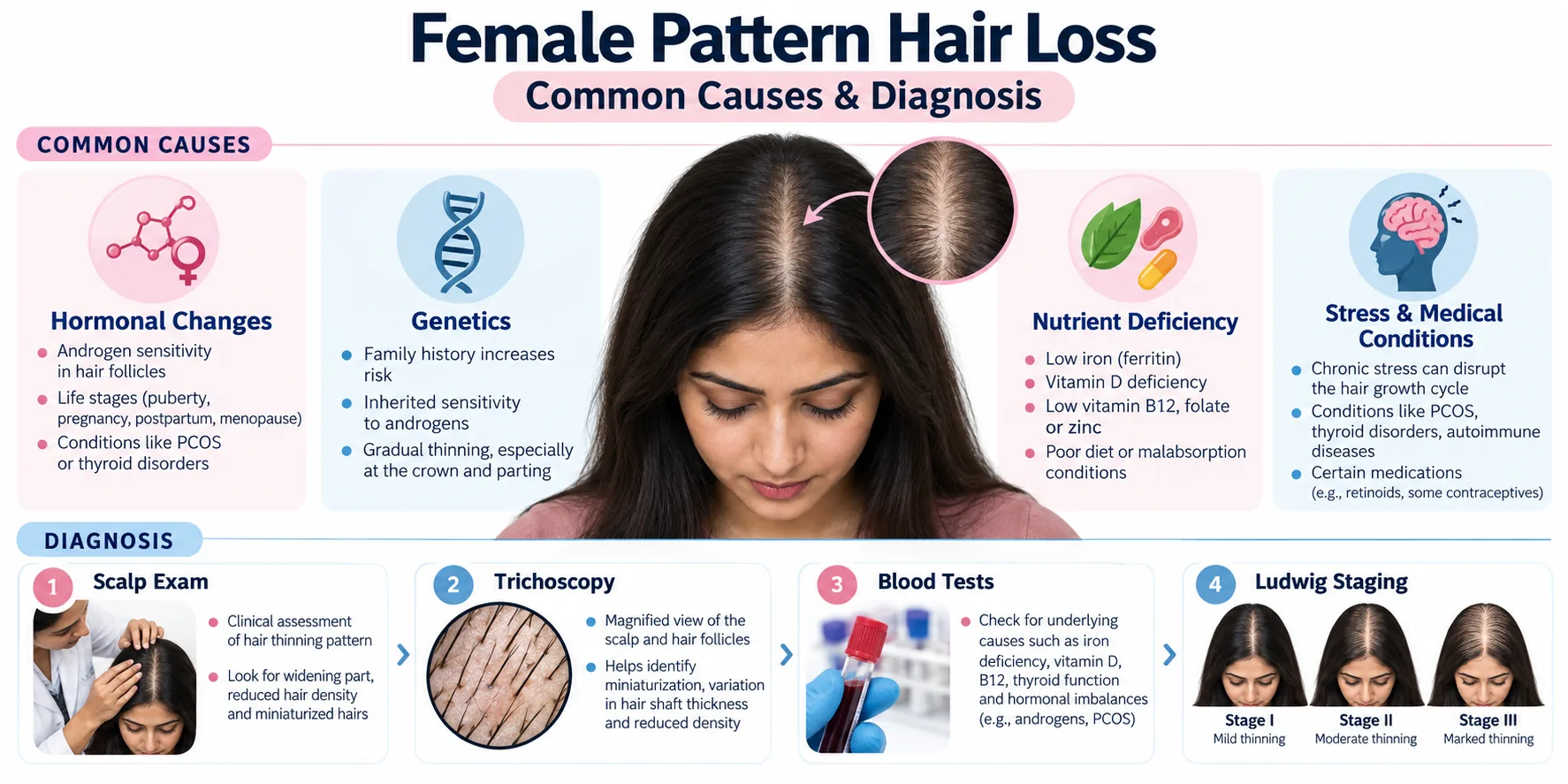
Female pattern hair loss (FPHL) affects millions of women worldwide, and Navi Mumbai is no exception. Understanding the root causes, getting an accurate diagnosis, and choosing the right treatment can restore confidence and hair density. This guide walks you through the science, the diagnostic process, and the most effective treatment options available locally.
Understanding Female Pattern Hair Loss
FPHL, also known as female pattern baldness, is a progressive thinning of hair that typically begins at the crown and widens the part, while the frontal hairline remains largely intact. Unlike male pattern baldness, the loss pattern is more diffuse, making early detection crucial.
What Causes Female Pattern Hair Loss?
Hormonal fluctuations: Changes during pregnancy, menopause, thyroid disorders, and polycystic ovary syndrome (PCOS) can disrupt the hair growth cycle.
Genetics: A family history of androgenetic alopecia increases susceptibility.
Androgen sensitivity: Even modest levels of androgens can affect hair follicles in women.
Nutrient deficiencies: Iron, vitamin D, and zinc deficiencies exacerbate thinning.
Stress and medical conditions: Telogen effluvium, autoimmune diseases, and severe illness can trigger temporary shedding.
According to Dr. Shubhangini Sharma, hormonal changes such as pregnancy and thyroid imbalances are among the most common triggers for women in the region.
How Is Female Pattern Hair Loss Diagnosed?
Accurate diagnosis is essential to rule out treatable conditions and to tailor therapy.
Diagnostic Steps
Clinical examination: Dermatologists assess thinning patterns, scalp health, and the width of the hair part.
Pull test and trichoscopy: Microscopic evaluation of hair shafts helps differentiate FPHL from alopecia areata or telogen effluvium.
Blood work: Thyroid panel, ferritin, vitamin D, and hormonal profiles (including testosterone and DHEAS) identify systemic contributors.
Ludwig staging: A visual scale that grades severity from I (mild) to III (advanced).
Comprehensive testing ensures that underlying issues like PCOS or menopause‑related loss are addressed alongside the primary pattern loss.
Treatment Options in Navi Mumbai
Modern dermatology offers a spectrum of interventions, from topical medications to surgical solutions. The choice depends on the stage of hair loss, underlying causes, budget, and personal preference.
Medical Treatments
Minoxidil 5%: The only FDA‑approved topical for women, it prolongs the anagen phase and can regrow hair in up to 40% of users.
Oral anti‑androgens (e.g., spironolactone, finasteride): Useful for women with elevated androgen levels or PCOS.
Iron and vitamin supplementation: Correcting deficiencies improves overall hair health.
Platelet‑Rich Plasma (PRP) Therapy
PRP involves injecting concentrated platelets from your own blood into the scalp to stimulate follicular activity. Multiple sessions are typically required, with noticeable density gains after 3‑4 months.
Follicular Unit Extraction (FUE) harvests healthy follicles from the donor area (usually the occipital scalp) and implants them into thinning zones. Advances in graft design now allow natural‑looking results even for women with diffuse loss.
While traditionally associated with male pattern baldness, FUE is increasingly popular among women seeking a permanent solution. Costs vary, but a typical session ranges from INR 150,000 to 300,000 depending on graft count.
Lifestyle & Hair‑Care Strategies
Gentle styling: Avoid tight ponytails, harsh chemical treatments, and excessive heat.
Scalp massage: Improves microcirculation and may enhance the efficacy of topical agents.
Balanced diet: Emphasize protein, omega‑3 fatty acids, and micronutrients essential for keratin synthesis.
Addressing the widening hair part is often a matter of combining medical therapy with proper hair‑care practices.
Choosing the Right Path for You
When deciding between PRP, medication, or a hair transplant, consider the following factors:
Stage of loss: Early‑stage thinning responds well to minoxidil and PRP; advanced stages may require grafting.
Underlying health: Hormonal imbalances should be stabilized before surgical interventions.
Budget and time commitment: PRP involves multiple visits; a transplant is a one‑time procedure but carries higher upfront cost.
Research published in the Indian Journal of Dermatology highlights that early intervention leads to better regrowth outcomes female pattern hair loss study. A comprehensive review of treatment concepts also emphasizes the role of minoxidil and anti‑androgens as first‑line options clinical guidelines.
Frequently Asked Questions
1What causes female pattern hair loss?
The main triggers are hormonal changes (pregnancy, menopause, thyroid disorders), genetics, androgen sensitivity, nutrient deficiencies, and stress‑related conditions.
2How is female pattern hair loss diagnosed?
Diagnosis involves a clinical scalp exam, trichoscopy, a pull test, blood work to check hormones and nutrients, and sometimes Ludwig staging to gauge severity.
3Can female pattern hair loss be reversed?
While complete reversal isn’t guaranteed, early treatment with minoxidil, hormonal therapy, PRP, or hair transplant can significantly improve density and halt further loss.
4Is PRP effective for female hair loss?
Clinical studies show PRP can increase hair thickness and follicle activity in many women, especially when combined with topical minoxidil.
5Can women have a hair transplant?
Yes. Modern FUE techniques are safe for women and provide natural‑looking results, particularly for crown thinning and widened parts.
Conclusion
If you’re experiencing thinning hair or a widening part, schedule a consultation with a qualified dermatologist in Navi Mumbai today. Early diagnosis and a personalized treatment plan can halt progression and restore confidence.