
FUE vs FUT Hair Transplant Scars: Linear and Dot Scars Explained
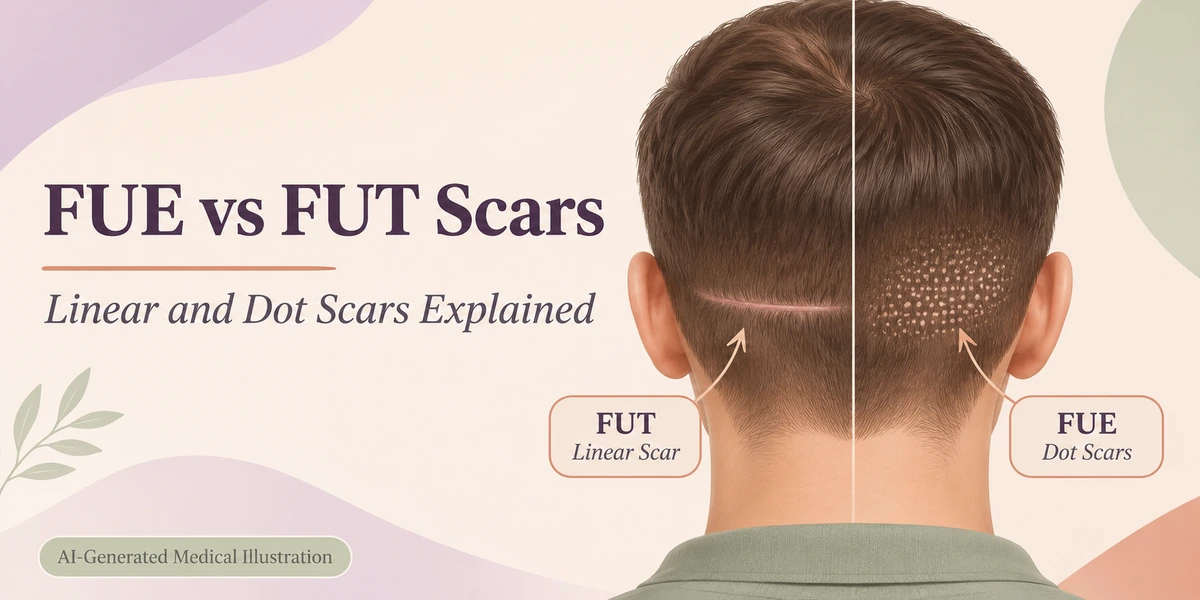
Both follicular unit extraction (FUE) and follicular unit transplantation (FUT) involve removing donor hair follicles from the back of the scalp, and each method leaves a characteristic scar pattern. FUT typically produces a single horizontal line that may widen over time, while FUE creates hundreds of small, round punctate scars that are dispersed across the donor zone. Neither technique is completely scar‑free, and scar appearance depends on hair length, skin type, extraction density, wound tension and individual healing response. Understanding these differences helps patients set realistic expectations and choose a donor‑area strategy that aligns with their lifestyle and aesthetic goals.
What Is FUE vs FUT Hair Transplant Scarring?
Scarring after hair transplantation refers to the permanent alteration of skin architecture in the donor area where follicles are harvested. In FUT, a strip of scalp is surgically excised, and the wound is closed, leaving a linear scar that runs parallel to the hairline. In FUE, individual follicular units are punched out with a tiny circular blade, resulting in multiple microscopic puncture sites that heal as tiny, often white, dot scars.
Why Do Scars Form After Hair Transplantation?
Both procedures involve cutting through the epidermis and dermis, triggering the body’s wound‑healing cascade. The skin repairs the defect by forming collagen and remodeling tissue, which inevitably produces a scar. The shape and size of the scar are dictated by the geometry of the incision (linear vs. circular) and by how the wound edges are approximated or left to heal by secondary intention.
Who May Notice Scarring?
Patients who keep their hair short, have fair or thin skin, or possess a propensity for hypertrophic or keloid formation are more likely to perceive donor‑area scars. Individuals with dense, coarse hair may hide dot scars more effectively, whereas those with longer hair can usually conceal a linear FUT scar under a typical 10–15 mm haircut.
How Do the Techniques Create Different Scars?
In FUT, the surgeon removes a strip measuring typically 1–4 cm in width. After the strip is excised, the wound edges are sutured or stapled, creating a linear closure. Healing follows primary intention, and the final scar width is usually 1–3 mm when well healed, but can stretch with tension or subsequent procedures Hair Transplant Scars: FUE vs FUT & How Each Ages.
FUE uses a motorized punch (0.8–1.0 mm diameter) to extract each follicular unit. The resulting micro‑defects close by secondary intention, forming a tiny scar roughly 0.5–1 mm in diameter. Over weeks to months, these dot scars fade, become whitish, and blend with surrounding hair FUE vs FUT Donor Area Comparison: Scar Breakdown.
What Do Scar Characteristics Mean for Patients?
Linear scars are continuous, making them visible when hair is cut short or when the scalp is examined directly. Their visibility can be reduced by trichophytic closure, where the lower edge of the wound is beveled to allow hair to grow through the scar. Dot scars are dispersed, so each individual mark is less noticeable, but a high extraction density can create a “checker‑board” pattern that may be seen with very short hair or under close inspection.
Benefits and Limitations of Each Approach
| Feature | FUE (Dot Scars) | FUT (Linear Scar) |
|---|---|---|
| Scar Shape | Hundreds of 0.5–1 mm circular scars | Single 1–3 mm horizontal line |
| Hair Length to Hide Scar | #2–#3 clipper guard (6–10 mm) often sufficient | Usually 10–15 mm or longer |
| Impact on Donor Density | Potentially lower graft yield per session | Higher graft yield; entire strip can provide many grafts |
| Risk of Widening | Rare; each dot heals independently | Possible if tension is high or scar contracts |
| Suitability for Tight Scalps | Better for limited laxity | Requires adequate scalp laxity for strip removal |

Risks and Possible Complications
Both techniques share general surgical risks such as infection, bleeding and temporary numbness. Specific scar‑related complications include:
- Widened linear scar: Excess tension, poor closure or subsequent procedures can stretch the FUT scar, making it more visible.
- Pigment changes: Hyper‑ or hypopigmentation may occur around both linear and dot scars, especially in darker skin types.
- Donor‑area thinning: High extraction density in FUE can leave a patch of reduced hair density, while FUT removes a strip of scalp permanently.
- Abnormal scar formation: Hypertrophic or keloid scars are rare but possible, particularly in patients with a personal or family history of keloids.
Recovery and Donor‑Area Care
FUT recovery involves managing the linear incision: gentle washing after 48 hours, avoiding tension on the suture line, and protecting the area from sun exposure for several months. FUE recovery focuses on keeping the puncture sites clean, applying a mild antiseptic ointment, and minimizing friction from hats or headgear. In both cases, scar maturation continues for up to 12 months, during which time the scar may change colour and texture.
When to Seek Medical Advice
If a scar becomes increasingly painful, shows rapid growth, changes colour dramatically, or develops raised borders suggestive of hypertrophy, patients should contact a qualified dermatologist or hair‑restoration surgeon promptly. Early intervention can improve outcomes with scar‑revision techniques or topical therapies.
Medical References
Frequently Asked Questions
Will I have a visible scar after a FUT hair transplant?
FUT creates a single linear scar that is usually 1–3 mm wide when fully healed, and it can be hidden under hair longer than 10 mm, but it may be visible with very short hair or if the scar widens.
Are FUE dot scars completely invisible?
FUE leaves many tiny circular scars about 0.5–1 mm in diameter. They are often imperceptible with normal hair lengths, but they can be seen when the scalp is shaved very short or examined closely.
Can a linear FUT scar be reduced or hidden after surgery?
Techniques such as trichophytic closure and careful wound tension management can minimise scar width, and hair can grow through the scar line, making it less noticeable over time.
What factors influence how my donor-area scar will look?
Hair length, skin colour, scalp laxity, extraction density, wound tension, and individual healing tendencies (including keloid risk) all affect scar colour, width and visibility.
Is scar revision guaranteed to remove a FUT or FUE scar?
Scar-revision or camouflage procedures can improve appearance but cannot guarantee complete removal; residual texture or colour changes may remain.
Which method offers a higher graft yield?
FUT generally provides a larger number of grafts in a single session because an entire strip of scalp is harvested, whereas FUE may yield fewer grafts per session due to the time-intensive extraction of individual units.
Should I avoid certain hairstyles after a hair transplant?
Avoid tight hairstyles that place tension on the donor area for several weeks, and protect the scalp from excessive sun exposure to reduce pigment changes and promote optimal scar healing.
Conclusion
Understanding the distinct scar patterns of FUE and FUT helps patients make informed decisions about donor‑area management. While FUE leaves dispersed dot scars that are often concealed with short hair, FUT produces a single linear scar that may be hidden under longer hairstyles but can widen over time. Individual factors such as skin type, hair density and healing response play a crucial role in scar visibility. Discussing realistic expectations with a qualified surgeon remains essential for optimal aesthetic outcomes.
Medical Disclaimer
This article is intended for general educational purposes only and does not replace individual medical advice, diagnosis or treatment. Suitability, risks and outcomes vary. Consult a qualified healthcare professional for medical guidance specific to your situation.