
How Is the Hair Transplant Donor Area Assessed in Navi Mumbai?

What Makes a Hair Transplant Hairline Look Natural?
October 7, 2026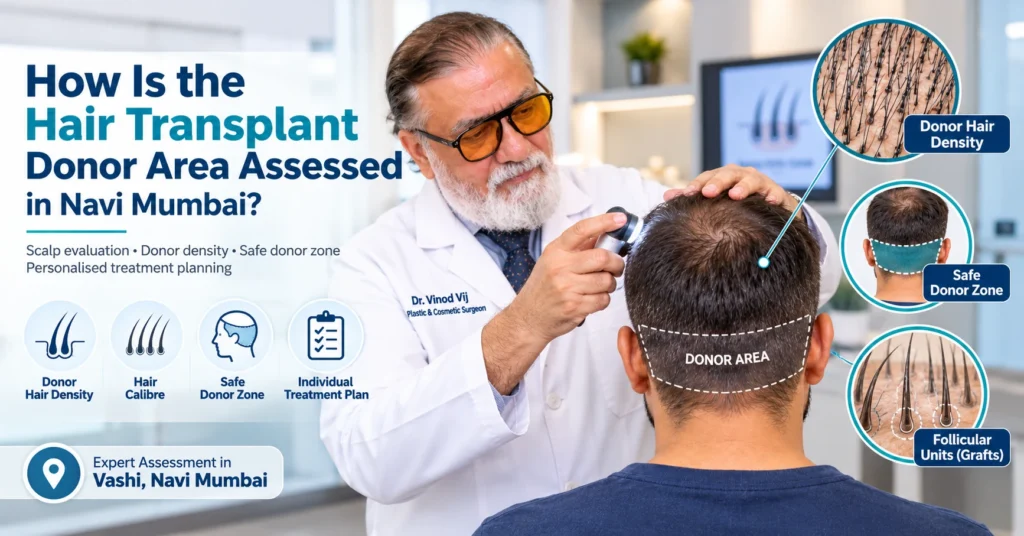
A hair transplant donor area is usually the back and sides of the scalp, where follicles tend to be more resistant to pattern hair loss. There is no single safe graft number for every patient. Safe harvesting depends on donor density, hair thickness, scalp characteristics, previous procedures and future hair-restoration needs.
For patients considering a hair transplant in Navi Mumbai, careful donor-area planning is just as important as designing the recipient area. Removing too many grafts can leave visible thinning and may reduce the number of follicles available for future treatment.
What Is the Hair Transplant Donor Area?
The donor area is the region from which healthy follicular units are removed for transplantation. In most scalp hair transplants, follicles are harvested from the back and sides of the head because these areas often remain more stable in people with androgenetic alopecia.
A follicular unit may contain one, two, three or more hairs. During FUE, individual follicular units are extracted and transplanted into areas affected by hair loss.
Patients exploring surgical restoration can learn more about Hair Transplant in Navi Mumbai.
What Is the Safe Donor Zone?
The safe donor zone refers to the part of the scalp where follicles are considered more suitable for long-term transplantation because they are less likely to be affected by progressive pattern hair loss.
However, the safe donor zone is not identical in every patient. Its size and stability depend on factors such as age, family history, pattern of baldness and the condition of the surrounding scalp.
This is why donor-area planning should be individualised rather than based on a fixed diagram or standard graft number.
Why Is Donor Area Assessment Important?
Donor hair is a limited resource. Once follicles are removed through FUE, those same follicles generally do not grow again at the extraction sites.
A proper donor assessment helps the surgeon:
-
- Maintain a natural appearance at the back and sides of the scalp.
-
- Reduce the risk of visible thinning.
-
- Distribute extraction sites evenly.
-
- Preserve grafts for possible future procedures.
-
- Match the available donor supply with the patient’s long-term hair-loss pattern.
The aim is not to extract the highest possible number of grafts in one sitting. The aim is to use the donor area responsibly.
How Is the FUE Donor Area Assessed?
Before recommending a graft number, several donor-area characteristics should be evaluated.
Donor Hair Density
Density refers to the number of follicular units present within a particular area of the scalp.
A patient with naturally higher donor density may have greater harvesting potential than someone with sparse donor hair.
Hair Calibre
Hair calibre means the thickness of individual hair shafts.
Thicker hair often provides greater visual coverage than very fine hair, which may influence how many grafts are required to create the desired appearance.
Hairs Per Follicular Unit
Not every graft contains the same number of hairs.
Some follicular units contain a single hair, while others contain two, three or more hairs. The overall number and distribution of hairs can influence the visual density achieved after transplantation.
Size of the Donor Area
A larger stable donor zone may provide more harvesting options, but the surgeon must still avoid excessive extraction from one region.
Previous Hair Transplants
Patients who have undergone previous FUE or FUT procedures may have fewer available follicles for another transplant.
Previous scarring, extraction patterns and remaining donor density all need to be considered.
Future Hair Loss
Hair loss may continue after transplantation.
For younger patients or those with progressive male pattern baldness, conservative donor planning may help preserve grafts for future treatment.
How Many Grafts Can Be Safely Taken From the Donor Area?
There is no universal maximum number of grafts that can safely be extracted from every patient.
Safe donor capacity depends on:
-
- Existing donor density.
-
- Size and stability of the donor area.
-
- Hair thickness.
-
- Number of hairs per follicular unit.
-
- Previous hair transplant procedures.
-
- Pattern and expected progression of hair loss.
-
- Extraction distribution.
-
- Future restoration requirements.
Two patients with a similar degree of baldness may have very different donor capacities.
Therefore, graft requirements should be determined after examining both the recipient area and the donor area rather than relying only on online graft calculators.
How Are Hair Transplant Grafts Calculated?

Hair transplant planning involves balancing two important questions:
How many grafts are needed?
and
How many grafts can safely be harvested?
The surgeon evaluates the size of the area requiring restoration, existing hair density, desired coverage and available donor supply.
A treatment plan should not simply aim for the maximum possible density. It should balance aesthetic goals with long-term donor preservation.
What Is Donor Area Overharvesting?
Donor-area overharvesting occurs when too many follicles are removed or extraction sites are concentrated excessively within one region.
This can cause the donor area to appear noticeably thin, uneven or patchy.
Potential consequences include:
-
- Increased scalp visibility.
-
- Patchy density.
-
- Uneven appearance when the hair is cut short.
-
- Reduced donor supply for future surgery.
-
- Greater visibility of small extraction scars.
Careful FUE planning involves spreading extraction sites appropriately across suitable donor areas rather than repeatedly harvesting from the same small region.
Safe Donor Area vs Overharvested Donor Area
| Feature | Carefully Harvested Donor Area | Overharvested Donor Area |
|---|---|---|
| Extraction pattern | Evenly distributed | Concentrated in limited areas |
| Visual density | Better preserved | Noticeably reduced |
| Scalp visibility | Usually less noticeable | May become clearly visible |
| Future graft availability | Better preserved | Reduced |
| Short hairstyle appearance | More uniform | Patchiness may be visible |
| Long-term planning | Considers future procedures | May limit future options |
Does Hair Grow Back in the FUE Donor Area?
The follicles removed during FUE generally do not regenerate at the same extraction points.
The donor area can still appear full because surrounding hairs continue to grow and may camouflage the tiny extraction sites.
This is one reason why extraction spacing and donor density are so important.
Removing an excessive proportion of follicles can make thinning more noticeable.
Will the Donor Area Look Thin After FUE?
Temporary redness, small crusts and short-term changes in appearance can occur after FUE.
As the donor area heals and surrounding hair grows, the extraction points generally become less noticeable.
Long-term appearance depends on:
-
- Original donor density.
-
- Number of grafts removed.
-
- Distribution of extraction sites.
-
- Hair length.
-
- Hair calibre.
-
- Individual healing.
If too many follicles are removed, persistent thinning may remain visible.
Can the Same Donor Area Be Used for a Second Hair Transplant?
Yes, some patients can undergo a second hair transplant using the same general donor region.
However, suitability depends on how many follicles remain after the first procedure.
Before planning another session, the surgeon should reassess:
-
- Remaining donor density.
-
- Previous extraction pattern.
-
- Existing scars.
-
- Progression of hair loss.
-
- Areas requiring further restoration.
The donor area should be viewed as a lifetime resource rather than an unlimited supply of grafts.
Can Beard or Body Hair Be Used if Scalp Donor Hair Is Limited?
In selected cases, beard or body hair may be considered as an additional donor source.
However, body hair differs from scalp hair in texture, growth cycle, calibre and length.
It may therefore be more suitable for certain areas or used to supplement scalp grafts rather than replace them completely.
Suitability must be assessed individually.
How Does the Norwood Scale Affect Graft Planning?
The Norwood Scale is commonly used to describe different stages of male pattern baldness.
As the stage of hair loss increases, the area requiring restoration may also increase.
However, the Norwood stage alone cannot determine the exact number of grafts needed.
Two patients at the same stage may have different:
-
- Head sizes.
-
- Donor densities.
-
- Hair thickness.
-
- Existing miniaturised hair.
-
- Desired coverage.
-
- Future hair-loss risk.
The Norwood Scale should therefore be used as a planning reference, not as an exact graft calculator.
Which Area Should Receive Limited Donor Grafts First?
When donor supply is limited, the surgeon and patient may need to decide which areas are most important to restore.
Possible treatment areas include:
-
- Frontal hairline.
-
- Frontal scalp.
-
- Mid-scalp.
-
- Crown.
-
- Temples.
There is no single priority that applies to everyone.
Many patients place greater importance on the frontal hairline because it frames the face, but the final plan depends on individual hair loss and aesthetic goals.
Patients with temple recession can also read about Temple Hair Transplant in Navi Mumbai.
Why Is Long-Term Donor Preservation Important?

Pattern hair loss can continue for years.
A patient who undergoes transplantation today may require additional treatment later if surrounding non-transplanted hair continues to thin.
If too much donor hair is used during the first procedure, fewer follicles may remain for:
- Future hairline correction.
- Mid-scalp restoration.
- Crown restoration.
- Additional density.
- Revision procedures.
Conservative donor management helps preserve future options.
Donor Area Assessment With Dr. Vinod Vij in Navi Mumbai
Dr. Vinod Vij is a Plastic & Cosmetic Surgeon practising in Navi Mumbai.
During a hair transplant consultation, the donor area can be assessed together with the pattern and extent of hair loss.
Important factors may include:
-
- Donor hair density.
-
- Hair calibre.
-
- Scalp condition.
-
- Previous transplantation.
-
- Recipient-area requirements.
-
- Hair-loss progression.
-
- Realistic treatment expectations.
Patients with progressive male pattern hair loss may also find this guide useful: Male Pattern Baldness Treatment in Navi Mumbai.
Frequently Asked Questions
The donor area is the region from which healthy follicles are harvested for transplantation. It is usually located at the back and sides of the scalp, where hair often remains more resistant to pattern hair loss.
There is no universal safe number. The amount that can be harvested depends on donor density, hair thickness, donor-area size, previous procedures and future hair-restoration needs.
The follicular units removed during FUE generally do not grow again at the same extraction sites. Surrounding hairs continue to grow and can help camouflage the extraction points.
Excessive harvesting may cause visible thinning, patchiness and reduced donor availability for future transplantation. This is known as donor-area overharvesting.
The surgeon examines the donor region to assess follicular density, hair calibre, distribution and scalp condition. The findings are combined with recipient-area requirements to create an individual treatment plan.
Conclusion
The hair transplant donor area is one of the most important factors in long-term hair restoration planning.
There is no fixed graft number that is safe for every patient. Donor density, hair characteristics, previous procedures and future hair-loss progression must all be considered before deciding how many grafts should be harvested.
Careful donor management helps reduce the risk of overharvesting while preserving follicles for possible future treatment.
Book a Hair Transplant Consultation With Dr. Vinod Vij
Patients considering a hair transplant in Navi Mumbai can consult Dr. Vinod Vij for an individual assessment of their donor area, pattern of hair loss and possible treatment options.
Website: https://drvinodvij.com/
Location: Vashi, Navi Mumbai
Medical Disclaimer: This article is intended for general educational purposes only. It does not replace professional medical advice, diagnosis or treatment. Hair transplant suitability, graft requirements, recovery and results vary between individuals.
