
Liposuction for Man Boobs: The Path to Masculine Chest
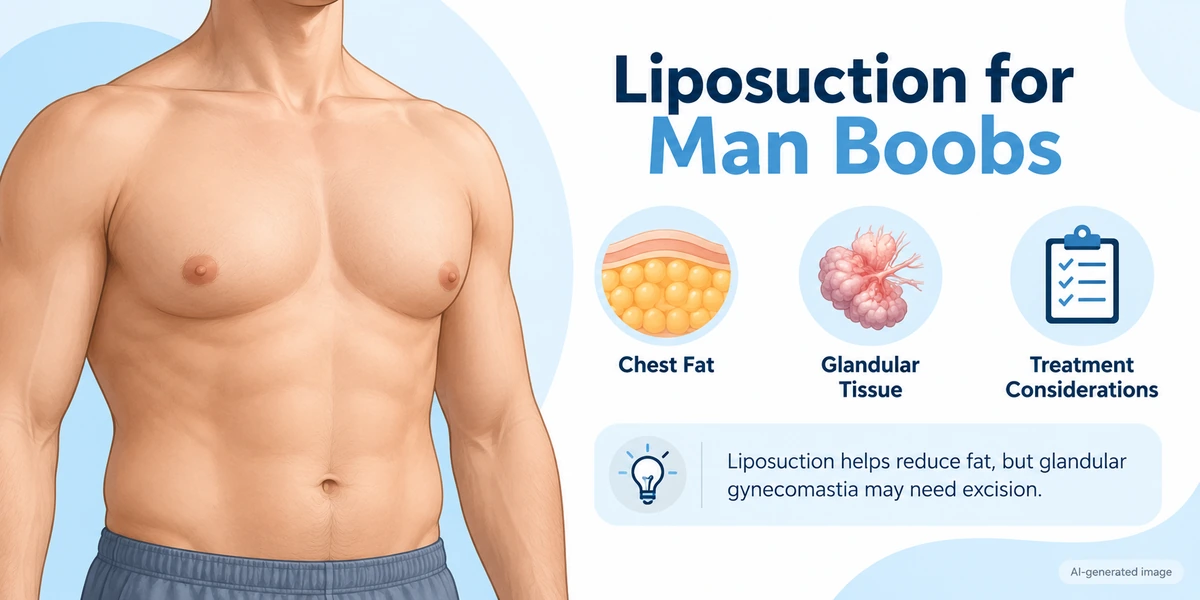
Chest enlargement in men is a relatively common concern that can develop during adolescence or adulthood. Although it is often described informally as man boobs, the underlying cause may involve excess fatty tissue, enlarged breast glandular tissue or a combination of both.
These differences are important because they influence the appropriate approach to management.
Liposuction for man boobs is a surgical technique used to remove selected deposits of fatty tissue from the chest. It may be considered when chest enlargement is predominantly caused by fat accumulation.
However, liposuction alone is not always appropriate for true gynecomastia, which involves increased glandular breast tissue. Some individuals require glandular excision or a combination of surgical techniques.
Not every person with chest enlargement requires surgery. Changes in body weight, medications, hormones and underlying medical conditions should also be considered.
This article explains the difference between gynecomastia and chest fat accumulation, how liposuction works, when surgery may be appropriate, possible complications, recovery timelines and nonsurgical management options.
What Are Man Boobs?


The term man boobs is commonly used to describe an enlarged male chest.
However, it does not identify the underlying medical cause.
Chest enlargement can result from different types of tissue.
1. Excess Fatty Tissue
An increase in fatty tissue around the chest may occur with weight gain or changes in body fat distribution.
This is often called pseudogynecomastia or lipomastia.
The enlargement is predominantly caused by fat rather than excess breast glandular tissue.
2. Enlarged Glandular Breast Tissue
True gynecomastia involves increased glandular breast tissue.
It commonly develops because of changes in the balance or action of oestrogens and androgens.
A firm or rubbery area may sometimes be felt beneath the nipple or areola.
3. Mixed Chest Enlargement
Some individuals have both increased fatty tissue and glandular enlargement.
This is an important distinction because treatment directed only at fat may leave significant glandular tissue behind.
4. Excess Skin
Chest enlargement, ageing or substantial weight loss may result in loose skin.
Skin laxity is not the same as fat accumulation or glandular enlargement.
Liposuction does not reliably correct substantial excess skin.
What Is Gynecomastia?
Gynecomastia is a benign enlargement of glandular breast tissue in males.
It may affect one or both sides of the chest.
The condition can develop during periods of hormonal change, particularly infancy, puberty and later adulthood.
However, it may also be associated with medicines, medical conditions or other factors.
Possible symptoms include:
-
Enlargement around the nipple and areola
-
A palpable firm or rubbery area beneath the nipple
-
Breast tenderness
-
Increased sensitivity
-
Asymmetry between the two sides
-
Changes in chest contour
Gynecomastia is not necessarily caused by obesity.
A person with a relatively low body fat percentage can still develop glandular breast enlargement.
Similarly, chest enlargement in a person with excess body fat does not automatically establish the presence of true gynecomastia.
A medical assessment is important to distinguish these conditions.
What Causes Gynecomastia?
Gynecomastia can develop for several reasons.
Hormonal Changes
The balance between oestrogen activity and androgen activity influences breast tissue development.
Changes in this balance may contribute to glandular enlargement.
Puberty
Temporary gynecomastia can occur during adolescence.
Many cases improve without surgery as hormonal activity stabilizes.
Persistent enlargement should be assessed according to symptoms and individual circumstances.
Ageing
Changes in hormone levels, body composition and medical conditions may influence breast tissue in older adults.
Certain Medications
Some prescription medicines can contribute to gynecomastia.
Examples include selected antiandrogen medicines, spironolactone and certain other drugs.
The relationship depends on the medicine, dose and individual response.
Medication should never be stopped without professional advice.
Anabolic Steroids and Hormonal Substances
Anabolic-androgenic steroid use can disrupt normal endocrine regulation and contribute to breast glandular enlargement.
Underlying Medical Conditions
Certain conditions affecting the testes, thyroid, liver, kidneys or hormone production may be associated with gynecomastia.
Weight Gain
Increased fatty tissue can enlarge the chest.
Higher body fat may also influence hormone metabolism in some individuals.
However, increased chest fat and true glandular gynecomastia remain different conditions.
Gynecomastia vs. Chest Fat: What Is the Difference?


Understanding the tissue responsible for chest enlargement helps guide treatment decisions.
| Feature | True gynecomastia | Pseudogynecomastia |
|---|---|---|
| Main cause | Increased glandular breast tissue | Predominantly increased fatty tissue |
| Typical feel | May include a firm or rubbery area beneath the areola | Often softer and more diffuse |
| Hormonal association | May be associated with hormonal changes | Often associated with body fat distribution |
| Effect of weight loss | Glandular tissue may remain | Fat-related fullness may decrease |
| Role of liposuction | May be insufficient alone | May be considered in selected cases |
| Other treatments | Address underlying cause; excision in selected cases | Weight management or selected surgical treatment |
Physical examination findings can overlap, particularly when glandular tissue and fat are both present.
Neither chest appearance nor a self-examination can reliably establish the diagnosis in every case.
How Is Male Chest Enlargement Diagnosed?
Assessment usually begins with a medical history and physical examination.
The purpose is to identify the type of breast enlargement and determine whether an underlying condition needs treatment.

1. Medical History
A healthcare professional may ask about:
-
When chest enlargement began
-
Whether it affects one or both sides
-
Pain or tenderness
-
Recent weight changes
-
Pubertal development
-
Current medications
-
Hormone or supplement use
-
Relevant medical conditions
-
Family history
-
Alcohol or recreational substance use
2. Chest Examination
The clinician may assess tissue distribution, tenderness, asymmetry, nipple changes and palpable masses.
3. Hormonal Evaluation
Blood tests may be considered when hormonal or systemic causes are suspected.
Depending on the clinical findings, investigations may include testosterone, oestradiol, thyroid function and other relevant tests.
Not every person requires the same laboratory investigations.
4. Imaging
Ultrasound or mammography may be recommended when the diagnosis is uncertain or there are concerning findings.
5. Assessment for Other Conditions
A suspicious mass or abnormal nipple discharge requires appropriate evaluation.
Male breast cancer is uncommon, but it should not be overlooked when warning signs are present.
The Mayo Clinic’s guidance on gynecomastia diagnosis and treatment explains the role of medical history, physical examination, selected investigations and treatment based on the underlying cause.
What Is Liposuction for Man Boobs?
Liposuction is a surgical technique that removes selected deposits of subcutaneous fat using a suction device.
When performed on the chest, it aims to reduce fatty tissue that contributes to chest fullness.
The procedure typically involves introducing a narrow hollow tube, called a cannula, through small skin incisions.
Fat is loosened and removed through controlled suction.
The volume and distribution of fat removed depend on the individual’s anatomy and surgical plan.
Liposuction is not intended to remove every fat cell or eliminate the possibility of future chest enlargement.
It also does not directly correct hormonal abnormalities that may be responsible for gynecomastia.
Can Liposuction Remove Gynecomastia Completely?
Not in every case.
The answer depends largely on whether chest enlargement is caused by fatty tissue, glandular tissue or both.
When Liposuction May Be Sufficient
Liposuction alone may be considered when fatty tissue is the main cause of enlargement and the skin has sufficient elasticity.
When Liposuction May Be Insufficient
Dense glandular breast tissue beneath the nipple may not be adequately removed using routine liposuction techniques.
The remaining tissue can continue to produce visible projection.
When Combined Surgery May Be Required
In selected cases, liposuction is combined with direct glandular excision.
This allows fatty tissue and glandular tissue to be addressed separately.
When Skin Removal May Be Required
Substantial chest skin laxity may require additional surgery.
Such procedures usually involve longer incisions and more noticeable scars.
Therefore, the appropriate treatment should be based on the underlying tissue composition rather than the appearance of the chest alone.
Can Men Get Liposuction on Their Chest?
Yes.
Chest liposuction is an established surgical technique used in selected individuals with excess subcutaneous chest fat.
However, not every person with enlarged chest tissue is a suitable candidate.
Clinical assessment should consider:
-
The proportion of fat and glandular tissue
-
Skin quality and elasticity
-
Overall health
-
Weight stability
-
Smoking or nicotine use
-
Medication history
-
Underlying hormonal disorders
-
Previous chest surgery
-
Expectations and treatment goals
It is also important to establish whether nonsurgical management or observation may be appropriate.
What Happens During Male Chest Liposuction?
The exact procedure varies according to the patient’s anatomy, the type of tissue involved and the surgical technique.
1. Preoperative Assessment
The healthcare team evaluates chest anatomy, relevant medical conditions and potential risks.
The assessment may involve photographs for clinical documentation, with appropriate consent.
2. Anaesthesia
Chest liposuction may be performed using local anaesthesia with sedation or general anaesthesia.
The appropriate method depends on the procedure and individual health factors.
3. Surgical Marking
The treatment area may be marked to identify regions of fat distribution and planned contour changes.
4. Small Incisions
Small incisions are made to allow the cannula to enter the fatty tissue.
Their number and location depend on the technique.
5. Fluid Infiltration
A solution containing saline and selected medicines may be introduced into the tissue.
This may help with fat removal and bleeding control.
6. Fat Removal
A cannula is passed through the fatty layer to remove selected deposits of fat.
7. Glandular Excision When Required
If dense glandular tissue is present, a separate incision may be required to remove it.
This commonly involves access near the areolar border, although techniques vary.
8. Wound Closure
Incisions may be closed with sutures or managed according to the surgical plan.
Dressings are applied.
9. Recovery and Monitoring
The patient is observed after surgery, and instructions are provided for wound care, prescribed medicines, compression and physical activity.
Some individuals return home the same day, while others require additional observation.
Liposuction vs. Glandular Excision for Gynecomastia
Liposuction and glandular excision are not interchangeable.
| Feature | Liposuction | Glandular excision |
|---|---|---|
| Main tissue addressed | Fat | Glandular breast tissue |
| Surgical technique | Fat removal using a cannula | Direct tissue removal through an incision |
| Incision pattern | Usually small access incisions | Incisions vary, often near the areola |
| Best-suited tissue | Predominantly fatty enlargement | Significant glandular enlargement |
| Skin removal | Usually not included | May be combined with skin removal |
| Scarring | Small permanent incision scars | Scars depend on extent of excision |
| Possible complications | Contour irregularity, bleeding, fluid collection and others | Haematoma, asymmetry, nipple changes and others |
Some patients require a combination of both procedures.
The American Society of Plastic Surgeons’ educational overview of gynecomastia surgery describes how surgery may address fatty tissue, glandular tissue and excess skin according to individual anatomy.
Is Liposuction Better Than Gynecomastia Surgery?
The question is based on a common misunderstanding.
Liposuction is itself a surgical procedure.
The more useful comparison is between liposuction alone and surgical approaches that include glandular excision.
Neither is universally preferable.
Liposuction alone may be appropriate for predominantly fatty enlargement.
Glandular excision may be necessary when a substantial component of true gynecomastia is present.
A combined approach may be considered when there is both fat and glandular tissue.
The selection should consider the degree of enlargement, skin characteristics, underlying causes and potential risks.
What Types of Liposuction Are Used for the Chest?
Different liposuction methods may be used for selected patients.
Traditional Suction-Assisted Liposuction
This technique uses a cannula and suction to remove fatty tissue.
Power-Assisted Liposuction
Power-assisted systems use mechanical cannula movement to assist fat removal.
Ultrasound-Assisted Liposuction
Ultrasound-assisted techniques use energy to help disrupt fat before removal.
Other Energy-Assisted Techniques
Certain technologies use laser or other forms of energy during fat removal.
However, claims that one technology is always safer, produces no scarring or guarantees better skin tightening are not justified.
Each approach has specific benefits, limitations and risks.
Energy-assisted procedures may also introduce complications such as heat-related tissue injury.
The appropriate technique depends on clinical findings and the surgical plan.
Is Liposuction for Man Boobs Painful?
Pain and discomfort vary.
Anaesthesia is used during the procedure, but the experience depends on whether local anaesthesia, sedation or general anaesthesia is selected.
After surgery, individuals may experience:
-
Soreness
-
Swelling
-
Bruising
-
Chest tightness
-
Tenderness around incisions
-
Temporary altered sensation
Discomfort commonly improves over time.
However, severe or progressively worsening pain should not be considered routine.
The level of postoperative discomfort also depends on whether glandular excision or skin removal was performed.
How Long Does Recovery Take After Chest Liposuction?
Recovery varies according to the extent of surgery and individual healing.
Some individuals resume selected light activities within a relatively short period, while others require longer restrictions.
| Recovery stage | Possible observations |
|---|---|
| First 1–3 days | Swelling, bruising, tenderness and restricted movement |
| Week 1 | Early healing continues; discomfort may begin improving |
| Weeks 2–3 | Some improvement in swelling and daily mobility |
| Weeks 3–4 | Further recovery, although tissue firmness and sensitivity may remain |
| Weeks 4–6 | Some individuals may resume additional activities after medical clearance |
| Months 2–3 | Continued settling of tissues and reduction in residual swelling |
| Months 3–6 | Further contour changes and scar maturation |
| Beyond 6 months | Some tissue remodelling may continue; persistent symptoms warrant assessment |
This is a general framework, not a guarantee.
The recovery period may be longer after combined glandular excision, skin removal or complications.
Why Is the Chest Swollen After Gynecomastia Liposuction?
Swelling is part of the body’s inflammatory response to tissue injury.
Liposuction disrupts fatty tissue, small blood vessels, connective tissue and lymphatic pathways.
This can produce temporary fluid accumulation.
Common postoperative observations include:
-
Diffuse chest puffiness
-
Firmness
-
Mild asymmetry
-
Tenderness
-
Changes in skin sensation
Swelling may be uneven during early recovery.
However, sudden or progressive enlargement should be evaluated for a haematoma, seroma or another complication.
For additional information about delayed fluid-related changes following fat removal, see swelling six months after liposuction and its possible causes.
What Is a Seroma After Gynecomastia Surgery?
A seroma is a collection of fluid beneath the skin.
It may develop after liposuction, glandular excision or other procedures involving separation of tissue layers.
Possible signs include:
-
Localized swelling
-
A soft or fluctuant bulge
-
Pressure or discomfort
-
Visible asymmetry
-
Persistent fluid-like fullness
Some seromas resolve without intervention.
Others may require drainage or further management.
A suspected seroma should not be drained or compressed aggressively at home.
What Is a Haematoma After Male Breast Reduction?
A haematoma is a collection of blood within tissue.
It may develop following surgery and can cause:
-
Sudden swelling
-
Increasing pain
-
Chest asymmetry
-
Bruising or skin discolouration
-
Firmness
A significant haematoma may require urgent medical attention and sometimes further treatment.
New, painful or rapidly increasing chest swelling should be assessed promptly.
Does Male Chest Liposuction Leave Scars?
Yes.
Every surgical incision creates some degree of permanent scar tissue.
Liposuction incisions are often relatively small, but their visibility depends on:
-
Incision placement
-
Skin pigmentation
-
Genetics
-
Wound healing
-
Infection or inflammation
-
Scar tension
-
Individual scar-forming tendencies
When glandular excision or skin removal is performed, additional scars may be present.
Scars can become less noticeable as they mature, but they do not completely disappear.
What Are the Risks of Liposuction for Man Boobs?
Chest liposuction carries surgical risks.
Some complications are minor and temporary, while others require treatment.
1. Bleeding and Haematoma
Bleeding can cause fluid accumulation, swelling or discomfort.
2. Infection
An infection may produce increasing redness, warmth, pain, discharge or fever.
3. Seroma
Fluid may collect beneath the skin after surgery.
4. Contour Irregularities
Uneven fat removal, tissue contraction or healing differences can create indentations, asymmetry or uneven surfaces.
5. Changes in Nipple Sensation
Temporary or persistent numbness, tingling or reduced sensation may occur.
6. Skin Laxity
The skin may not retract sufficiently after fat removal.
This is more likely to be relevant when skin elasticity is limited or substantial volume is removed.
7. Scarring
Incisions can produce visible or raised scars.
8. Residual Glandular Tissue
When true gynecomastia is present, liposuction alone may leave glandular tissue behind.
9. Skin or Fat Necrosis
Reduced tissue blood supply can occasionally cause tissue injury.
10. Anaesthesia-Related Complications
Anaesthesia involves risks that vary according to the technique and individual health.
11. Blood Clots
Although uncommon in many limited procedures, venous thromboembolism remains a recognised surgical risk.
Chest pain, sudden breathlessness or fainting require emergency medical evaluation.
12. Need for Additional Surgery
Some individuals may require revision surgery because of complications, residual tissue or contour concerns.
No surgical technique can guarantee perfect symmetry or an entirely complication-free recovery.
Can Male Breast Enlargement Return After Liposuction?
Chest enlargement may recur or become noticeable again after treatment.
The reason depends on the original tissue and underlying causes.
Weight Gain
Remaining fat cells can enlarge when body weight increases.
This may produce renewed chest fullness.
Persistent Glandular Tissue
If glandular tissue remains after liposuction, it may continue to contribute to nipple or chest projection.
Hormonal Conditions
Unaddressed endocrine abnormalities may continue influencing breast tissue.
Medications or Hormonal Substances
Certain substances may contribute to ongoing or recurrent enlargement.
Changes in Skin and Chest Contour
Ageing or weight fluctuations may affect the appearance of the chest.
Recurrence does not automatically mean that a previous procedure was technically unsuccessful.
The underlying cause should be established before considering further treatment.
Does Liposuction Permanently Remove Chest Fat?
Liposuction removes selected fat cells from the treated area.
Those particular cells do not normally regenerate in the same way as ordinary short-term tissue swelling.
However, remaining fat cells can enlarge if body weight increases.
Liposuction does not prevent:
-
Future weight gain
-
Changes in fat distribution
-
Hormonal changes
-
Skin laxity
-
Development or persistence of glandular gynecomastia
Therefore, long-term results can change.
The procedure should not be presented as a permanent prevention method for all forms of male chest enlargement.
Can Exercise Reduce Man Boobs?
Exercise can support general health and reduce overall body fat when combined with appropriate nutrition.
However, the effect on chest enlargement depends on the underlying tissue.
Fat-Related Enlargement
Reduction in total body fat may decrease fatty fullness in the chest.
True Gynecomastia
Exercise cannot reliably eliminate enlarged glandular breast tissue.
Chest Muscle Training
Resistance exercises can strengthen pectoral muscles.
However, increasing muscle size does not directly remove glandular tissue.
It also cannot selectively remove fat from the chest.
Weight Management
Sustainable weight management may be useful for individuals whose chest enlargement is predominantly related to excess fat.
The appropriate approach should reflect overall health rather than unrealistic body-shape expectations.
Can Gynecomastia Go Away Without Surgery?
Yes, in some circumstances.
The possibility depends on the cause and duration.
Pubertal Gynecomastia
Many cases associated with puberty improve spontaneously.
Medication-Associated Gynecomastia
A clinician may review whether a medicine is contributing.
Treatment changes must be medically supervised.
Hormonal Conditions
Addressing an underlying endocrine disorder may be appropriate.
Fat-Related Chest Enlargement
Changes in body weight may reduce excess fatty tissue.
Long-Standing Glandular Enlargement
Established glandular tissue may persist even after the underlying cause has been addressed.
Some individuals with persistent symptomatic enlargement may consider surgical treatment after medical evaluation.
Not every case requires an operation.
Are Medications Used to Treat Gynecomastia?
Management depends on the cause.
Some people benefit from treating an underlying medical condition or adjusting a contributing medicine under clinical supervision.
In selected circumstances, specialist clinicians may consider medication for particular forms of gynecomastia.
However, medicines are not universally effective, and routine self-medication is inappropriate.
Hormonal medicines, anti-oestrogen medicines and supplements can have adverse effects and should not be taken without appropriate assessment.
Long-standing fibrotic glandular tissue may be less responsive to medical treatment.
Is Liposuction Suitable for Severe Gynecomastia?
Severe chest enlargement may involve:
-
Significant glandular tissue
-
Excess fatty tissue
-
Skin stretching
-
Nipple or areolar displacement
-
Chest asymmetry
Liposuction alone may not adequately address all these features.
Depending on the anatomy, additional glandular excision and skin removal may be considered.
More extensive surgery can involve larger scars and additional healing requirements.
Treatment suitability should be assessed individually.
What Happens to the Nipples After Gynecomastia Surgery?
The appearance and sensation of the nipple–areola complex may change after male breast reduction.
Possible changes include:
Swelling
Temporary swelling may affect nipple appearance.
Altered Sensation
Sensation may become reduced, increased or otherwise different.
Some changes persist.
Asymmetry
Small differences in nipple position or appearance may remain.
Scar Formation
Incisions near the areola may produce visible scars.
Tissue or Blood Supply Problems
Rarely, significant disruption of blood supply can affect nipple or areolar tissue.
The risk depends on the surgical technique and degree of tissue rearrangement.
For further information about surgery involving nipple tissue and its potential effects, see the educational article on nipple reduction surgery for males.
Nipple reduction and gynecomastia surgery address different anatomical concerns, and their treatment plans should not be confused.
What Is the Role of Compression Garments After Chest Liposuction?
Compression garments are commonly used after some forms of male breast reduction.
They may provide support and help manage swelling during recovery.
However, evidence and practices vary regarding the ideal pressure and duration.
The appropriate garment should:
-
Fit according to postoperative instructions
-
Avoid excessive pressure
-
Allow normal breathing
-
Avoid causing skin injury
-
Be worn for the recommended period
Compression garments do not eliminate every risk of seroma, haematoma or contour irregularity.
Continued use should follow individual medical guidance.
When Can Someone Return to Work After Gynecomastia Liposuction?
Return-to-work timing depends on the procedure and the physical demands of the job.
Desk-Based Work
Some individuals may return to light work within several days to a couple of weeks.
However, this varies.
Physically Demanding Work
Jobs involving lifting, strenuous upper-body activity or repeated bending may require longer restrictions.
Work Involving Extensive Movement
The ability to perform physical tasks should be determined by the healing stage and medical assessment.
A person who feels comfortable during light activities may still need to avoid heavy exertion.
When Is Exercise Safe After Male Chest Liposuction?
Physical activity should be resumed gradually.
Gentle Walking
Walking is commonly encouraged when medically permitted.
Chest Exercises
Push-ups, bench presses and other movements that heavily load the chest may need to be restricted during early healing.
Weight Training
Heavy lifting should resume only after medical clearance.
Running and High-Impact Activities
Activities that increase movement or pressure around the chest may require additional recovery time.
Swimming
Swimming should generally wait until surgical wounds are fully healed and the treating team has cleared the activity.
Returning to intense exercise too soon may increase swelling, discomfort or strain on healing tissues.
What Can Help Support Recovery?
Recovery care should reflect the specific procedure performed.
General principles include:
Follow Wound-Care Instructions
Keep incisions clean and manage dressings as directed.
Use Medicines Appropriately
Take prescribed medicines according to instructions.
Do not independently add antibiotics, pain medicines or supplements.
Avoid Smoking and Nicotine
Nicotine can interfere with tissue circulation and wound healing.
Maintain Adequate Nutrition
Sufficient calories, protein and essential nutrients support normal repair processes.
Stay Hydrated
Normal hydration supports general health.
Drinking excessive water does not guarantee faster reduction of swelling.
Avoid Unnecessary Chest Pressure
Protect healing tissues from trauma and uncomfortable pressure.
Attend Follow-Up Appointments
Clinical review helps identify fluid collections, infection and other healing concerns.
Monitor Unusual Symptoms
New or worsening pain, swelling, discharge or skin changes should not be ignored.
When Should Male Chest Enlargement Be Medically Evaluated?
Not every enlarged male chest requires surgical treatment.
However, some findings warrant medical assessment.
Seek evaluation if you notice:
-
New or rapidly developing enlargement
-
A firm or irregular lump
-
Enlargement affecting only one side
-
Persistent pain
-
Nipple discharge
-
Bloody nipple discharge
-
Changes in the skin over the breast
-
Nipple retraction
-
Enlarged lymph nodes near the armpit
-
Other symptoms suggesting hormonal or systemic illness
A new chest mass should not automatically be assumed to be benign gynecomastia.
Appropriate investigation is particularly important when suspicious findings are present.
When Should Someone Seek Medical Attention After Surgery?
Following chest liposuction or male breast reduction, contact a qualified healthcare professional if symptoms include:
-
Increasing chest pain
-
Sudden or significant swelling
-
Persistent bleeding
-
Worsening redness
-
Unusual warmth
-
Fever
-
Pus or wound discharge
-
Wound opening
-
New severe asymmetry
-
Darkening or unusual colour changes of the nipple or skin
-
A new painful lump
Seek emergency medical care for sudden chest pain, breathlessness, fainting or symptoms suggesting a blood clot.
Do not attempt to drain fluid collections or treat a suspected infection with unverified home remedies.
What Results Can Be Expected From Male Chest Liposuction?
Liposuction can reduce selected deposits of chest fat.
However, the overall appearance depends on several factors.
Fat Distribution
The amount and location of fatty tissue influence the extent of change.
Glandular Tissue
Persistent glandular tissue may continue to contribute to chest projection.
Skin Elasticity
Skin retraction varies.
Some individuals develop or retain visible skin laxity.
Chest Anatomy
Muscle shape, rib cage structure and natural asymmetry affect overall contour.
Healing Response
Swelling, scar tissue and tissue remodelling can change the appearance over time.
Weight Changes
Later weight gain may affect the remaining fatty tissue.
There is no guaranteed amount of flattening, symmetry or improvement in body image after the procedure.
Can Revision Surgery Be Required?
Some individuals undergo further surgery after initial chest liposuction or gynecomastia reduction.
Possible reasons include:
-
Persistent glandular tissue

-
Significant contour irregularity
-
Residual skin laxity
-
Scar-related complications
-
Recurrent enlargement
-
Persistent asymmetry
-
Other functional or structural concerns

Revision surgery has additional risks.
A persistent concern should first be assessed to identify whether it represents normal healing, residual tissue or a complication.
For another example of how fat-removal surgery can involve prolonged tissue changes, read about postoperative swelling and recovery after liposuction.