
Tummy Tuck vs. Liposuction: Which One is Right for You?
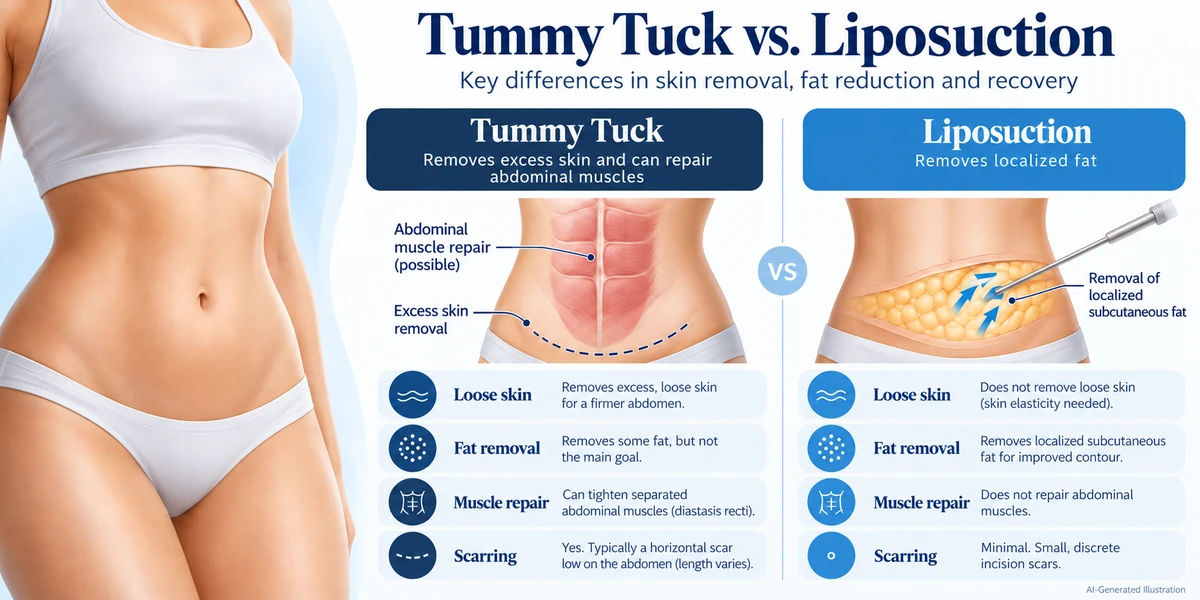
The main difference between a tummy tuck and liposuction is the tissue each procedure treats. A tummy tuck removes excess abdominal skin and may repair separated abdominal muscles, while liposuction removes selected deposits of fat beneath the skin. Both are surgical procedures, but they have different indications, scars, risks and recovery requirements.
A tummy tuck, also known as abdominoplasty, is often considered when loose abdominal skin or abdominal wall changes are the primary concern.
Liposuction may be considered when localized subcutaneous fat is present and the surrounding skin has sufficient elasticity.
Neither procedure is a weight-loss treatment, and not everyone with abdominal fullness requires surgery.
This article explains the differences between tummy tuck and liposuction, their limitations, possible complications and factors influencing suitability.
What Is a Tummy Tuck?
A tummy tuck is a surgical procedure that removes excess skin from the abdomen and may address separation of the abdominal muscles, known as rectus diastasis.
Depending on the technique, surgery may involve removing excess skin and associated fat, repositioning the remaining tissues and repairing the abdominal wall when indicated.
Types of Tummy Tuck
Full abdominoplasty: Usually involves removing excess abdominal skin and repositioning the belly button. Abdominal wall repair may also be performed.
Mini abdominoplasty: Generally focuses on selected skin laxity below the belly button, with a less extensive operation.
Extended abdominoplasty: May address excess skin extending toward the sides of the waist.
All forms of abdominoplasty create permanent surgical scars.
What Is Liposuction?
Liposuction removes localized deposits of subcutaneous fat using a narrow instrument called a cannula.
The cannula is introduced through small surgical incisions, and fat is removed using controlled suction.
Liposuction may be performed in areas such as the abdomen, waist, hips, thighs or arms.
However, it cannot reliably remove significant loose skin, repair separated abdominal muscles or eliminate visceral fat surrounding internal organs.
Skin elasticity is an important consideration because removing fat does not necessarily cause the overlying skin to tighten.
Tummy Tuck vs. Liposuction: Key Differences
| Feature | Tummy tuck | Liposuction |
|---|---|---|
| Medical name | Abdominoplasty | Liposuction |
| Main purpose | Remove excess abdominal skin and address selected abdominal wall changes | Remove localized subcutaneous fat |
| Loose skin removal | Yes | No |
| Muscle separation repair | May be performed | No |
| Fat removal | Some fat may be removed with excess skin | Primary purpose of the procedure |
| Incisions | Usually a longer lower abdominal incision | Smaller access incisions |
| Scarring | Permanent, generally more extensive | Permanent, generally smaller |
| Recovery | Often requires several weeks of restricted activity | May involve earlier return to light activities after limited procedures |
| Main limitations | Does not treat obesity or remove all abdominal fat | Does not correct major skin laxity or muscle separation |
The appropriate procedure depends on anatomy, medical suitability and the underlying cause of the abdominal concern.
Which Procedure May Be More Suitable?
A medical assessment is important because the appearance of abdominal fullness does not always reveal its cause.
When a Tummy Tuck May Be Considered
Abdominoplasty may be considered when excess abdominal skin is the main concern, particularly after pregnancy or substantial weight loss.
It may also be considered when abdominal muscle separation contributes to the appearance of the abdomen and surgical repair is appropriate.
However, not every person with loose skin or rectus diastasis requires an operation.
When Liposuction May Be Considered
Liposuction may be considered when localized fat deposits are present, skin elasticity is adequate and the individual is medically suitable.
It is generally less useful when abdominal fullness is mainly caused by loose skin, visceral fat or abdominal wall changes.
When Neither Procedure May Be Appropriate
Surgery may be unsuitable or require postponement when there is an uncontrolled medical condition, unstable weight, active infection or significant surgical risk.
Additional assessment may be necessary when abdominal prominence is caused by a hernia, visceral fat or another medical condition.
Can a Tummy Tuck and Liposuction Be Combined?
Yes. Both procedures may be performed during the same operation in selected individuals.
This combined approach is sometimes called lipoabdominoplasty.
Liposuction may address selected fatty areas while abdominoplasty removes excess skin and, when indicated, repairs the abdominal wall.
However, combined surgery increases operative complexity and requires careful planning to preserve tissue circulation.
Is Combined Surgery Always Necessary?
No.
Some individuals require only one procedure. Others may be better suited to staged operations.
The decision depends on the planned treatment areas, existing tissue characteristics, medical fitness and potential complications.
For more information, read liposuction after tummy tuck: timing, risks and recovery.
What Are the Risks of Tummy Tuck and Liposuction?
Both procedures carry risks associated with surgery and anaesthesia.
Tummy Tuck Risks
Possible complications include infection, bleeding, seroma, poor wound healing, skin injury, noticeable scarring, numbness and blood clots.
Some individuals may also experience persistent discomfort or changes in abdominal contour.
Liposuction Risks
Possible complications include swelling, bruising, fluid collections, contour irregularities, altered sensation, infection and skin injury.
Rare but serious complications can include blood clots, internal injury and fluid-related complications.
Risks of Combined Procedures
Combining procedures may increase operative time and the extent of tissue injury.
Individual risks must be assessed before surgery.
No surgical technique can guarantee a complication-free recovery.
Tummy Tuck vs. Liposuction Recovery
Recovery depends on the extent of surgery, individual health and whether additional procedures were performed.
Tummy Tuck Recovery
Abdominoplasty commonly requires several weeks of restricted activity.
Early recovery may involve swelling, abdominal tightness, tenderness and limited comfort during movement.
Some individuals are instructed to wear compression garments.
Heavy lifting and strenuous abdominal activity usually require medical clearance.
Swelling can continue improving for months, while scars may mature over a year or longer.
Read more about recovery five weeks after a tummy tuck.
Liposuction Recovery
After limited liposuction, some individuals can return to light activities earlier than after extensive abdominoplasty.
However, recovery is not necessarily complete within one or two weeks.
Swelling, bruising and tissue firmness may persist for several weeks or months.
The timing of exercise and compression garment use depends on the extent of fat removal and postoperative instructions.
Can Liposuction Remove Loose Belly Skin?
No. Liposuction primarily removes subcutaneous fat.
When the skin has limited elasticity, fat removal may leave existing loose skin unchanged or make it more noticeable.
A tummy tuck may address selected excess skin, but it also involves a larger incision and a different recovery process.
The choice should be based on an examination of the skin, fat distribution and abdominal wall.
Can a Tummy Tuck Remove Stretch Marks?
A tummy tuck may remove stretch marks located within the skin that is surgically excised.
However, it does not remove all stretch marks.
Stretch marks outside the removed skin may remain visible.
Liposuction does not directly remove stretch marks.
How Long Do the Results Last?
Both procedures produce anatomical changes that may be long-lasting, but the body’s appearance can continue changing.
After liposuction, remaining fat cells may enlarge with weight gain.
After abdominoplasty, pregnancy, significant weight changes and ageing may affect abdominal skin and contour.
Neither procedure prevents future weight fluctuations, tissue ageing or the development of new abdominal concerns.
Recovery and Safety Checklist

Anyone considering abdominal contouring surgery should understand the following:
-
Confirm the underlying concern: Determine whether fullness is caused by fat, loose skin, muscle separation or another condition.
-
Review medical fitness: Discuss medical conditions, medications and previous surgery.
-
Understand permanent scars: Both procedures create surgical scars.
-
Discuss possible complications: Ask about infection, bleeding, fluid collections, blood clots and wound-healing problems.
-
Plan for recovery: Arrange appropriate support and understand activity restrictions.
-
Follow postoperative instructions: Use medicines, compression garments and wound-care measures as directed.
-
Recognise warning signs: Increasing pain, fever, spreading redness or rapidly worsening swelling requires assessment.
These measures support informed decision-making but cannot eliminate every surgical risk.
When Should Someone Seek Medical Attention After Surgery?
Mild swelling, soreness and bruising may occur during recovery.
However, worsening abdominal pain, fever, wound discharge, unusual redness, significant bleeding or a new painful swelling should be medically evaluated.
Sudden chest pain, breathlessness or fainting requires emergency medical attention. These symptoms may indicate a serious complication.
For a detailed explanation of early postoperative recovery, read what to expect three weeks after a tummy tuck.
Frequently Asked Questions
1. What is the main difference between tummy tuck and liposuction?
A tummy tuck removes excess abdominal skin and may repair separated abdominal muscles. Liposuction removes selected deposits of subcutaneous fat but does not reliably correct loose skin or muscle separation.
2. Is a tummy tuck better than liposuction?
Neither procedure is universally better. The appropriate option depends on whether the main concern is loose skin, localized fat, abdominal wall changes or a combination of these factors.
3. Which has a longer recovery: tummy tuck or liposuction?
A tummy tuck generally involves a longer recovery because of the extent of skin surgery and possible muscle repair. However, recovery after extensive liposuction can also take several weeks or months.
4. Can liposuction tighten loose abdominal skin?
Liposuction does not reliably tighten significant loose skin. Its main purpose is fat removal, and existing skin laxity can sometimes become more noticeable afterward.
5. Can tummy tuck and liposuction be performed together?
Yes. Both procedures may be combined in selected individuals. However, combined surgery requires assessment of tissue circulation, overall health and surgical risks.
6. Do tummy tuck and liposuction leave scars?
Yes. Both procedures create permanent scars. Tummy tuck scars are generally longer, while liposuction usually involves smaller access incisions.
7. Are tummy tuck and liposuction weight-loss procedures?
No. Both are primarily body-contouring procedures. Neither is a treatment for obesity or a substitute for appropriate medical weight management.
Conclusion
Tummy tuck and liposuction are different surgical procedures that address different anatomical concerns.
Abdominoplasty primarily removes excess abdominal skin and may repair abdominal muscle separation, while liposuction removes selected subcutaneous fat deposits.
The choice depends on individual anatomy, skin elasticity, medical suitability and the risks associated with each procedure.
Neither procedure guarantees a specific appearance, and further treatment is not necessary for everyone.
Understanding the differences, possible complications and recovery requirements helps support informed medical decisions.
Disclaimer: All content and visuals on this website are for educational and informational purposes only. Images may be AI-generated or illustrative. Individual treatment results may vary. This information does not replace professional medical advice, diagnosis or consultation.