
Enhancing Lipo after Tummy Tuck
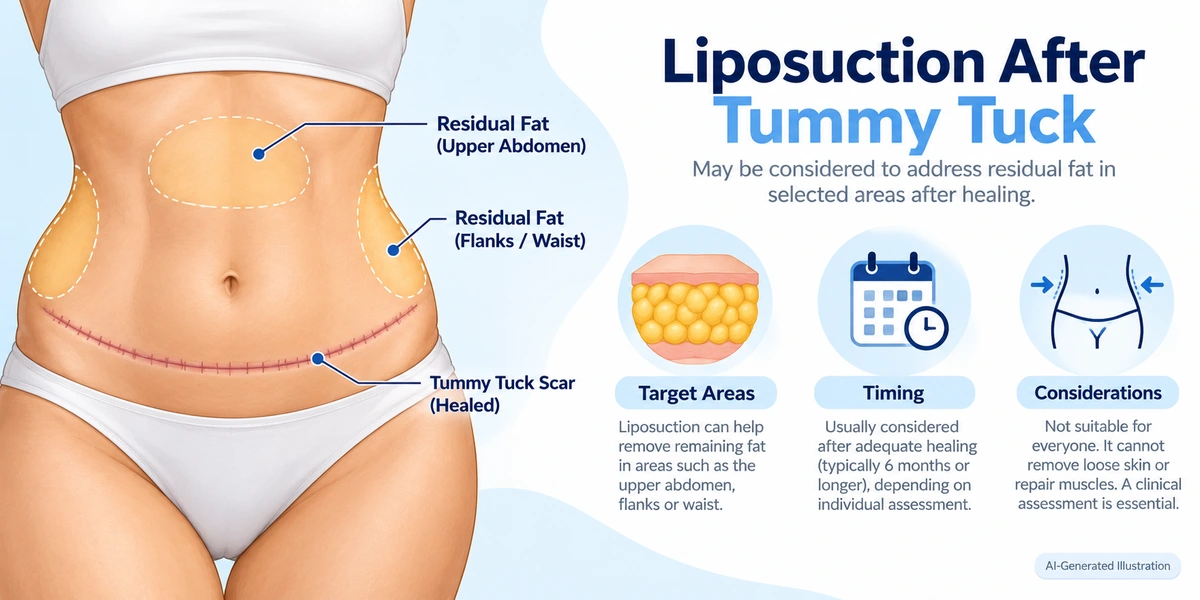
A tummy tuck, medically known as abdominoplasty, is a surgical procedure that removes excess abdominal skin and may repair separated abdominal muscles. Although it changes the abdominal contour, it does not necessarily remove every deposit of fat from the abdomen or surrounding areas.
Some individuals notice remaining fullness around the upper abdomen, waist or flanks after surgery. This may lead to questions about whether liposuction after a tummy tuck is possible.
Liposuction is a surgical technique that removes selected deposits of subcutaneous fat. It may be considered after abdominoplasty in certain circumstances, but not everyone requires or is suitable for further surgery.
Persistent fullness can also result from postoperative swelling, scar tissue, loose skin, abdominal wall changes or visceral fat. These conditions require different approaches.
This article explains how liposuction differs from a tummy tuck, why additional fat removal might be considered, the importance of adequate healing, possible risks and alternatives.
What Is a Tummy Tuck?
A tummy tuck is a surgical procedure designed to address excess abdominal skin and selected abdominal wall changes.
Depending on the operation, it may include skin removal, repositioning of the remaining tissue, repair of rectus diastasis and relocation of the belly button.
Abdominoplasty is not a general treatment for obesity. Its anatomical effects depend on the surgical technique, the extent of skin removal and the condition of the underlying abdominal wall.
The procedure also creates permanent scars, and recovery may take several weeks to months.
What Is Liposuction?
Liposuction removes selected deposits of fat situated beneath the skin.
During the procedure, a narrow tube known as a cannula is introduced through small incisions. Fat is removed using controlled suction.
Liposuction primarily addresses subcutaneous fat, not visceral fat located deeper inside the abdominal cavity.
It does not reliably correct significant loose skin, stretch marks, abdominal muscle separation or hernias.
These limitations become especially important when liposuction is considered after previous abdominal surgery.
Can Liposuction Be Performed After a Tummy Tuck?
Yes. Liposuction may be performed after abdominoplasty in selected individuals.
However, a tummy tuck changes the position, thickness, scarring and vascular supply of abdominal tissues. Additional fat removal may therefore require different planning from liposuction performed on an abdomen without previous surgery.
A suitable approach depends on how thoroughly the tissues have healed, the location of remaining fat, the condition of the skin and the person’s general health.
The presence of abdominal fullness does not automatically mean another surgical procedure is necessary.
Why Might Someone Consider Liposuction After a Tummy Tuck?
Several anatomical findings can lead to evaluation for further body contouring.
- Residual Upper Abdominal Fat
Some individuals retain subcutaneous fat in the upper abdomen.
However, upper abdominal prominence may also result from visceral fat, muscle separation or swelling.
- Fat Around the Flanks
Abdominoplasty does not always address all fat deposits around the waist and sides.
Selected fatty areas may remain after the original procedure.
-
Changes Following Weight Gain
Weight gain can increase the volume of remaining fat cells.
A change in abdominal contour after surgery does not necessarily indicate a complication.
- Uneven Fat Distribution
Some contour differences become more noticeable as postoperative swelling decreases.
However, unevenness may also be caused by scar tissue, skin adherence or tissue thinning.
Areas Not Treated During the Original Operation
Liposuction may be considered for fatty areas outside the original surgical field, depending on anatomy and medical suitability.
Suggested image placement — Diagram 1: Liposuction After Tummy Tuck: Residual Fat, Treatment Areas and Healing Assessment.
How Long Should You Wait Before Liposuction After a Tummy Tuck?
There is no universal waiting period that applies to every person.
In selected circumstances, additional surgery may be evaluated after approximately six months or longer. Some individuals may require a longer period for tissue healing and scar maturation.
These timeframes are general considerations, not guarantees of readiness.
Why Is Adequate Healing Important?
Abdominoplasty involves substantial changes to the abdominal tissues.
During the months following surgery, swelling gradually decreases, scars remodel and the repositioned skin settles.
The blood supply to the abdominal skin may also have been altered by the original operation.
Further surgery before adequate healing may increase difficulty in assessing the remaining fat and could contribute to tissue-related complications.
Is Three Months Too Early?
Three months may be too early for some individuals, especially when significant swelling, firmness or incomplete healing remains.
For additional information about this stage, see recovery and tissue changes three months after a tummy tuck.
Is Six Months Enough?
Some individuals may be ready for evaluation at this stage, but six months should not be treated as an automatic clearance for further liposuction.
Clinical findings are more important than the calendar alone.
Can Liposuction Be Done Several Years Later?
It may be possible, provided that the person is medically suitable and the tissues can safely tolerate additional surgery.
Previous scarring and blood-supply changes remain relevant even after several years.
Why Does the Abdomen Still Look Big After a Tummy Tuck?
An enlarged or prominent abdomen can have several causes.
- Postoperative Swelling
Inflammation and changes in fluid drainage may produce swelling after surgery.
Some swelling can remain for months.
- Scar Tissue and Fibrosis
Scar formation may produce firmness, thickening or uneven areas that resemble residual fat.
- Remaining Subcutaneous Fat
The abdomen may still contain fatty tissue that was not removed during the original procedure.
- Visceral Fat
Visceral fat lies inside the abdominal cavity and cannot be removed by ordinary liposuction.
Loose Skin
Skin laxity can create folds or fullness. Removing more fat may sometimes make loose skin more noticeable.
Abdominal Wall Changes
Muscle separation, abdominal wall weakness or other structural conditions can contribute to outward abdominal prominence.
A medical examination helps identify the underlying cause before additional treatment is considered.
Liposuction After Tummy Tuck vs. Liposuction During Tummy Tuck
Liposuction can sometimes be combined with the original tummy tuck or performed during a separate operation after healing.
These approaches have different planning and recovery considerations.
| Feature | Liposuction during tummy tuck | Liposuction after tummy tuck |
|---|---|---|
| Timing | Same operation | Separate operation after healing |
| Tissue condition | Original tissue arrangement is being modified | Previously operated tissues contain scar changes |
| Recovery | Recovery from combined surgery | Additional recovery period |
| Surgical planning | Considers simultaneous skin repositioning and fat removal | Considers existing scars, tissue thickness and blood supply |
| Anaesthesia | Managed as part of the original procedure | May require another anaesthetic |
| Potential limitations | Combined surgical trauma and circulation considerations | Prior scarring and altered tissue planes |
| Suitability | Based on anatomy and original surgical plan | Based on recovery, remaining fat and medical assessment |
Neither approach is universally better. The appropriate option depends on individual anatomy, the extent of surgery and potential risks.
What Are the Risks of Additional Liposuction?
Liposuction is a surgical procedure and carries risks even when performed after complete healing.
- Swelling and Bruising
Inflammation, bruising and tissue tenderness are common during early recovery.
- Fluid Collection
A seroma may develop when fluid accumulates beneath the skin.
A haematoma may occur when blood collects in the operated tissues.
- Infection
Increasing redness, warmth, pain, discharge or fever may indicate an infection.
- Contour Irregularities
Uneven fat removal or scar-related changes may create indentations, asymmetry or surface irregularities.
- Altered Sensation
Numbness, tingling or changes in abdominal skin sensitivity may occur.
Some sensory changes can persist.
- Delayed Wound Healing
Previous tissue surgery may alter skin circulation. Additional tissue injury can increase concern about healing in vulnerable areas.
- Skin Damage
Reduced blood supply can occasionally cause serious tissue damage or necrosis.
- Blood Clots and Anaesthesia Risks
Additional surgery carries risks related to anaesthesia, immobility and venous thromboembolism.
The specific likelihood of complications depends on the individual’s health and the procedure performed.
When Should Liposuction Be Avoided or Postponed After a Tummy Tuck?

Additional liposuction may be inappropriate when the abdomen has not healed adequately or when the concern is unlikely to respond to fat removal.
Important Factors Requiring Clinical Assessment
-
Incomplete wound healing: Incisions or deeper tissues may not yet have recovered sufficiently.
-
Active infection: Infection requires appropriate treatment before elective additional surgery.
-
Persistent unexplained swelling: The cause should be identified before more tissue is removed.
-
Compromised skin circulation: Poor blood supply may increase the risk of tissue injury.
-
Significant skin thinning: Further fat removal could increase contour or skin-related problems.
-
Uncontrolled medical conditions: Conditions affecting surgery or wound healing may need management first.
-
Unstable body weight: Continued weight changes may affect treatment planning.
-
Unresolved fluid collection: A suspected seroma or haematoma needs evaluation.
-
Predominantly loose skin: Liposuction cannot reliably remove excess skin.
-
Visceral fat or abdominal wall prominence: These causes are not corrected by ordinary fat suction.
This is not a complete list of contraindications. Suitability depends on individualized medical assessment.
How Is Someone Evaluated Before Further Liposuction?
Assessment generally begins with a review of the original surgery and any postoperative complications.
The clinician may consider the type of abdominoplasty performed, previous liposuction, incision locations, healing history and present symptoms.
A physical examination may assess skin thickness, remaining fatty tissue, scar mobility, swelling, asymmetry and abdominal wall condition.
Previous operative records can provide useful information about how the abdominal tissues were repositioned.
Ultrasound or other imaging may be considered if a fluid collection or another structural abnormality is suspected.
Not every person requires imaging or laboratory investigations. Testing depends on the clinical findings.
Does Liposuction After a Tummy Tuck Cause Swelling?
Yes. Additional liposuction creates new tissue inflammation, so temporary swelling is expected.
The amount and duration depend on the treatment area, extent of fat removal, previous scar tissue and individual healing.
Some individuals may experience firmness or altered sensation while the tissues recover.
Persistent, new or worsening swelling should not automatically be considered normal.
For a fuller explanation, read swelling six months after liposuction and its possible causes.
What Is Recovery Like After Additional Liposuction?
Recovery varies considerably.
During the first several days, soreness, swelling, bruising and temporary activity limitations are common.
Over subsequent weeks, discomfort may decrease and everyday movement may become easier.
However, residual firmness, swelling and changes in contour can continue for months.
The time required to return to work depends on the extent of surgery, whether the work is physically demanding and the individual’s progress.
Strenuous exercise, heavy lifting and abdominal exercises generally require medical clearance.
Some individuals may be instructed to wear compression garments, but the type, fit and duration should be determined individually.
The American Society of Plastic Surgeons’ guidance on tummy tuck recovery explains that postoperative instructions may include wound care, compression, activity restrictions and follow-up assessment.
For information on earlier abdominoplasty healing, see what to expect three weeks after a tummy tuck.
Can Liposuction Correct Loose Skin or an Uneven Tummy Tuck?
Liposuction may reduce selected deposits of fat, but it cannot reliably correct every abdominal contour concern.
If loose skin is the main problem, removing additional fat may make the skin appear more lax.
Similarly, unevenness caused by scar adherence, tissue thinning or abdominal wall changes may not improve with liposuction.
Further surgery can sometimes create additional asymmetry or surface irregularities.
The cause should be identified before selecting a treatment approach.
Are There Alternatives to Additional Liposuction?
Yes. The appropriate alternative depends on why abdominal fullness or unevenness remains.
Observation may be suitable while postoperative swelling and tissue remodelling continue.
Weight management may help when fullness is associated with overall body fat changes, although it cannot selectively eliminate fat from one area.
Medical management may be necessary for infection, fluid collections or other postoperative complications.
Structural abdominal wall problems require different evaluation from subcutaneous fat deposits.
Further surgery should not be considered the only possible response to dissatisfaction with abdominal contour.
Can Fat Return After Liposuction?
Liposuction removes selected fat cells from the treated area.
However, remaining fat cells can enlarge with future weight gain.
The appearance of the abdomen may also change because of ageing, hormonal influences, skin laxity and changes in visceral fat.
Liposuction therefore does not guarantee a permanently unchanged abdominal contour.
When Should Someone Seek Medical Attention?
Mild discomfort and swelling can be part of ordinary postoperative healing.
However, increasing pain, rapidly worsening swelling, fever, discharge, wound breakdown or unusual skin discoloration should be assessed promptly.
A new painful lump may indicate a fluid collection or another complication.
Sudden chest pain, breathlessness or fainting requires emergency medical attention because these symptoms may indicate a serious condition such as pulmonary embolism.
No suspected fluid collection should be drained or aggressively massaged at home without appropriate medical assessment.
Frequently Asked Questions
1. Can you have liposuction after a tummy tuck?
Yes. Liposuction may be performed after a tummy tuck in selected individuals. However, suitability depends on healing, tissue circulation, remaining fat distribution and overall health.
2. How long should you wait before liposuction after tummy tuck?
Some individuals may be evaluated after approximately six months or longer, but there is no universal waiting period. The appropriate timing depends on tissue healing and clinical assessment.
3. Is liposuction safe after a tummy tuck?
Liposuction can be considered in selected individuals, but it carries surgical risks. Previous abdominoplasty may change tissue planes, scarring and blood supply, requiring careful evaluation.
4. Can liposuction remove upper belly fat after a tummy tuck?
It may reduce selected deposits of subcutaneous fat. However, upper abdominal fullness may also result from visceral fat, swelling, scar tissue or abdominal wall characteristics.
5. Does liposuction after tummy tuck remove loose skin?
No. Liposuction primarily removes fat and does not reliably remove excess skin. Further fat removal may sometimes make skin laxity more noticeable.
6. Can liposuction fix an uneven tummy tuck?
It may help certain irregularities caused by residual fat, but it cannot correct every form of asymmetry or scar-related change. The underlying cause should be evaluated first.
7. Does liposuction after tummy tuck cause swelling?
Yes. Additional liposuction creates a new inflammatory response, and temporary swelling is expected. The duration varies according to the procedure and individual healing.
Conclusion
Liposuction after a tummy tuck may be considered when selected areas of subcutaneous fat remain after abdominoplasty.
However, the presence of abdominal fullness does not automatically mean that additional fat removal is appropriate.
Residual swelling, scar tissue, skin laxity, visceral fat and abdominal wall changes can produce similar appearances.
The timing of liposuction depends on how thoroughly the tissues have healed, the type of previous surgery, skin circulation and individual medical factors.
Previous abdominoplasty may also make further liposuction more technically complex because of changes in scarring, tissue thickness and blood supply.
As with other surgical procedures, additional liposuction carries risks, including infection, bleeding, fluid collections, contour irregularities, altered sensation and wound-healing complications.
Understanding the underlying cause of the concern, the limitations of liposuction and the potential risks of further treatment is important for informed decision-making.
Disclaimer: All content and visuals on this website are for educational and informational purposes only. Images may be AI-generated or illustrative. Individual treatment results may vary. This information does not replace professional medical advice, diagnosis or consultation.