
Chin Implant in Navi Mumbai: Weak Chin & Jawline Correction Guide
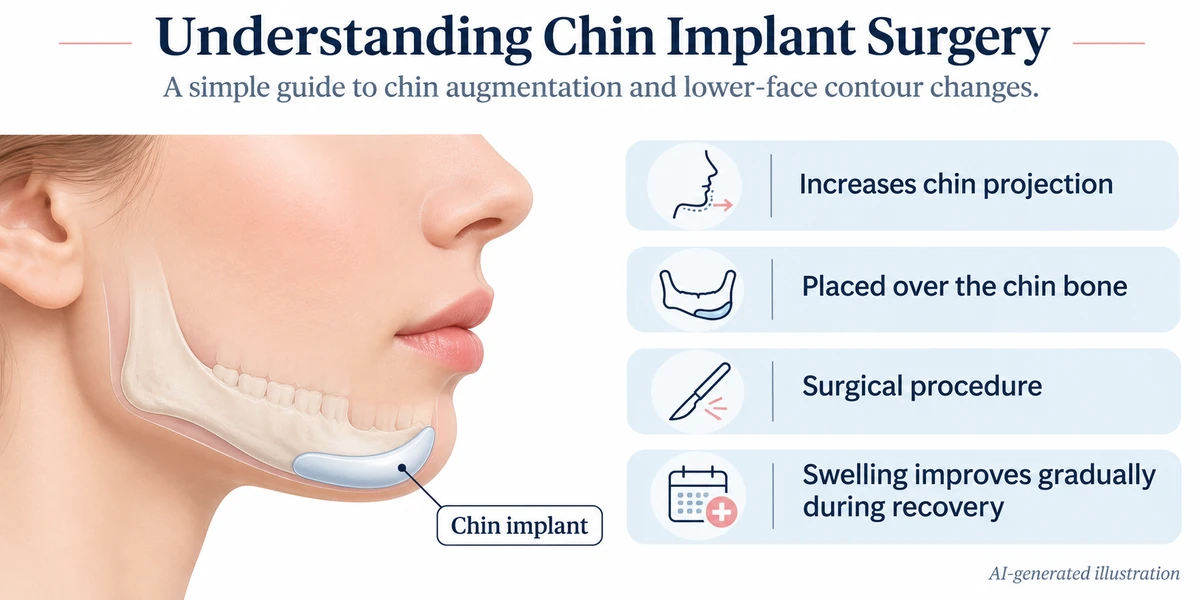
Chin implant surgery is a procedure that places an implant over the chin bone to increase chin projection or alter the contour of the lower face. It may be considered for selected individuals with a small or recessed chin, but it cannot correct every cause of a weak-looking jawline or an underlying bite problem.
A chin implant, also known as chin augmentation or alloplastic mentoplasty, changes the projection of the chin without repositioning the jawbone.
The procedure requires an individual assessment because facial appearance depends on the relationship between the chin, lower jaw, teeth, nose, lips and surrounding soft tissues.
Like other operations, chin implant surgery involves permanent anatomical changes and possible complications, including infection, altered sensation, implant displacement and changes to the underlying bone.
This guide explains weak chin anatomy, available treatment options, the chin implant procedure, recovery, risks and long-term considerations.
What Is a Chin Implant?
A chin implant is a medical implant designed to add projection or volume to the front of the chin.
Implants are commonly made from materials such as silicone. Other materials may be used depending on the surgical technique and clinical requirements.
The implant is positioned over the underlying chin bone through an incision inside the mouth or beneath the chin.
The choice of implant shape, size and material depends on individual anatomy.
A chin implant primarily changes local chin contours. It does not move the entire lower jaw or correct dental alignment.
What Is a Weak or Recessed Chin?
The term weak chin is commonly used to describe a chin that appears relatively small or positioned further back in the facial profile.
It is a descriptive appearance-related term rather than a diagnosis.
A recessed-looking chin may be associated with:
Naturally limited chin projection
Inherited facial proportions
A small or underdeveloped lower jaw
Differences in skeletal growth
Jaw alignment or bite abnormalities
Changes in surrounding facial tissues
The relative prominence of the nose or lips
Some people have a naturally smaller chin without any functional problem.
Not every small chin requires treatment.
Weak Chin vs Receding Jaw: What Is the Difference?
A small chin and a recessed lower jaw are not necessarily the same condition.
| Feature | Small or underprojected chin | Recessed lower jaw |
|---|---|---|
| Main anatomical concern | Local chin prominence | Position or development of the mandible |
| Dental bite | May be normal | May be affected |
| Appearance | Chin appears relatively small | Lower facial skeleton may appear retruded |
| Chin implant | May be considered in selected cases | Does not correct jaw position |
| Other treatment | Observation, filler or genioplasty | Orthodontic or maxillofacial assessment may be required |
This distinction matters because adding an implant can change appearance without correcting an underlying skeletal or functional problem.
How Is a Weak Chin Assessed?
A medical assessment may consider the position and proportions of several facial structures.
Chin Projection
The clinician evaluates how far the chin projects in relation to other facial features.
Lower Jaw Position
The mandible is assessed to determine whether the concern involves the chin alone or the overall jaw position.
Dental Bite
Dental alignment and bite relationships may be evaluated when a skeletal discrepancy is suspected.
Facial Symmetry
The assessment considers differences between the right and left sides of the face.
Soft-Tissue Characteristics
Skin thickness, fat distribution and muscular characteristics influence the visible chin contour.
Medical History
Previous surgery, facial trauma, dental procedures, medications and medical conditions may affect treatment planning.
Depending on the findings, imaging or specialist assessment may be appropriate.
What Treatment Options Are Available for a Weak Chin?
Treatment depends on the cause of the concern.
1. No Treatment or Observation
A naturally small chin is not inherently abnormal.
When there is no functional concern and the individual does not wish to change the appearance, no intervention is required.
2. Chin Implant Surgery
A chin implant adds projection to selected areas over the chin bone.
It may be considered when the underlying jaw and bite are otherwise appropriate.
3. Sliding Genioplasty
Sliding genioplasty is a bone-based procedure.
It involves surgically repositioning a portion of the chin bone, which may allow changes in projection or other dimensions depending on the surgical plan.
It has different risks from implant surgery.
4. Dermal Chin Fillers
Selected injectable fillers can add soft-tissue volume to the chin.
These do not reposition bone or correct a skeletal jaw discrepancy.
Fillers also carry medical risks, including rare but serious vascular complications.
5. Orthodontic or Jaw Surgery Assessment
When jaw position or dental bite is involved, orthodontic or orthognathic treatment may be relevant.
A cosmetic chin implant should not substitute for necessary evaluation of significant skeletal or functional abnormalities.
Chin Implant vs Chin Fillers vs Sliding Genioplasty
| Feature | Chin implant | Chin filler | Sliding genioplasty |
|---|---|---|---|
| Approach | Surgical implant placement | Injection of filler material | Surgical repositioning of chin bone |
| Main effect | Adds chin projection or contour | Adds selected soft-tissue volume | Changes bony chin position |
| Bone repositioning | No | No | Yes |
| Incision | Inside mouth or under chin | Usually no surgical incision | Surgical incision |
| Duration | Intended for long-term placement | Product-dependent, usually temporary | Permanent bony repositioning |
| Important risks | Infection, displacement, bone changes, nerve injury | Vascular occlusion, infection, nodules | Nerve injury, bone-healing problems, infection |
| Recovery | Surgical healing over weeks | Usually shorter initial recovery | Bone and soft-tissue healing |
| Possible future treatment | Implant removal or revision | Repeat treatment or complication management | Revision may sometimes be required |
No approach is automatically the best choice for every person.
For a more detailed treatment comparison, read Chin Implant vs Chin Filler: Which Is Better for Facial Balance?.
Who May Be Suitable for Chin Implant Surgery?
Chin implant surgery may be considered after an individual clinical assessment.
Relevant factors include:
A relatively small or underprojected chin
Appropriate chin and jaw anatomy
Skeletal maturity
General medical fitness
Realistic expectations
Understanding of permanent implant placement
Willingness to accept postoperative restrictions
Awareness of possible long-term complications
Smoking, nicotine exposure, uncontrolled medical conditions and previous procedures may influence surgical safety.
Suitability is not established by appearance alone.
When May a Chin Implant Not Be Appropriate?
An implant may be inappropriate or require further assessment when the main concern involves:
A significant recessed jaw
Abnormal dental bite
Jawbone deformity
Active infection
Poorly controlled medical conditions
Elevated wound-healing risks
Certain previous implant complications
Significant facial asymmetry needing another approach
Unrealistic expectations about surgery
The evaluation should also consider whether the proposed implant would adequately address the actual anatomical concern.
How Is Chin Implant Surgery Performed?
The exact procedure depends on the implant, surgical technique and individual anatomy.
Step 1: Medical Assessment
The surgeon reviews medical history, current medications, allergies and previous facial procedures.
The position of the chin, lower jaw and surrounding structures is assessed.
Step 2: Implant Planning
An implant of a particular size, shape and material is selected according to the intended anatomical change.
The largest available implant is not necessarily appropriate.
Step 3: Anaesthesia
Local anaesthesia, sedation or general anaesthesia may be used depending on the operation and clinical circumstances.
Step 4: Surgical Incision
An incision is made inside the lower mouth or beneath the chin.
Each location has different considerations for wound care, infection and scarring.
Step 5: Implant Placement
A pocket is created over the chin bone, and the implant is positioned according to the surgical plan.
Some techniques use fixation methods to help maintain implant position.
Step 6: Wound Closure
The incision is closed with appropriate sutures, and dressings may be applied.
Step 7: Postoperative Monitoring
The patient receives instructions covering wound care, medication, oral hygiene, dietary precautions and activity restrictions.
The exact surgical details should be discussed before informed consent.
Does Chin Implant Surgery Leave a Scar?
Yes. Every surgical incision creates a scar.
Incision Inside the Mouth
An incision inside the lower lip may avoid an external skin scar.
However, an intraoral incision still creates a scar and requires appropriate oral hygiene during healing.
Incision Beneath the Chin
An incision below the chin creates an external scar.
The scar may become less noticeable over time, but it does not disappear completely.
Scar appearance varies according to individual healing and the surgical method.
No technique guarantees scar-free surgery.
What Are the Possible Risks of Chin Implant Surgery?
Chin implant surgery carries recognised surgical and implant-specific risks.
Infection
An infection can develop around the incision or implant.
Certain infections may require implant removal.
Implant Displacement
An implant can shift or become misaligned.
This may alter chin symmetry or contour.
Nerve Injury and Altered Sensation
Injury or irritation involving nearby nerves may cause numbness, tingling or changes in sensation around the chin or lower lip.
Some changes may persist.
Bleeding or Hematoma
Bleeding or blood accumulation may occur after surgery.
Poor Wound Healing
The incision may heal slowly or partially separate.
Implant Exposure or Extrusion
The implant may become exposed through the overlying tissues in uncommon circumstances.
Bone Resorption
Pressure from an implant may be associated with changes or resorption of the underlying chin bone.
Persistent Pain or Discomfort
Some individuals experience ongoing pain or implant-related discomfort.
Scar-Related Problems
Abnormal scarring or tissue tightening can occur.
Asymmetry or Unwanted Contour
The final appearance may differ from the planned result.
Anaesthesia-Related Complications
Local anaesthesia, sedation and general anaesthesia all have potential risks.
Revision or Removal Surgery
Further surgery may be required for implant problems or other concerns.
Revision cannot guarantee complete correction.
Chin Implant Surgery Recovery Timeline
Recovery depends on the procedure, general health and individual healing.
| Recovery period | Common experiences | General precautions |
|---|---|---|
| First 24–72 hours | Swelling, tenderness, tightness and possible bruising | Rest and follow prescribed care instructions |
| Days 4–7 | Early discomfort may begin to improve | Protect the chin and follow wound-care advice |
| Weeks 1–2 | Swelling may gradually decrease; routine activities may become easier | Avoid pressure and restricted activities |
| Weeks 2–4 | Further reduction in bruising and swelling | Resume activities only as advised |
| Weeks 4–6 | Ongoing soft-tissue healing | Follow exercise and impact restrictions |
| Months 2–3 | Residual swelling and tissue firmness may continue changing | Attend recommended reviews |
| Following months | Further settling and scar maturation | Report persistent or new concerns |
These are general expectations, not guaranteed milestones.
Some individuals recover more quickly, while others require longer.
What Is Normal During Early Chin Implant Recovery?
Common temporary effects may include:
Swelling
Bruising
Tenderness
A sensation of tightness
Temporary numbness
Mild difficulty chewing
Discomfort during facial movement
Symptoms should generally show a trend towards improvement.
Progressively worsening pain, expanding swelling or other unusual symptoms require assessment.
What Can You Eat After Chin Implant Surgery?
Dietary instructions depend partly on incision location.
When an incision is made inside the mouth, a clinician may recommend liquids or soft foods during early healing.
Possible options include:
Yogurt or curd
Soft rice
Porridge
Mashed vegetables
Easy-to-chew foods
Soups at a comfortable temperature
The duration of restrictions should follow the treating surgeon’s instructions.
Avoid putting unnecessary pressure on the healing incision.
When Can You Return to Work and Exercise?
Return to ordinary activities depends on comfort and postoperative instructions.
Desk-based work may be possible earlier than physically demanding employment.
Heavy lifting, strenuous exercise and activities that could cause impact to the chin are commonly restricted during early healing.
The exact return-to-exercise schedule should be determined by the treating surgeon.
People whose work involves protective face equipment or potential facial injury may need additional precautions.
How Long Do Chin Implants Last?
Chin implants are generally intended for long-term placement.
However, long-term placement does not mean that every implant will remain complication-free for life.
Potential long-term issues include:
Implant displacement
Infection
Persistent discomfort
Changes in the underlying chin bone
Altered sensation
Changes in the surrounding facial tissues
The possible need for implant removal or revision
Natural ageing can also alter the appearance of the chin and jawline over time.
For additional information, read Chin Implant After 20 Years: Long-Term Safety and Revision Considerations.
Can a Chin Implant Improve the Jawline?
A chin implant may change the apparent definition of the front of the lower face by increasing chin projection.
However, it does not:
Correct an abnormal bite
Move the entire lower jaw forward
Remove fat beneath the chin
Reliably tighten loose neck skin
Correct every cause of facial asymmetry
Guarantee a sharply defined jawline
A comprehensive anatomical assessment helps identify which concerns an implant can reasonably address.
When Will Chin Implant Results Become Clearer?
The change in projection may be noticeable soon after surgery, but early swelling can affect the visible contour.
As healing progresses, tissue swelling may decrease and the shape of the chin may become easier to evaluate.
The final appearance can continue changing over several months.
A particular profile, perfect facial symmetry or a specific cosmetic result cannot be guaranteed.
Is Chin Implant Surgery Reversible?
The implant can sometimes be surgically removed.
However, removal should not be described as a completely reversible process.
Implant placement can cause scarring, changes in surrounding tissues or bone pressure effects.
Removing an implant may not restore the tissues to precisely their original condition.
Implant removal is another surgical procedure and involves additional risks.
Chin Implant Surgery: Safety and Recovery Checklist

Before and after treatment, consider the following:
Identify the anatomical concern: Distinguish a small chin from an underlying jaw-position problem.
Review medical suitability: Discuss existing conditions, medications, allergies and previous facial surgery.
Understand the implant material: Ask about the implant type, position and possible long-term effects.
Discuss alternatives: Consider observation, fillers, genioplasty or jaw assessment when appropriate.
Review possible complications: Include infection, nerve injury, displacement and bone resorption.
Understand permanent scars: Both external and intraoral incisions create scars.
Discuss anaesthesia: Understand the planned technique and potential risks.
Follow wound-care instructions: Protect the incision and use prescribed medication appropriately.
Maintain oral hygiene: Follow specific instructions if the incision is inside the mouth.
Avoid direct pressure: Protect the chin from accidental impact during healing.
Follow activity restrictions: Resume strenuous exercise only after medical clearance.
Attend follow-up visits: Allow assessment of healing and implant position.
Recognise warning signs: Report worsening pain, swelling, infection or unexpected numbness.
These measures may reduce avoidable problems but cannot eliminate all procedural risks.
Normal Recovery vs Warning Signs
| May occur during routine recovery | Requires medical assessment |
|---|---|
| Swelling that gradually improves | Rapidly increasing swelling |
| Mild or moderate tenderness | Severe or worsening pain |
| Temporary bruising | Persistent bleeding |
| Mild tightness around the chin | Increasing difficulty with mouth movement |
| Temporary altered sensation | New or worsening concerning numbness |
| Healing incision | Pus, fever, spreading redness or wound separation |
| Gradual changes in contour | New implant movement or marked asymmetry |
Emergency warning: Difficulty breathing or swallowing, uncontrolled bleeding or rapidly expanding facial swelling requires emergency medical care.
Questions to Ask Before Chin Implant Surgery
An informed consultation should address the cause of reduced chin projection, the choice of implant and the possibility that a different procedure may be more appropriate.
Important questions include:
Is my concern related to the chin alone or the position of the entire jaw?
Is my dental bite normal?
Why is an implant being considered instead of genioplasty or filler?
Which implant material and shape are proposed?
Where will the incision be placed?
What are the risks of nerve injury and bone changes?
What recovery restrictions will apply?
What would happen if the implant becomes infected or moves?
Can the implant require removal in the future?
What are the limitations of the expected result?
These discussions are part of informed decision-making and should occur without pressure to proceed.
Frequently Asked Questions
1. What is chin implant surgery?
Chin implant surgery is a procedure that places a medical implant over the chin bone to increase chin projection or change lower facial contours. It is also called chin augmentation.
2. Can a chin implant correct a weak or recessed chin?
A chin implant may increase projection in selected individuals with an underprojected chin. However, a recessed lower jaw or abnormal bite may require different treatment.
3. What is the difference between a chin implant and chin filler?
A chin implant is surgically placed over the chin bone for long-term augmentation. Chin fillers add injectable soft-tissue volume, with duration and risks depending on the product used.
4. How long does chin implant recovery take?
Initial swelling and discomfort may improve over several days or weeks. Residual swelling and changes in facial contour may continue for several months.
5. Is a chin implant permanent?
Chin implants are generally intended for long-term placement, but complications or changes in personal circumstances may require removal or revision. They are not guaranteed to remain problem-free for life.
6. What are the main risks of chin implant surgery?
Possible complications include infection, bleeding, scarring, altered sensation, nerve injury, implant displacement, bone resorption, asymmetry and the need for additional surgery.
7. Can a chin implant improve jawline definition?
A chin implant may change the appearance of the lower facial profile by increasing chin projection. However, it cannot correct all causes of a weak-looking jawline, including skeletal jaw abnormalities or excess neck fat.
Conclusion
Chin implant surgery is one option for addressing selected concerns involving limited chin projection.
The procedure can change the shape of the lower face, but it cannot correct every cause of a weak-looking chin or jawline.
The distinction between a small chin and a recessed lower jaw is particularly important when considering treatment.
Chin implants, fillers and sliding genioplasty have different anatomical effects, recovery requirements and possible complications.
Understanding individual suitability, implant-related risks, long-term changes, alternatives and postoperative precautions supports informed decision-making.
Disclaimer: All content and visuals on this website are for educational and informational purposes only. Images may be AI-generated or illustrative. Individual treatment results may vary. This information does not replace professional medical advice, diagnosis or consultation.