
Facial Plastic Surgery Consultation: 10 Essential Questions to Ask
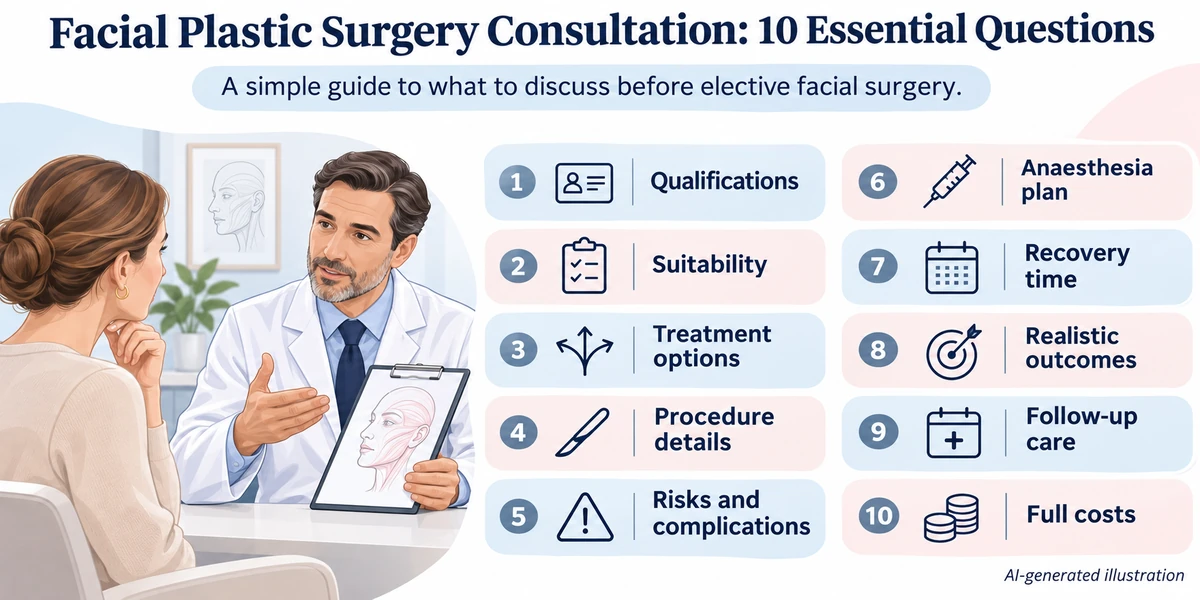
A facial plastic surgery consultation is an opportunity to understand the proposed procedure, assess medical suitability, verify the surgeon’s qualifications and discuss potential risks before making a decision. Patients should ask about alternatives, anaesthesia, recovery, permanent changes, complications and what happens if further treatment becomes necessary.
Facial plastic surgery includes procedures involving the nose, eyelids, ears, cheeks, chin and other facial structures. Some operations are performed for reconstructive or functional reasons, while others are elective cosmetic procedures.
Because the face contains important nerves, blood vessels, muscles and sensory structures, surgical decisions require careful consideration.
A consultation should provide balanced medical information, not pressure to undergo treatment.
This guide explains ten important questions to ask, how to prepare for the appointment and what to consider before giving informed consent.
Why Is a Facial Plastic Surgery Consultation Important?
An initial consultation helps identify whether a procedure is suitable for the individual’s anatomy, health and concerns.
The discussion may involve:
Medical history and existing conditions
Previous facial procedures or injuries
Facial structure and functional concerns
Possible surgical and non-surgical options
Risks and complications
Anaesthesia considerations
Recovery requirements
Permanent scars or anatomical changes
Limitations of treatment
Alternatives, including no intervention
A consultation does not automatically mean surgery is necessary or recommended.
Patients should have adequate time to understand their options and decide whether to proceed.
10 Essential Questions to Ask During a Facial Plastic Surgery Consultation
1. What Are Your Qualifications, Training and Experience?
The first question concerns the qualifications of the person who would perform the procedure.
Patients may ask:
Are you registered with the relevant medical regulatory authority?
What recognised specialty qualifications and training do you hold?
Have you received training relevant to this particular facial procedure?
How frequently do you perform this type of operation?
Who will be responsible for the surgery and postoperative care?
In India, patients can verify medical registration through the relevant official medical register or State Medical Council.
Professional titles and advertising descriptions should not be treated as substitutes for verifying qualifications.
Experience is one consideration, but the number of operations performed does not guarantee a particular result.
2. Am I Medically Suitable for This Procedure?
Not every individual is an appropriate candidate for elective facial surgery.
A surgeon should assess factors such as:
General health
Current medications
Existing medical conditions
Allergies
Previous operations
Smoking or nicotine use
Wound-healing risks
Functional concerns
Facial anatomy
Patients should also ask whether any medical investigations or additional specialist assessments are necessary.
If the possible risks outweigh the expected benefits, postponing or avoiding surgery may be appropriate.
3. What Are My Treatment Options, Including No Surgery?
Different procedures may address different anatomical concerns.
For example, limited chin projection, facial volume loss and loose skin are separate conditions that may require different approaches.
Patients should ask:
What is causing the concern?
Is surgery medically necessary or purely elective?
Are there non-surgical approaches?
What happens if I choose no treatment?
What are the limitations of each option?
Understanding alternatives prevents the assumption that a particular procedure is the only available solution.
For example, Chin Implant vs Chin Filler explains how surgical implants and injectable fillers differ in their anatomical effects, risks and recovery requirements.
4. What Does the Proposed Surgery Involve?
Patients should understand what the operation entails before providing consent.
Questions may include:
Where will the incision be placed?
Which tissues or structures will be altered?
Will any tissue be removed?
Will an implant or other material be used?
Are the changes permanent?
Will there be visible scars?
How long is the procedure expected to take?
The explanation should be understandable without requiring specialist medical knowledge.
When implants, grafts or other materials are proposed, patients should ask about their potential long-term complications and any need for future procedures.
5. What Are the Possible Risks and Complications?
All surgical procedures involve risks.
Depending on the operation, complications may include:
Bleeding or hematoma
Infection
Poor wound healing
Permanent scarring
Numbness or altered sensation
Nerve injury
Asymmetry
Functional impairment
Dissatisfaction with appearance
Anaesthesia-related complications
Blood clots
Possible revision surgery
Certain facial procedures involve additional specific risks.
For example, nasal surgery may affect breathing, eyelid procedures may affect eye comfort or closure, and facial contouring operations may involve nearby nerves or blood vessels.
Patients should ask which risks are particularly relevant to their anatomy and medical history.
No surgeon can guarantee that complications will not occur.
6. What Type of Anaesthesia Will Be Used?
The anaesthesia plan depends on the procedure and medical requirements.
Possible approaches include local anaesthesia, sedation or general anaesthesia.
Important questions include:
Which type of anaesthesia is planned?
Who will administer and monitor it?
What medical assessment is required beforehand?
What are the relevant anaesthesia risks?
Will observation or hospital admission be required?
When is it safe to eat or drink before surgery?
Patients should disclose medicines, allergies, previous anaesthesia problems and relevant medical conditions.
Anaesthesia instructions must be individualised.
7. What Recovery Time and Activity Restrictions Should I Expect?
Recovery varies considerably between facial procedures.
A minor intervention may involve limited downtime, while more extensive surgery can require longer healing and activity restrictions.
Patients should discuss:
Expected swelling and bruising
Pain-management instructions
Wound or dressing care
Time away from work
Restrictions on exercise and lifting
Sleeping position
Driving and travel
Need for assistance at home
Timing of follow-up visits
A clear recovery plan helps patients understand the practical consequences of treatment.
8. What Outcomes Are Realistic for My Facial Anatomy?
A consultation should explain what surgery can and cannot change.
Facial appearance depends on the relationship between skin, fat, muscles, bones and other tissues.
The same procedure can produce different effects in different individuals.
Patients should ask:
Which anatomical features can be changed?
Which features will remain unchanged?
How will ageing affect the long-term appearance?
Can asymmetry remain after treatment?
Are visible or internal scars expected?
When can the final result be reasonably assessed?
Digital simulations or illustrations, when used, are planning aids and not guarantees of actual outcomes.
Perfect facial symmetry or a particular cosmetic appearance cannot be promised.
9. What Happens if a Complication or Unexpected Result Occurs?
Surgery may require additional care even when appropriate precautions are followed.
Patients should understand:
Whom to contact after surgery
How urgent postoperative concerns are assessed
Whether emergency support is available
How complications are managed
When hospital treatment might be required
Whether further procedures may become necessary
Revision surgery is not automatically appropriate for every concern.
Further treatment carries additional risks and may not correct the problem completely.
10. What Are the Complete Costs and Follow-Up Requirements?
Informed decision-making includes understanding the financial and practical requirements of treatment.
Patients may ask for a written explanation of:
Professional and surgical fees
Anaesthesia charges
Facility or hospital fees
Investigations and medical tests
Prescribed medicines
Dressings or postoperative supplies
Follow-up appointments
Additional treatment if complications occur
Possible revision-related expenses
The purpose of discussing costs is financial clarity, not comparing procedures solely by price.
A lower quoted cost does not establish safety, suitability or effectiveness.
Facial Plastic Surgery Consultation: Questions at a Glance
| Topic | Essential question | Why it matters |
|---|---|---|
| Qualifications | What training and experience do you have? | Helps verify professional suitability |
| Medical fitness | Am I a suitable candidate? | Identifies personal risk factors |
| Alternatives | What options do I have? | Supports informed choice |
| Procedure | What will surgery involve? | Clarifies permanent anatomical changes |
| Complications | What are the possible risks? | Supports realistic risk assessment |
| Anaesthesia | What anaesthesia will be used? | Clarifies monitoring and safety |
| Recovery | How long will healing take? | Helps plan daily responsibilities |
| Outcomes | What changes are realistic? | Prevents unrealistic expectations |
| Complication management | What happens if something goes wrong? | Clarifies postoperative support |
| Costs and follow-up | What does the full treatment involve? | Helps avoid unexpected obligations |
How Should You Prepare for a Facial Plastic Surgery Consultation?
Preparing relevant information can make the discussion more useful.
Bring Your Medical History
Include important information about previous medical conditions, operations and anaesthesia experiences.
Prepare a Medication List
List prescription medicines, over-the-counter products and supplements.
Do not stop medicines without medical advice.
Mention Previous Facial Treatments
Previous surgery, implants, fillers, injections or facial injuries may affect assessment and surgical planning.
Describe Your Concerns Clearly
Explain which facial feature or functional concern prompted the consultation.
It can be useful to distinguish appearance-related concerns from symptoms such as difficulty breathing, impaired eyelid closure or pain.
Write Down Questions
A prepared list can help ensure important subjects are not overlooked.
Consider Bringing a Support Person
A trusted relative or companion may help with note-taking and recalling information, if the patient prefers.
The discussion and final decision should remain centred on the patient’s informed preferences.
What Should Happen During the Consultation?
An appropriate consultation generally includes medical assessment, explanation of treatment options and discussion of possible risks.
| Consultation stage | What may be discussed |
|---|---|
| Medical history | Conditions, allergies, medications and previous procedures |
| Clinical examination | Facial anatomy and functional findings |
| Treatment discussion | Surgical, non-surgical and no-treatment options |
| Risk assessment | General and procedure-specific complications |
| Recovery planning | Wound care, activities, follow-up and assistance |
| Informed consent | Benefits, limitations, uncertainties and alternatives |
| Decision-making | Time to consider the information or seek another opinion |
The exact sequence depends on the procedure and individual circumstances.
How Do Different Facial Procedures Affect Consultation Questions?
The general safety questions remain similar, but certain issues are procedure-specific.
Rhinoplasty
Discussion may include breathing, nasal support, asymmetry, internal or external scars and the possibility of revision.
Eyelid Surgery
Important considerations may include eye dryness, vision-related symptoms, lid closure, scarring and eye protection during recovery.
Chin Augmentation
Patients may ask about chin projection, skeletal structure, implants, fillers, sensation changes and long-term implant-related complications.
Buccal Fat Removal
Discussion should include permanent fat removal, the risk of excessive cheek hollowing and facial changes with ageing.
Facial Fat Grafting
Patients should understand donor-site risks, variable fat survival, the possibility of uneven volume and complications related to injection.
For a more detailed comparison, read Facial Fat Grafting vs Dermal Fillers.
Ear Reshaping
The consultation may address cartilage shape, surgical scars, recurrence, asymmetry and recovery precautions.
These are examples rather than a complete list of all facial procedures.
How Long Does Recovery Take After Facial Plastic Surgery?
There is no single recovery timeline that applies to all facial operations.
| Recovery consideration | What patients should ask |
|---|---|
| First 24–72 hours | What discomfort, swelling or monitoring is expected? |
| First 1–2 weeks | What daily activities may be restricted? |
| Following weeks | When can exercise and work activities resume? |
| Following months | How long may swelling or tissue firmness continue? |
| Longer term | How do scars, implants or other tissue changes evolve? |
These periods are discussion points, not predicted recovery milestones.
The treating surgeon should provide a procedure-specific plan.
How Can You Understand Surgical Risks Without Becoming Misled?
Risk information should be balanced, individualised and medically supported.
A consultation should explain both common temporary effects and uncommon serious complications.
For example, swelling and bruising may be expected after some operations, while infection, bleeding or nerve injury represent possible complications.
A surgeon may discuss how factors such as smoking, medical conditions, previous operations and surgical complexity influence individual risk.
Statements such as completely safe, no complications, scar-free surgery or guaranteed results should be approached cautiously.
Surgery can be performed with appropriate safety measures, but risk cannot be eliminated.
What Is Informed Consent in Facial Plastic Surgery?
Informed consent is more than signing a form.
It involves understanding the proposed procedure and voluntarily deciding whether to proceed after receiving sufficient information.
An informed discussion generally includes:
The purpose of treatment
Reasonable alternatives
Expected benefits and their limitations
Important risks and complications
Anaesthesia considerations
Recovery requirements
Potential need for further treatment
The option to decline surgery
Patients should be able to ask questions and consider the information without inappropriate pressure.
Consent discussions should be documented according to applicable professional and legal requirements.
Should You Seek a Second Opinion?
A second opinion may be useful when:
The proposed operation is extensive or irreversible
More than one surgical approach is possible
Risks and alternatives remain unclear
There are concerns about qualifications or experience
The expected benefit appears uncertain
The individual is uncomfortable making an immediate decision
Seeking another medical opinion is a legitimate part of informed decision-making.
A second opinion may confirm the original plan, suggest another approach or support choosing no surgery.
Facial Plastic Surgery Consultation Safety Checklist

Before deciding on an elective facial procedure, consider the following:
Verify professional qualifications: Check recognised registration and relevant specialty training.
Discuss medical suitability: Review health conditions, allergies and previous procedures.
Understand the diagnosis or anatomical concern: Ask what is actually causing the issue.
Review alternatives: Include non-surgical management and no treatment.
Understand the procedure: Ask about incision placement, tissue changes and implants.
Discuss complications: Include procedure-specific risks and possible long-term effects.
Review anaesthesia: Clarify monitoring, preparation and recovery requirements.
Understand scarring: Ask which permanent scars may remain.
Plan recovery: Discuss work, exercise, wound care and assistance at home.
Clarify emergency support: Know whom to contact for unexpected symptoms.
Review follow-up requirements: Understand the need for postoperative assessments.
Allow time for a decision: Avoid proceeding because of pressure or unrealistic promises.
This checklist supports informed decision-making but does not replace individual medical advice.
When Should You Delay or Reconsider Facial Plastic Surgery?
Postponement or further assessment may be appropriate when:
A medical condition is not adequately controlled
The cause of the concern remains uncertain
Active infection or inflammation is present
Important risks have not been explained
There is uncertainty about professional qualifications
Recovery support is insufficient
Expectations are unrealistic
The person feels pressured to decide immediately
Elective surgery is not always necessary, and choosing not to undergo treatment is a valid decision.
Frequently Asked Questions
1. What should I ask during a facial plastic surgery consultation?
Ask about the surgeon's qualifications, your medical suitability, available alternatives, surgical technique, possible complications, anaesthesia, recovery, expected outcomes and postoperative care.
2. How can I verify a facial plastic surgeon's qualifications?
Check medical registration with the applicable regulatory authority and ask about recognised specialty qualifications, relevant training and experience with the specific procedure.
3. Is facial plastic surgery always necessary?
No. Many facial concerns are natural anatomical variations and do not require treatment. Depending on the concern, non-surgical options or observation may be appropriate.
4. What should I bring to my first consultation?
Bring relevant medical records, a list of medications and allergies, information about previous facial procedures and a written list of questions. A trusted support person may accompany you if preferred.
5. What risks should be discussed before facial plastic surgery?
The discussion should cover bleeding, infection, scarring, anaesthesia complications, altered sensation, nerve injury, asymmetry, functional changes and procedure-specific risks.
6. How long does recovery take after facial plastic surgery?
Recovery depends on the operation, general health and individual healing. Some procedures require limited downtime, while others involve several weeks of restrictions and longer-term swelling or scar maturation.
7. Can I seek a second opinion before facial plastic surgery?
Yes. A second opinion may be useful when the proposed treatment is irreversible, risks are unclear, several options are available or you want additional information before deciding.
Conclusion
A facial plastic surgery consultation should help patients understand their medical suitability, treatment options, possible complications and recovery requirements.
Verifying professional qualifications, discussing realistic outcomes and understanding what happens if complications occur are important steps in informed decision-making.
No operation guarantees a specific appearance, and elective facial surgery is not appropriate for everyone.
Taking sufficient time to consider the available information, ask questions and seek another opinion when necessary supports a more informed decision.
Disclaimer: All content and visuals on this website are for educational and informational purposes only. Images may be AI-generated or illustrative. Individual treatment results may vary. This information does not replace professional medical advice, diagnosis or consultation.