
Hair Transplant After 5 Years
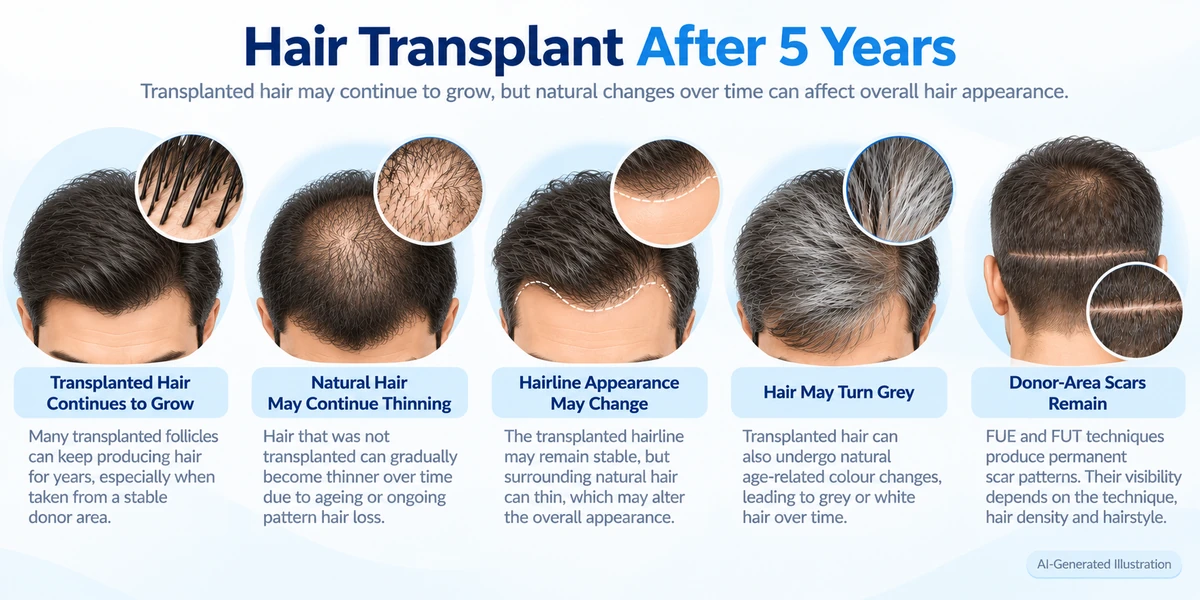
What Happens 5 Years After a Hair Transplant?
Five years after transplantation, the appearance of the scalp is influenced by the health of the transplanted follicles and the natural hair surrounding them.
1. Transplanted Hair May Continue Growing
Many transplanted follicles retain characteristics of their original donor region.
When harvested from relatively stable areas, these follicles may continue producing hair for years.
However, their continued growth is not guaranteed for every individual.
2. Natural Hair May Continue Thinning
Hair transplantation does not stop the progression of androgenetic alopecia.
Hair that remains in its original location may gradually become finer or stop producing visible hair.
This can change the density around transplanted follicles.
3. Hair Density May Look Different
Some individuals maintain an appearance similar to their established postoperative result.
Others notice greater scalp visibility because of progressive thinning of untreated hair.
Changes in hair shaft thickness, styling and scalp conditions may also influence perceived density.
4. The Hairline May Change in Appearance
The transplanted frontal hairline may remain relatively stable while natural hair behind it continues thinning.
This can create visible gaps or an uneven distribution of hair.
5. Hair Colour and Texture May Change
Transplanted hair can undergo normal ageing-related changes, including greying and changes in shaft thickness.
Not everyone experiences these changes at the same rate.
6. Donor-Area Scars Remain
FUE and FUT create permanent surgical scars.
Their visibility depends on the technique, extraction pattern, original hair density and hairstyle.
Does a Hair Transplant Last 5 Years?
A hair transplant can continue producing hair after five years, particularly when transplanted follicles originate from donor areas relatively resistant to androgenetic alopecia.
This relative resistance is sometimes explained through the principle of donor dominance.
The transplanted follicles may retain biological characteristics associated with their original location.
However, donor dominance does not mean that transplanted follicles are immune to all causes of hair loss.
Long-term growth may be affected by ageing, scalp disease, inflammatory conditions, scarring or changes in the donor region.
The American Academy of Dermatology’s guidance on hair transplantation explains that hair loss may continue after surgery and that suitable medical treatment can sometimes help manage further thinning.
Therefore, five-year results should be evaluated according to individual follicle health and overall hair-loss progression.
Is Transplanted Hair Permanent?
Transplanted hair is often described as long-lasting because donor follicles may be relatively resistant to the effects of dihydrotestosterone, or DHT, involved in androgenetic alopecia.
However, the term permanent should not be understood as a guarantee that every graft will continue producing hair throughout life.
Several factors can influence long-term follicle function.
Donor Hair Characteristics
Hair obtained from relatively stable donor regions may provide lasting growth.
However, donor density and follicle characteristics vary between individuals.
Ageing
Hair shaft diameter, pigment production and growth-cycle characteristics may change with age.
Medical Conditions
Thyroid disorders, nutritional deficiencies and certain systemic illnesses can contribute to hair loss.
Scalp Disorders
Inflammatory or scarring scalp conditions can damage follicles.
Progressive Pattern Hair Loss
The main long-term concern may be continued loss of hair surrounding the transplant rather than loss of the transplanted follicles themselves.
For an explanation of how these changes may progress over a longer period, read hair transplant results after 15 years.
Why Does Hair Become Thin 5 Years After a Transplant?
Hair thinning several years after transplantation can have multiple causes.
Continued Androgenetic Alopecia
Pattern hair loss may progress after the original surgery.
Non-transplanted follicles may gradually undergo miniaturisation, producing thinner and shorter hair shafts.
Age-Related Changes
Hair calibre and the proportion of actively growing follicles may change with age.
Donor-Area Thinning
Although the donor region is usually selected for its relative stability, some individuals experience thinning in these areas.
Telogen Effluvium
Physical illness, certain medicines, nutritional problems and other triggers may cause increased shedding.
Telogen effluvium may affect transplanted and non-transplanted hair.
Alopecia Areata
Alopecia areata is an immune-mediated condition that can cause patchy hair loss.
It may develop independently of a previous transplant.
Scarring Alopecia
Certain inflammatory scalp diseases can permanently damage follicles.
Symptoms such as persistent redness, burning, pain or scalp scarring warrant assessment.
Hair Shaft Damage
Excessive heat, chemical processing or repeated traction can damage hair shafts and affect their appearance.
A clinical examination can help determine whether thinning is caused by normal ageing, continued pattern hair loss or another condition.
Transplanted Hair vs. Natural Hair After 5 Years
The distinction between transplanted and non-transplanted hair is essential when evaluating long-term results.
| Feature | Transplanted hair | Non-transplanted natural hair |
|---|---|---|
| Origin | Relocated from a donor region | Remains in its original scalp location |
| Pattern hair-loss resistance | Often relatively greater if taken from a stable donor region | Depends on individual follicle sensitivity |
| Long-term growth | May continue for many years | May remain stable or progressively thin |
| Age-related changes | Possible | Possible |
| Greying | Possible | Possible |
| Effect of scalp disorders | Can be affected | Can be affected |
| Permanent density guarantee | No | No |
A person may retain transplanted frontal hair while the untreated crown or mid-scalp becomes thinner.
This does not necessarily mean that the transplanted grafts have failed.
Suggested image placement — Image 1: Hair Transplant After 5 Years: Transplanted Hair vs. Natural Hair Thinning.
Can Transplanted Hair Fall Out After 5 Years?


Yes. However, the meaning of hair shedding depends on the underlying cause.
Healthy follicles naturally cycle through periods of growth, transition, rest and shedding.
A shed hair shaft does not necessarily indicate permanent follicle loss.
Normal Hair Cycling
Anagen is the active growth phase.
Catagen is a transitional phase.
Telogen is the resting phase.
Exogen is the phase during which a hair shaft is released.
A functioning follicle may produce another hair after the previous shaft sheds.
Progressive Miniaturisation
Some follicles may gradually produce finer hairs because of androgenetic alopecia or other factors.
New Medical Conditions
Sudden or patchy loss may reflect a condition unrelated to the original surgery.
Therefore, noticeable changes five years after transplantation should not automatically be attributed to graft failure.
Is It Normal to Lose Natural Hair After a Transplant?
Yes. Continued hair loss in untreated regions can occur because transplantation does not change the genetic or hormonal factors responsible for androgenetic alopecia.
For example, a person may receive transplanted grafts in the frontal scalp while existing hair in the mid-scalp continues thinning.
Over time, the transplanted region may appear denser than the surrounding area.
Some individuals experience slow progression, while others develop more noticeable thinning.
Medical treatment may be considered when appropriate, but not everyone requires the same approach.
What Happens to the Hairline After 5 Years?
A transplanted hairline may maintain much of its established position, although surrounding changes can affect its appearance.
Frontal Hairline Stability
Follicles transplanted from a relatively resistant donor area may continue growing.
Temple Recession
Untreated temple hair can continue thinning.
Mid-Scalp Thinning
Reduced density behind the frontal hairline can create visible gaps.
Changes in Hair Direction
The direction and distribution of transplanted follicles are determined partly by surgical placement.
Any irregularity in the original design may become more noticeable if surrounding hair thins.
Natural Asymmetry
Minor differences between the two sides of the hairline can occur.
Not every visible change requires further surgical treatment.
Can the Crown Become Thin After 5 Years?
Yes.
The crown, or vertex, is a common region affected by androgenetic alopecia.
Hair loss may continue in this area even when transplanted frontal hair remains stable.
In some individuals, the crown was not treated during the original procedure.
Others may have received crown grafts but experience further thinning in the surrounding natural hair.
A clinical assessment can help determine whether further management is appropriate.
Are Hair Transplant Side Effects Still Present After 5 Years?
Most immediate postoperative symptoms occur during early healing rather than five years later.
Temporary swelling, bruising, tenderness and scabbing generally resolve much earlier.
However, some long-term findings can remain.
Donor-Area Scarring
FUE and FUT create different permanent scar patterns.
Their visibility depends on the original procedure and surrounding hair density.
Altered Scalp Sensation
Some individuals experience persistent numbness or changes in sensation.
Uneven Hair Distribution
Differences in graft density, placement or direction may remain visible.
Donor-Area Thinning
Extraction patterns can become more apparent when donor hair becomes thinner.
Scar-Related Hair Loss
Follicles may not grow normally within areas of significant scar tissue.
Persistent Contour Changes
Certain irregularities at extraction or implantation sites may remain.
However, new redness, pustules, pain or patchy hair loss after five years should not automatically be regarded as a routine surgical side effect.
Such findings may require assessment for a separate scalp condition.
What Are the Long-Term Risks of Hair Transplantation?
Long-term considerations depend on the original surgical technique, donor management and individual healing.
Visible Scars
All hair transplantation techniques produce some degree of scarring.
Donor-Area Depletion
Excessive extraction may reduce donor density and limit future transplantation options.
Uneven Hairline Appearance
A hairline may appear less balanced if untreated hair loss continues.
Persistent Sensory Changes
Altered sensation may occasionally remain.
Reduced Hair Coverage
Some grafts may not survive, and additional natural hair loss may reduce overall density.
Further Surgery
Additional procedures may be considered for selected individuals, but they carry further risks.
For authoritative patient information on surgical complications, read the NHS guidance on hair transplants.
The NHS describes potential complications including infection, bleeding, scarring and failure of some transplanted grafts to survive.
How Is Hair Thinning Evaluated 5 Years After a Transplant?
Assessment may include a medical history, scalp examination and selected investigations.
Review of Previous Surgery
Relevant details may include the original procedure, donor location, approximate graft distribution and known complications.
Hair-Loss History
The clinician may ask when thinning began, whether it progressed gradually or suddenly and whether other symptoms are present.
Scalp Examination
The hairline, crown, mid-scalp and donor region may be assessed for changes in density and scalp condition.
Trichoscopy
Trichoscopy uses magnification to examine hair shafts and the scalp.
It may help identify follicular miniaturisation, variation in shaft thickness and signs of inflammation.
Laboratory Investigations
Blood tests may be considered if thyroid disease, nutritional deficiency or another medical condition is suspected.
Scalp Biopsy
A biopsy may be considered in selected cases where inflammatory or scarring hair loss is suspected.
Not every person requires all these investigations.
The appropriate evaluation depends on clinical findings.
Can Medicines Help Maintain Hair Transplant Results?
Medical treatment may be useful when ongoing androgenetic alopecia is present.
However, medication should be based on diagnosis and individual suitability.
Minoxidil
Minoxidil is used for certain forms of pattern hair loss.
It may help maintain or improve hair growth in suitable individuals.
Potential adverse effects include scalp irritation and unwanted hair growth.
Oral minoxidil may also have systemic adverse effects and requires appropriate medical supervision when prescribed.
Finasteride
Finasteride reduces the conversion of testosterone to dihydrotestosterone.
It may slow the progression of male pattern hair loss in selected individuals.
Possible adverse effects include sexual and mood-related symptoms.
Medication suitability and precautions should be discussed with a qualified clinician.
Other Treatments
Additional treatment may be considered for selected conditions, but not every type of hair thinning responds to the same medicine.
Corticosteroids, for example, are not a routine substitute for evidence-based androgenetic alopecia treatment. They are used for particular inflammatory or immune-mediated disorders when clinically indicated.
Antibiotics should be used for an appropriate diagnosed or suspected bacterial infection, not automatically for hair thinning.
For a related discussion of medical and nonsurgical approaches, see treatment options for male hair loss at age 25.
Can PRP Improve Hair Density After 5 Years?
Platelet-rich plasma, or PRP, is sometimes considered for selected forms of hair loss.
The procedure involves preparing a platelet-enriched sample from a person’s blood and administering it to the treatment area.
Some studies suggest potential benefits for certain forms of pattern hair loss.
However, the quality of evidence and treatment protocols vary.
PRP cannot reliably recreate follicles that are permanently lost, and it does not guarantee preservation of transplanted grafts.
Treatment decisions should reflect the actual diagnosis and available evidence.
How Can Someone Care for Their Hair 5 Years After a Transplant?
By five years, the transplanted grafts are no longer in the immediate surgical healing phase.
Long-term care therefore focuses on general scalp health and management of any continuing hair loss.
Long-Term Hair Care Checklist
-
Use gentle shampoo and hair-care products: Choose products appropriate for the scalp and hair type.
-
Avoid repeated traction: Tight hairstyles and frequent pulling may contribute to hair damage.
-
Limit excessive heat exposure: High-temperature styling can damage hair shafts.
-
Manage scalp conditions: Persistent dandruff, itching or inflammation may require treatment.
-
Maintain adequate nutrition: A balanced diet supports normal hair function.
-
Avoid unnecessary supplements: Correct confirmed deficiencies rather than relying on unverified hair-growth products.
-
Protect exposed scalp skin: Use suitable sun protection where hair coverage is limited.
-
Avoid smoking: Smoking has adverse effects on general vascular and tissue health.
-
Review unusual hair loss: New or rapidly worsening thinning warrants assessment.
-
Use prescribed treatment appropriately: Do not independently stop or alter medical treatment.
These measures may support healthy scalp and hair care but cannot guarantee that hereditary hair loss will stop.
