
Treatment Options for Male Hair Loss at Age 25
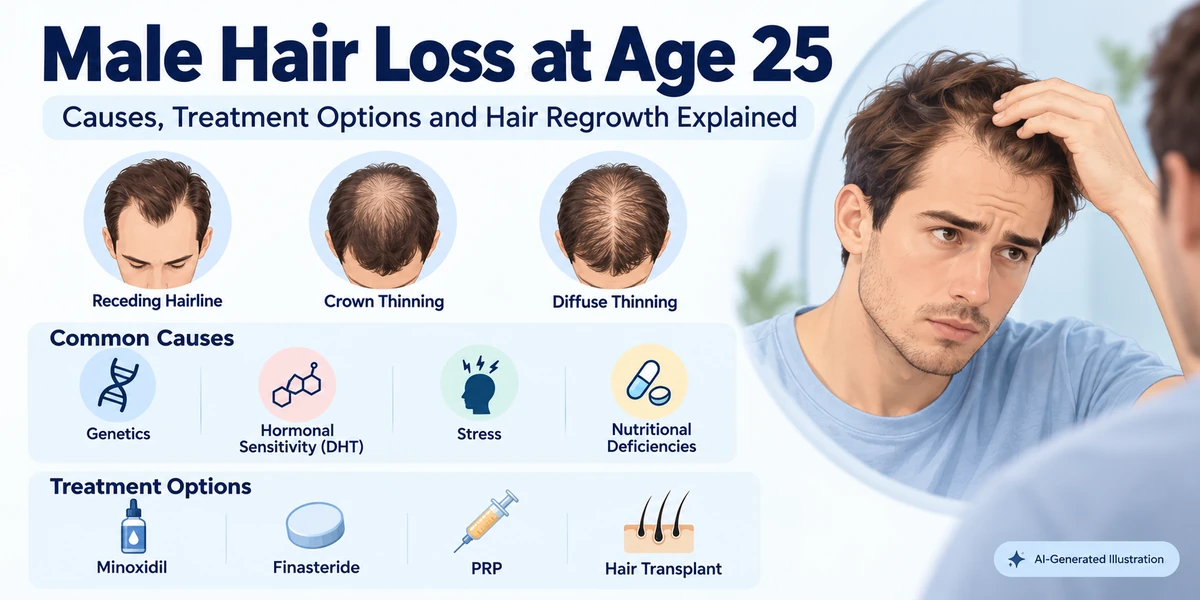

Hair loss at the age of 25 can be concerning, especially when changes such as a receding hairline, thinning crown or excessive hair shedding become noticeable. Although hair loss is often associated with older age, it can begin during adolescence or early adulthood. According to the American Academy of Dermatology, male pattern hair loss can begin as early as the late teenage years or early twenties.
Male hair loss at age 25 may result from genetic factors, hormonal sensitivity, nutritional deficiencies, certain medical conditions or physical and emotional stress. Some types of hair loss are temporary, while others may gradually progress over time. Understanding the common causes of hair fall in men can help explain why early hair thinning occurs.
Understanding the cause of hair loss is important because different conditions require different approaches. Treatments such as topical minoxidil, prescription medicines, platelet-rich plasma therapy and hair transplantation may be considered depending on the diagnosis. The American Academy of Dermatology’s guide to hair loss diagnosis and treatment explains why identifying the underlying cause is important before choosing treatment.
This article explains the causes of early male hair loss, available treatment options, their benefits and limitations, and important factors to consider when managing hair thinning.
Is Hair Loss at Age 25 Normal?
Hair loss during the twenties is not unusual. Some men develop male pattern hair loss during their late teens or early adulthood.
Hair follicles naturally go through a continuous cycle of growth, transition, rest and shedding. Losing approximately 50–100 hairs per day is commonly considered within the normal range, although individual shedding varies.
However, certain changes may indicate a hair-loss condition:
Gradual recession of the frontal hairline
Thinning around the temples
Reduced hair density at the crown
Increased visibility of the scalp
Persistent or unusually heavy shedding
Development of patchy areas without hair
The most common cause of progressive hair thinning in men is androgenetic alopecia, also known as male pattern hair loss.
While hereditary hair loss may begin at 25, not every change in hair density indicates permanent baldness.
What Causes Male Hair Loss at Age 25?

Several factors can affect the hair-growth cycle and follicular function.
1. Genetics and Hereditary Hair Loss
Genetics plays a major role in male pattern hair loss.
Androgenetic alopecia occurs when genetically susceptible hair follicles gradually become smaller through a process known as follicular miniaturisation.
Over time, affected follicles produce shorter, finer hairs, reducing overall hair density.
Hereditary hair loss can be influenced by genes inherited from both sides of the family.
2. Hormonal Sensitivity and DHT
Dihydrotestosterone (DHT) is a hormone produced from testosterone.
In individuals with genetic susceptibility, DHT contributes to the gradual miniaturisation of certain scalp follicles.
This process can shorten the growth phase of hair and result in progressive thinning.
Importantly, men with androgenetic alopecia do not necessarily have abnormally high testosterone levels.
The sensitivity of hair follicles to DHT plays an important role.
3. Nutritional Deficiencies
Hair follicles require adequate nutrients to maintain normal growth.
Deficiencies in iron, zinc, protein or other essential nutrients may contribute to hair shedding.
Rapid weight loss, restrictive diets and inadequate calorie intake may also disrupt the hair-growth cycle.
However, nutritional supplements are not proven to reverse hereditary male pattern baldness in individuals without a deficiency.
4. Physical and Emotional Stress
Significant physical or emotional stress may trigger a condition known as telogen effluvium.
This occurs when an increased number of hair follicles enter the resting phase.
Hair shedding may become noticeable two to three months after an illness, major surgery, significant weight change or another triggering event.
In many cases, hair growth improves after the underlying cause resolves.
5. Medical Conditions
Several medical conditions can contribute to hair loss, including:
Thyroid disorders
Alopecia areata
Scalp fungal infections
Inflammatory scalp conditions
Nutritional deficiencies
Certain chronic illnesses
These conditions may produce different patterns of hair loss and require appropriate medical evaluation.
6. Medication-Related Hair Loss
Some medications may contribute to hair shedding as a side effect.
Examples include certain medicines used for cancer treatment and some other medical conditions.
The possibility of medication-related hair loss depends on the specific drug, dose and individual response.
Prescribed medicines should not be discontinued without medical advice.
7. Hair Styling and Traction
Repeated tension from tightly pulled hairstyles may cause traction alopecia.
Frequent chemical treatments, harsh brushing and excessive heat styling can also damage hair shafts and increase breakage.
Hair breakage and follicular hair loss are different problems, although both may make hair appear thinner.
What Are the Early Signs of Male Pattern Baldness?
Male pattern hair loss usually develops gradually.
Receding Hairline
The hairline may move backwards, particularly around the temples.
This can create an increasingly pronounced M-shaped appearance.
Crown Thinning
Hair density may decrease at the crown, sometimes becoming noticeable under bright lighting.
Hair Miniaturisation
Individual hair strands become finer and shorter as follicles gradually miniaturise.
Increased Scalp Visibility
The scalp may become more visible when the hair is wet or under direct light.
Progressive Hair Thinning
Unlike temporary shedding, androgenetic alopecia usually progresses over months or years.
These signs are not sufficient for diagnosis on their own. Other conditions can produce similar changes.
How Is Hair Loss Diagnosed at Age 25?
The first step in understanding hair loss is identifying its underlying cause.
A healthcare professional may review:
Family history of hair loss
Age when thinning began
Pattern and rate of hair loss
Recent illness or significant stress
Nutritional habits
Medications and supplements
Scalp itching, redness or scaling
Hair and scalp examination findings
A dermoscopic scalp examination, also called trichoscopy, may help identify follicular miniaturisation and other relevant changes.
Blood investigations may be recommended when the history or examination suggests a nutritional deficiency, thyroid disorder or another medical condition.
Not every person with typical male pattern hair loss requires blood testing.
What Are the Treatment Options for Male Hair Loss at Age 25?
The treatment approach depends on the diagnosis, severity, medical history and individual preferences.
For male pattern hair loss, several established and emerging treatments are available.
1. Topical Minoxidil
Minoxidil is a commonly used topical treatment for androgenetic alopecia.
It is available in solutions and foam formulations that are applied to the scalp.
Minoxidil can help prolong the hair-growth phase and may improve hair density in some individuals.
Potential benefits
May slow ongoing hair thinning
May improve the thickness of existing hair
May stimulate regrowth in some follicles
Can be used as a nonsurgical treatment
Limitations and possible side effects
Results vary, and not everyone experiences significant regrowth.
Visible improvement may require several months of consistent use.
Possible adverse effects include scalp irritation, itching, dryness and unwanted hair growth.
Some individuals experience temporary increased shedding when treatment begins.
Continued use is usually necessary to maintain its benefits.
2. Oral Finasteride
Finasteride is a prescription medication used to manage male pattern hair loss.
It works by inhibiting the enzyme 5-alpha-reductase, reducing the conversion of testosterone into DHT.
By lowering DHT levels, finasteride may slow follicular miniaturisation.
Potential benefits
May reduce the progression of hereditary hair loss
May help preserve existing hair density
May promote some hair regrowth
Possible risks and limitations
Finasteride can cause adverse effects, including:
Reduced sexual desire
Erectile dysfunction
Ejaculatory problems
Breast tenderness or enlargement
Mood changes or depression
Sexual side effects that persist after discontinuation have been reported. Depression and suicidal thoughts are important safety concerns.
Anyone considering finasteride should discuss its benefits and risks with a qualified prescriber. If depression or suicidal thoughts develop while taking finasteride for hair loss, the medicine should be stopped and prompt medical advice sought; suicidal thoughts require urgent assistance.
Treatment response typically takes several months, and ongoing use is generally required to maintain benefits.
3. Platelet-Rich Plasma (PRP) Therapy
Platelet-rich plasma therapy involves collecting a blood sample and processing it to concentrate platelets.
The platelet-rich preparation is then injected into selected areas of the scalp.
Platelets contain growth factors involved in biological repair and signalling processes.
Some studies suggest PRP may improve hair density or thickness in individuals with androgenetic alopecia.
However, evidence remains variable because treatment methods and schedules differ between studies.
Possible adverse effects include temporary pain, swelling, bruising and infection.
PRP should not be presented as a guaranteed method of hair regrowth.
4. Low-Level Laser Therapy
Low-level laser therapy uses specialised light-emitting devices directed at the scalp.
Some studies suggest that certain devices may improve hair density in people with androgenetic alopecia.
Potential advantages include the non-invasive nature of treatment.
However, outcomes vary between individuals and devices, and several months of use may be required to assess a response.
It is important to distinguish regulatory clearance of a device from proof that it will be effective for every person.
5. Hair Transplant Surgery
Hair transplantation is a surgical procedure that relocates hair follicles from a donor region to areas affected by hair loss.
The donor region is commonly located at the back or sides of the scalp, where follicles may be less susceptible to androgen-related miniaturisation.
Two commonly used techniques are:
Follicular Unit Extraction (FUE)
Individual follicular units are extracted using small punches and transplanted into the recipient area.
Follicular Unit Transplantation (FUT)
A strip of hair-bearing scalp is removed, and follicular units are separated for transplantation.
Both procedures have their own advantages, limitations and potential complications.
Is Hair Transplantation Suitable at Age 25?
Hair transplantation may be considered in selected individuals, but age alone does not determine suitability.
Hereditary hair loss may continue to progress during the twenties.
Therefore, important considerations include:
Stability of the hair-loss pattern
Availability of suitable donor follicles
Extent of existing hair thinning
Likelihood of future hair loss
Long-term hairline planning
Realistic expectations about density
Potential need for ongoing medical treatment
Transplanted follicles may continue producing hair, while surrounding non-transplanted follicles may still undergo progressive thinning.
Possible complications include infection, scarring, bleeding, poor graft survival and uneven cosmetic appearance.
Hair transplantation does not prevent future hereditary hair loss.
6. Other Prescription Treatments
Other medical approaches, such as oral minoxidil and dutasteride, may be considered in selected cases.
Their use for hair loss may be off-label depending on the country and applicable regulatory approvals.
Oral minoxidil may cause excessive hair growth, fluid retention, changes in blood pressure and cardiovascular side effects.
Dutasteride reduces DHT but may cause sexual and other adverse effects.
Such medicines require an individual risk assessment and appropriate medical supervision.
Comparison of Male Hair Loss Treatments
| Treatment | Main purpose | Important limitation |
|---|---|---|
| Topical minoxidil | Support hair growth and density | Ongoing use is usually needed |
| Finasteride | Reduce DHT-related hair thinning | Prescription medicine with possible adverse effects |
| PRP therapy | Potentially support hair density | Variable evidence and treatment protocols |
| Low-level laser therapy | Potentially support follicular activity | Results vary; device-specific evidence |
| Hair transplantation | Redistribute existing follicles | Does not prevent future hair loss |
| Nutritional treatment | Correct confirmed deficiencies | Does not reverse hereditary baldness |
Can Male Hair Loss at 25 Be Reversed?
Whether hair loss can be reversed depends on its underlying cause.
Hereditary Male Pattern Hair Loss
Androgenetic alopecia generally progresses over time.
Treatments may help slow progression and improve density, particularly when affected follicles remain capable of producing hair.
However, full restoration of original hair density cannot be guaranteed.
Stress-Related Hair Loss
Telogen effluvium may improve after the triggering event has resolved.
Hair growth often recovers gradually over several months.
Nutritional Hair Loss
Hair growth may improve when a relevant deficiency is diagnosed and corrected.
Alopecia Areata
Some people experience spontaneous regrowth, while others require medical treatment.
The course of alopecia areata is unpredictable, and recurrence is possible.
Can Hair Loss at Age 25 Be Managed Naturally?
Healthy lifestyle habits support general hair and scalp health.
However, lifestyle changes alone do not reliably stop genetically determined male pattern baldness.
Maintain Balanced Nutrition
Include adequate protein, iron, zinc and other essential nutrients through a varied diet.
Avoid taking high-dose supplements without a confirmed need, since excess amounts of some nutrients can also be harmful.
Avoid Tight Hairstyles
Reduce repeated tension on the hair follicles.
Use Gentle Hair-Care Practices
Avoid unnecessary heat exposure, aggressive brushing and frequent harsh chemical treatments.
Manage Significant Stress
Stress management and adequate sleep contribute to overall health and may be helpful when stress-related shedding is present.
Treat Underlying Conditions
Thyroid disorders, nutritional deficiencies and inflammatory scalp diseases should be appropriately assessed and managed.
Do Home Remedies Help With Male Hair Loss?
Home remedies such as coconut oil, rosemary oil, onion juice and aloe vera are frequently promoted for hair regrowth.
However, there is insufficient high-quality clinical evidence to recommend them as reliable treatments for hereditary male pattern baldness.
Some oils may help condition hair and reduce breakage, but this does not necessarily indicate improved follicular growth.
Natural products can also cause irritation or allergic reactions.
Individuals experiencing progressive thinning should not delay medical evaluation in favour of unverified treatments.
How Long Does Hair Loss Treatment Take to Show Results?
Hair growth occurs gradually, so visible improvement generally takes time.
| Treatment | General assessment timeframe |
|---|---|
| Topical minoxidil | Approximately 6–12 months |
| Oral finasteride | Approximately 6–12 months |
| PRP therapy | Varies according to treatment protocol |
| Low-level laser therapy | Several months |
| Hair transplantation | Often 6–12 months or longer |
These are general timeframes rather than guaranteed results.
Individual response depends on the diagnosis, treatment adherence, follicular health and other factors.
How Long Do Hair Loss Treatment Results Last?
Different treatments have different maintenance requirements.
Minoxidil and finasteride generally require continued use to maintain their benefits.
Stopping treatment may allow hair loss to resume.
Hair transplantation can provide long-lasting growth from successfully transplanted follicles, but surrounding hair may continue thinning.
PRP and low-level laser therapy may require ongoing sessions, although their optimal long-term maintenance schedules are not firmly established.
Regular clinical assessment may help determine whether treatment is still appropriate.
When Should Men Seek Medical Evaluation for Hair Loss?
Medical evaluation is particularly important when hair loss:
Begins suddenly or progresses rapidly
Causes clearly defined bald patches
Occurs with scalp pain, redness or inflammation
Is accompanied by significant itching or scaling
Follows a major illness or medication change
Occurs alongside unexplained fatigue or weight changes
Is associated with scarring or permanent follicle damage
Early evaluation may help identify causes that require specific treatment.