
Lip Asymmetry Treatment in Navi Mumbai: Surgery vs Fillers
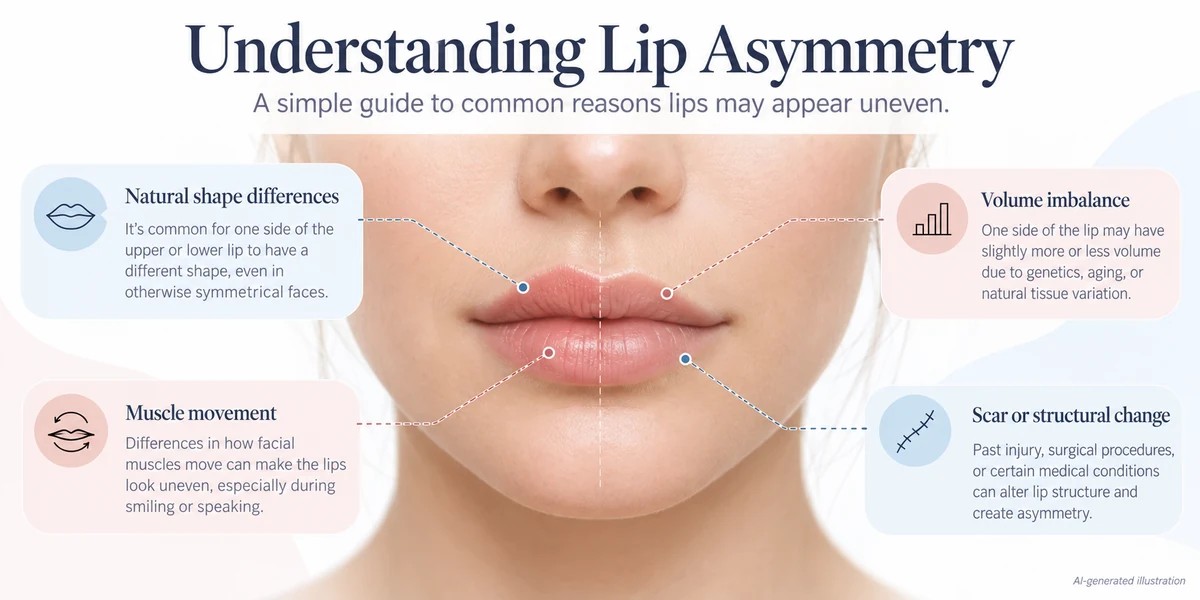
Lip asymmetry treatment depends on why the lips appear uneven. Some differences are natural and do not require treatment. In selected cases, hyaluronic acid fillers may be used to add volume to a thinner area, while lip reduction or reconstructive surgery may be considered when excess tissue, scarring or structural differences are present.
The upper and lower lips are not always perfectly symmetrical. Differences in shape, size, movement and position are common facial characteristics.
Before considering cosmetic treatment, it is important to identify whether the asymmetry is related to natural anatomy, previous procedures, injury or an underlying medical condition.
This article explains the causes of uneven lips, available treatment options, recovery expectations, possible complications and important safety considerations.
What Is Lip Asymmetry?
Lip asymmetry refers to a difference in the shape, size, volume, contour or position of the lips.
It can affect:
The right and left sides of the upper lip
The right and left sides of the lower lip
The relationship between the upper and lower lips
The lip border or Cupid’s bow
Lip movement while smiling or speaking
Mild asymmetry is common and does not necessarily represent a medical problem.
More noticeable differences may be present from birth or develop later in life.
What Causes Uneven Lips?
Several factors can contribute to lip asymmetry.
1. Natural Facial Anatomy
Most faces have small differences between their right and left sides.
Lip thickness, muscle arrangement, dental position and facial bone structure can influence the appearance of the lips.
2. Genetic or Developmental Differences
Some individuals naturally develop lips with unequal volume or shape.
Congenital differences, including cleft-related conditions, may also affect lip structure.
3. Previous Injuries or Scarring
Accidents, burns, previous surgery or other injuries may change lip tissue and movement.
Scar tissue can produce tightness, uneven contours or restricted movement.
4. Previous Lip Fillers
Uneven filler distribution, swelling, migration or residual filler may contribute to an asymmetrical appearance.
The appropriate approach depends on the filler material, location and clinical findings.
5. Age-Related Changes
Lip volume, skin elasticity and surrounding facial tissues can change over time.
These changes may make existing asymmetry more noticeable.
6. Differences in Facial Muscle Movement
Facial nerve conditions or differences in muscle activity may affect how the lips move during smiling, speaking or resting.
A cosmetic procedure may not address the underlying neurological cause.
7. Dental or Jaw-Related Factors
Differences in bite alignment, tooth position or jaw structure can influence the apparent position of the lips.
Important: Sudden Lip Asymmetry
Sudden unevenness of the mouth, especially with facial drooping, difficulty speaking, arm weakness or other neurological symptoms, may indicate a stroke. Seek emergency medical care immediately.
Cosmetic treatment should never delay medical assessment of sudden facial changes.
How Is Lip Asymmetry Assessed?
An individual evaluation helps identify whether the concern involves volume, tissue position, movement or another anatomical factor.
Medical History
The clinician may review when the asymmetry appeared, whether it has changed, and any previous injuries or cosmetic treatments.
Functional Assessment
Difficulty with speech, eating, lip closure or saliva control may require a different management approach from purely cosmetic unevenness.
The assessment should also consider the person’s preferences and whether any intervention is necessary.
Examination at Rest
Lip thickness, borders, shape and the relationship between upper and lower lips may be assessed.
Examination During Movement
Smiling, speaking and mouth closure may reveal differences caused by muscle movement.
Assessment of Previous Fillers
When previous injectable treatment is involved, the clinician may consider the type and location of filler and whether further evaluation is needed.
What Are the Treatment Options for Lip Asymmetry?
Treatment depends on the underlying cause. Observation without a procedure is appropriate for many people with mild natural asymmetry.
1. Hyaluronic Acid Lip Fillers
Hyaluronic acid fillers may be considered when one area of the lip has relatively less volume.
The aim is to add selected volume rather than remove tissue.
Possible uses include:
Addressing certain differences in lip fullness
Modifying selected areas of the lip border
Adjusting contour where reduced volume contributes to asymmetry
However, fillers cannot reliably correct all anatomical differences.
They also cannot directly treat a facial nerve disorder, remove excess natural tissue or correct significant structural deformity.
Results vary and are not guaranteed.
2. Lip Reduction Surgery
Lip reduction surgery removes a selected amount of lip tissue.
It may be considered when one lip, or one area of a lip, has substantially more tissue than the corresponding region.
An incision is often placed on the inner surface of the lip.
The operation creates permanent tissue changes and carries risks of scarring, altered sensation, asymmetry and wound-healing problems.
For further information, read Lip Reduction Surgery: Procedure, Recovery and Risks.
3. Reconstructive Lip Surgery
Selected structural differences caused by injury, congenital conditions or previous surgery may require reconstructive procedures.
The surgical approach depends on the affected tissue, degree of scarring and functional considerations.
Some cases may require multidisciplinary assessment.
4. Management of Previous Fillers
If unevenness is related to existing filler, the treatment depends on the product and its placement.
Some hyaluronic acid fillers may be treated with hyaluronidase when clinically appropriate.
However, dissolving filler is a medical procedure with limitations and possible adverse reactions.
Not every filler material can be dissolved using hyaluronidase.
5. Treatment of an Underlying Medical Condition
When lip asymmetry results from facial weakness, inflammation, dental problems or another medical condition, treating the underlying cause takes priority.
Cosmetic fillers or surgery may be inappropriate.
Lip Fillers vs Lip Reduction Surgery: What Is the Difference?

Fillers and lip reduction surgery have different anatomical purposes.
| Feature | Lip fillers | Lip reduction surgery |
|---|---|---|
| Primary purpose | Add volume | Remove selected tissue |
| Treatment type | Injection | Surgery |
| Potential use | Selected areas with reduced volume | Selected areas with excess tissue |
| Incisions | Usually no surgical incision | Usually requires an incision |
| Duration | Generally temporary, but may persist longer than expected | Permanent removal of tissue |
| Recovery | Swelling and bruising may occur | Surgical wound healing and swelling |
| Important risks | Vascular occlusion, infection, nodules, asymmetry | Scarring, infection, altered sensation, asymmetry |
| Limitations | Cannot remove natural excess tissue | Cannot reliably correct all causes of unevenness |
Neither approach is automatically safer, better or more appropriate for every individual.
Can Lip Fillers Correct Uneven Lips?
Yes, in selected circumstances.
If one part of the lip has relatively less volume, adding a carefully considered amount of filler may change the visible contour.
However, it is important to distinguish between asymmetry caused by reduced volume and asymmetry caused by muscle movement, scarring or lip position.
Are Lip Fillers Permanent?
Most hyaluronic acid fillers are designed to provide temporary effects.
However, the duration varies with the product, amount injected, treatment area and individual factors.
Filler can sometimes remain detectable longer than the commonly advertised treatment duration.
Repeated injections may increase lip volume or alter contour over time.
For additional reading, see Lip Fillers: Procedure, Risks and Treatment Considerations.
When May Lip Correction Surgery Be Considered?
Surgical correction may be considered when there is a structural issue that cannot reasonably be addressed by adding filler.
Examples include:
Significant differences in natural lip tissue
Selected congenital lip differences
Persistent deformity after injury
Scar-related changes in lip shape
Excess tissue in one area of the lip
Functional concerns requiring reconstructive assessment
The exact technique depends on individual anatomy.
Surgery may create additional scarring or changes in sensation and does not guarantee perfect symmetry.
Is Lip Asymmetry Correction Always Necessary?
No.
Small differences in the appearance of the lips are normal.
Treatment may not be necessary when asymmetry:
Has been present for many years
Does not affect speaking, eating or lip closure
Is not associated with an underlying medical condition
Does not cause significant personal concern
Choosing observation instead of a cosmetic procedure is a valid option.
There is no medically required standard of perfectly symmetrical lips.
What Are the Risks of Lip Fillers?
Lip fillers are medical procedures and can cause complications.
Common Temporary Effects
Swelling, bruising, tenderness, redness and discomfort may develop after injection.
Uneven Appearance
Filler may create or accentuate asymmetry, particularly if swelling or the amount injected differs between areas.
Lumps or Nodules
Some individuals may develop palpable or visible lumps.
Infection
Infection may occur following injection.
Filler Migration
Injected material may move from its intended location.
Vascular Occlusion
Accidental injection into or compression of a blood vessel may impair blood flow.
This can cause tissue injury or necrosis.
Rare but severe vascular complications of facial filler injection include visual impairment, blindness and stroke.
Severe pain, blanching, unusual white or dusky skin colour, or changes in vision after filler injection require immediate emergency assessment.
Never attempt self-injection or use needle-free filler devices.
What Are the Risks of Lip Correction Surgery?
Surgical lip correction may involve:
Bleeding
Infection
Swelling and bruising
Wound separation
Visible or internal scarring
Changes in lip sensation
Persistent asymmetry
Altered lip movement
Difficulty with eating or speaking during recovery
Dissatisfaction with the resulting contour
Possible need for additional treatment
The likelihood and nature of complications depend on the procedure, anatomy and general health.
How Long Does Recovery Take After Lip Asymmetry Treatment?
Recovery depends on whether the procedure involves fillers or surgery.
| Recovery period | After fillers | After lip surgery |
|---|---|---|
| First 24–72 hours | Swelling, tenderness or bruising | Swelling, discomfort and temporary restrictions |
| First week | Early swelling generally improves | Wound care and dietary adjustments may be needed |
| Weeks 1–2 | Most initial swelling may settle | Swelling and tenderness may continue improving |
| Weeks 2–4 | Contour may be easier to assess | Continued healing and reduction in swelling |
| Following months | Delayed reactions remain possible | Residual swelling and scar maturation may continue |
These periods are approximate, not guaranteed recovery milestones.
The exact healing process depends on treatment details and individual factors.
For a more detailed discussion of postoperative eating, speaking and activity, read Lip Reduction Recovery: Swelling, Eating and Return to Work.
How Should You Care for Your Lips After Treatment?
Post-treatment instructions depend on the procedure.
Following fillers, the clinician may provide instructions about avoiding excessive pressure or manipulation of the treated area.
Following surgery, wound hygiene, temporary dietary modification and limiting unnecessary lip stretching may be recommended.
Do not massage a treated area, take unprescribed medication or attempt filler dissolution without professional advice.
Lip Asymmetry Treatment: Safety and Recovery Checklist
Before treatment and during recovery, consider the following:
Identify the cause: Distinguish natural asymmetry from injury, previous filler or facial weakness.
Assess lip function: Consider speech, eating, mouth closure and facial movement.
Review previous treatment: Disclose prior fillers, surgery and other cosmetic procedures.
Understand the difference: Fillers add volume, while reduction surgery removes tissue.
Discuss treatment limitations: Neither option guarantees completely identical lips.
Understand filler risks: Review vascular occlusion, infection, nodules and migration.
Understand surgical risks: Review scarring, altered sensation and wound-healing problems.
Follow aftercare instructions: Use prescribed medication and wound care as directed.
Monitor warning signs: Report severe pain, colour changes, worsening swelling or infection.
Attend follow-up assessments: Allow sufficient time for swelling and tissues to settle.
These precautions support informed decisions and appropriate care but do not eliminate medical risks.
When Should You Seek Medical Attention?
After lip fillers or surgery, prompt assessment is important for increasing pain, worsening redness, fever, discharge, persistent bleeding or unexpected swelling.
Severe pain or unusual whitening, blue-grey or dusky skin after filler treatment requires immediate emergency evaluation.
Sudden visual symptoms, facial drooping, speech difficulty or one-sided weakness require emergency medical care.
Frequently Asked Questions
1. Can naturally uneven lips be corrected?
Some types of lip asymmetry may be treated with fillers, lip reduction or reconstructive surgery. However, treatment is not necessary for every person, and perfect symmetry cannot be guaranteed.
2. Are lip fillers suitable for uneven lips?
Hyaluronic acid fillers may be considered when reduced volume contributes to asymmetry. They are not appropriate for every cause of uneven lips.
3. What is the difference between lip fillers and lip reduction surgery?
Lip fillers add volume to selected areas, while lip reduction surgery removes excess tissue. The appropriate approach depends on the underlying anatomical concern.
4. How long do lip filler results last?
The duration varies with the filler material, treatment area and individual factors. Hyaluronic acid fillers are generally temporary, although some material may persist longer than expected.
5. Can lip asymmetry return after treatment?
Yes. Facial ageing, changes in muscle movement, filler breakdown or other tissue changes can affect appearance over time. Surgical correction also does not guarantee permanent visual symmetry.
6. What are the risks of lip asymmetry treatment?
Possible risks include swelling, bruising, infection, scarring, persistent asymmetry and altered sensation. Fillers also carry a rare but serious risk of vascular complications.
7. When should uneven lips be medically assessed?
Sudden lip asymmetry, facial weakness, difficulty speaking, pain, unexplained swelling or changes in lip function require medical evaluation. Sudden neurological symptoms require emergency care.
Conclusion
Lip asymmetry can arise from natural anatomy, differences in lip tissue, previous fillers, injury, ageing or changes in facial muscle movement.
When treatment is considered, the underlying cause determines whether fillers, surgery, another medical intervention or no procedure is appropriate.
Fillers may be useful for selected volume differences, while surgery may be considered for excess tissue or structural concerns.
Both approaches have limitations and potential complications. An individual clinical assessment and realistic understanding of outcomes are essential.
Disclaimer: All content and visuals on this website are for educational and informational purposes only. Images may be AI-generated or illustrative. Individual treatment results may vary. This information does not replace professional medical advice, diagnosis or consultation.