
Lip Reduction Recovery: Swelling, Eating, Speaking & Return to Work
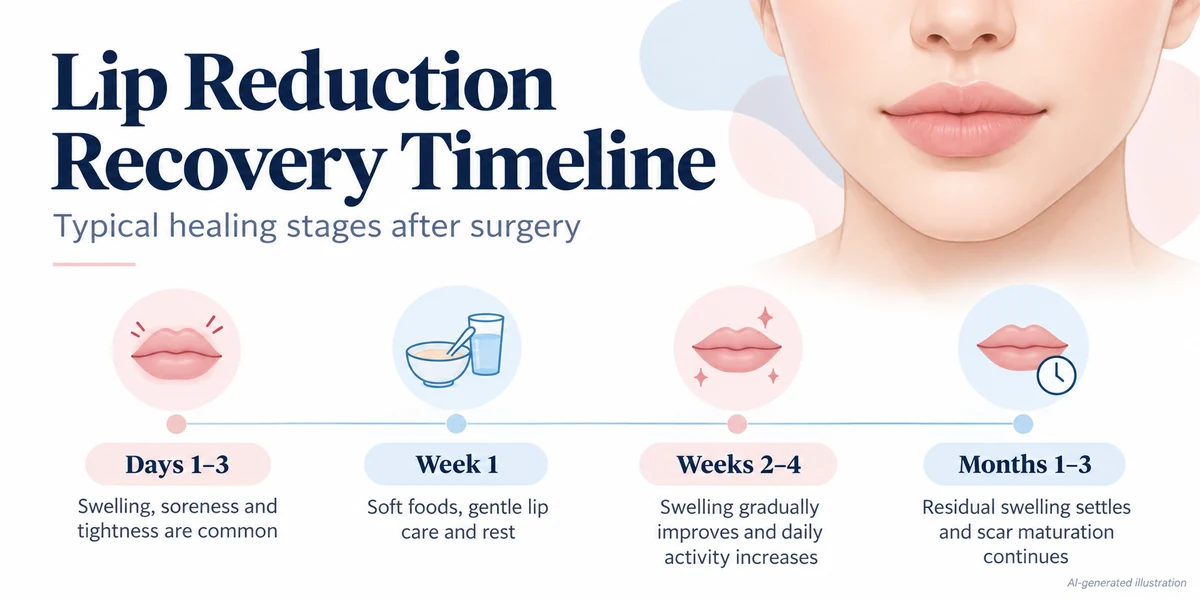
Lip reduction recovery usually involves swelling, tenderness and temporary difficulty with eating or speaking during the first few days after surgery. Discomfort often improves gradually over the following weeks, but residual swelling and changes in lip contour may continue for several months.
Lip reduction surgery, also known as reduction cheiloplasty, removes a selected amount of lip tissue to reduce volume or address certain structural concerns. Incisions are commonly placed inside the mouth, where healing requires careful attention to oral hygiene and unnecessary lip movement.
Recovery differs according to the surgical technique, amount of tissue removed, individual health and wound-healing response.
This guide explains the expected recovery stages, eating and speaking precautions, oral care, return to work, possible complications and symptoms that require medical assessment.
How Long Does Lip Reduction Recovery Take?
Early discomfort and bruising may improve over several days, while swelling often takes longer to resolve.
Some individuals feel comfortable with basic daily activities relatively soon. Others may need more time because of swelling, speech-related discomfort or the demands of their work.
The final lip contour cannot be reliably assessed during early recovery.
Healing and tissue changes may continue for several months.
Lip Reduction Recovery Timeline
The following table provides approximate recovery stages rather than a guaranteed schedule.
| Recovery period | Common experiences | General care considerations |
|---|---|---|
| First 24–72 hours | Swelling, tightness, tenderness and possible bruising | Follow wound-care instructions, rest and use prescribed medication |
| Days 4–7 | Discomfort may begin to improve; eating and speaking can remain uncomfortable | Continue recommended oral hygiene and dietary precautions |
| Weeks 1–2 | Gradual reduction in swelling; incision continues healing | Avoid unnecessary stretching or pressure on the lips |
| Weeks 2–4 | Increasing comfort during routine activities | Resume activities according to medical clearance |
| Months 1–3 | Residual swelling and firmness may continue changing | Attend follow-up assessments if advised |
| Months 3–6 | Further tissue settling and scar maturation | Evaluate lip contour after adequate healing |
Individual recovery may be shorter or longer.
Associated procedures, medical conditions and wound complications can affect the timeline.
How Much Swelling Is Normal After Lip Reduction?
Swelling is expected after lip surgery.
The lips may initially appear larger, firmer or less symmetrical than expected because of the postoperative inflammatory response.
Common early findings can include:
Generalised lip swelling
Mild to moderate tenderness
Temporary tightness
Bruising
Reduced comfort when smiling or speaking
Uneven swelling between different areas
Swelling should generally show an improving trend, although day-to-day variation may occur.
Rapidly increasing swelling, severe pain or swelling accompanied by fever or breathing difficulty is not routine recovery and requires prompt medical attention.
When Does Lip Reduction Swelling Go Down?
Swelling is often more noticeable during the first several days and then gradually decreases.
Much of the early improvement may occur over the first few weeks.
However, mild residual swelling can persist for months, particularly after more extensive tissue adjustment.
Cleveland Clinic notes that complete settling of swelling and the final appearance can take several months, sometimes up to approximately six months.
This does not mean everyone requires six months to resume ordinary daily activities.
What Can You Eat After Lip Reduction Surgery?
Eating may be uncomfortable because chewing, opening the mouth and moving food can stretch healing lip tissues.
A liquid or soft-food diet may be recommended during the initial recovery period.
Foods That May Be Easier During Early Recovery
Depending on medical instructions, examples include:
Yogurt or curd
Soft rice
Mashed vegetables
Smooth porridge
Soft scrambled eggs
Well-cooked, easy-to-chew foods
Soups at a comfortable temperature
The recommended consistency and duration of dietary restrictions vary.
Foods That May Be Uncomfortable
During early healing, some individuals may be advised to temporarily avoid:
Hard or crunchy foods
Foods requiring wide mouth opening
Very hot foods or beverages
Highly spicy or acidic foods if they irritate the incision
Foods that place excessive pressure on the healing lips
Follow the treating surgeon’s instructions rather than relying on a fixed postoperative diet.
When Can You Speak Normally After Lip Reduction?
Speaking requires repeated movement of the lips.
Early postoperative tightness and tenderness may make prolonged conversations uncomfortable.
During the initial days, medical instructions may include limiting excessive talking, smiling or lip stretching.
Normal speech generally becomes easier as swelling and discomfort decrease.
However, the recovery experience varies.
Someone whose work requires continuous speaking may need a different return-to-work plan from someone performing tasks with little verbal communication.
Persistent speech difficulty should be assessed rather than assumed to be a normal long-term effect.
How Should You Sleep After Lip Reduction Surgery?
A clinician may recommend sleeping with the head elevated during early healing.
This may help manage postoperative swelling.
Avoid placing unnecessary direct pressure on the mouth or sleeping in positions that repeatedly compress the lips.
Use the specific positioning instructions provided after surgery.
How Can You Manage Swelling and Discomfort?
Postoperative comfort measures may include prescribed medication, suitable cold application, rest and head elevation.
Cold Application
When recommended, a cool compress may help manage swelling and discomfort.
Use a protective cloth, avoid excessive pressure and follow instructions about duration and frequency.
Do not apply ice directly to the skin or healing tissue.
Prescribed Medication
Take medicines only as directed.
Do not start aspirin, anti-inflammatory medicines, supplements or other products specifically for recovery without checking whether they are appropriate.
Some products can affect bleeding risk or interact with prescribed treatment.
Avoiding Smoking and Nicotine
Smoking and nicotine exposure can impair wound healing.
Follow the treating clinician’s instructions regarding avoidance before and after surgery.
How Should You Clean Your Mouth and Lips?
Oral hygiene is particularly important because lip reduction incisions are often located inside the mouth.
A clinician may recommend specific mouth rinses, brushing precautions or cleaning instructions.
General considerations include:
Keeping the mouth clean according to postoperative advice
Using any prescribed mouth rinse as directed
Avoiding repeated touching or pulling at the incision
Not disturbing sutures
Avoiding vigorous rubbing of the healing lip
Following dietary restrictions until medically cleared
Do not use unprescribed antiseptics or home remedies directly on the wound.
What Happens to the Stitches After Lip Reduction?
Incisions are commonly closed with sutures.
Some are absorbable and dissolve as healing progresses, while others may require removal.
The timing varies according to the suture material and procedure.
Do not pull or cut sutures yourself.
Report any wound separation, persistent bleeding or unusual discharge to the treating clinician.
Will Lip Reduction Leave Scars?
Lip reduction surgery creates a permanent surgical scar.
Because the incision is often inside the mouth, the scar may be less visible externally.
However, this does not mean the procedure is scar-free.
Possible scar-related concerns include:
Firmness or tightness
Abnormal scar thickening
Sensitivity
Uneven tissue healing
Scar-related changes in lip shape
Scar maturation may continue over several months.
Any persistent functional problem or significant scar abnormality requires assessment.
When Can You Return to Work After Lip Reduction?
Return to work depends on comfort, healing progress and job requirements.
| Type of activity | Recovery consideration |
|---|---|
| Desk-based work | May be easier to resume when discomfort is controlled |
| Remote work | Reduced travel demands may help, but prolonged speaking can still be uncomfortable |
| Teaching or customer-facing roles | Frequent talking may require additional recovery time |
| Physically demanding work | Lifting and exertion restrictions may delay return |
| Jobs requiring protective face equipment | Pressure or friction near the lips may need special consideration |
There is no universal return-to-work date.
Cleveland Clinic notes that some individuals may need several weeks before returning to work, depending on the extent of surgery and recovery.
When Can You Exercise After Lip Reduction?
Exercise should resume gradually according to the treating surgeon’s instructions.
Strenuous physical activity can increase blood pressure and may aggravate postoperative swelling or bleeding.
Avoid heavy lifting, intense workouts and other restricted activities until medically cleared.
If multiple procedures were performed, recovery restrictions may be longer.
Normal Recovery vs Warning Signs
Understanding the difference between expected healing and possible complications is important.

| May occur during routine recovery | Requires medical assessment |
|---|---|
| Swelling that gradually improves | Rapidly worsening swelling |
| Mild tenderness | Severe or increasing pain |
| Temporary bruising | Persistent or heavy bleeding |
| Mild tightness when speaking | Increasing difficulty moving or closing the lips |
| Temporary difficulty chewing | Inability to maintain adequate fluid intake |
| Healing incision with mild discomfort | Pus, foul discharge or wound separation |
| Mild swelling-related unevenness | Persistent or worsening asymmetry with concerning symptoms |
Emergency warning: Difficulty breathing or swallowing, uncontrolled bleeding or rapidly expanding swelling requires emergency medical care.
What Are the Possible Complications of Lip Reduction Surgery?
Although many individuals recover without major complications, lip reduction surgery carries medical risks.
Infection
An infection may cause increasing pain, redness, swelling, discharge or fever.
Bleeding
Bleeding may occur during or after surgery.
Significant or persistent bleeding needs prompt evaluation.
Delayed Wound Healing
The incision may heal slowly or partially separate.
Altered Sensation
Temporary numbness or altered lip sensation may occur. In some cases, sensory changes can persist.
Scar Formation
Abnormal scarring or tissue tightness may affect the appearance or movement of the lips.
Persistent Asymmetry
Differences in healing or the amount of tissue removed can contribute to uneven lip contours.
Changes in Lip Function
Unwanted changes in lip movement, closure or comfort during eating and speaking may occur.
Anaesthesia-Related Risks
Local anaesthetic or other anaesthesia-related complications are possible.
Potential complications should be reviewed before surgery, and unexpected symptoms should not be dismissed as ordinary healing.
When Will You See the Final Lip Reduction Result?
Lip reduction permanently removes selected tissue, but the visible appearance continues changing as the wound heals.
Initial swelling can obscure the intended contour.
The lip shape usually becomes easier to evaluate over the following weeks and months.
Some residual swelling and scar-related firmness may continue changing for several months.
A particular lip shape, perfect symmetry or specific appearance cannot be guaranteed.
For an overview of the procedure itself, read Lip Reduction Surgery: Procedure, Recovery and Risks.
Can Uneven Lips Develop During Recovery?
Yes. Unequal swelling can temporarily make one side of the lip appear fuller than the other.
However, asymmetry may also result from differences in tissue removal, scarring or wound healing.
Persistent or worsening asymmetry should be assessed.
For more information about different causes of uneven lips, read Lip Asymmetry Treatment: Fillers, Surgery and Risks.
Lip Reduction Recovery and Aftercare Checklist
During recovery, the following points may help support appropriate postoperative care.
Follow prescribed medication instructions: Do not change treatment without medical advice.
Maintain oral hygiene: Clean the mouth and incision as directed.
Choose appropriate foods: Follow recommended liquid or soft-food restrictions.
Avoid unnecessary lip stretching: Limit movements that cause pain or strain during early healing.
Manage swelling carefully: Use cold application or head elevation only as advised.
Protect the incision: Do not pull sutures or repeatedly touch the wound.
Avoid smoking and nicotine: Follow medical instructions to support wound healing.
Resume work gradually: Consider speaking requirements and physical demands.
Delay strenuous exercise: Restart only after medical clearance.
Attend follow-up appointments: Allow the clinician to assess healing and possible complications.
Recognise warning signs: Seek assessment for fever, excessive bleeding, severe pain or worsening swelling.
These precautions may help recovery but cannot eliminate the risk of complications.
Can Lip Fillers Be Used Instead of Lip Reduction Surgery?
Lip fillers and lip reduction surgery address different concerns.
Fillers add volume, while lip reduction surgery removes selected tissue.
If enlarged lips result from hyaluronic acid filler rather than naturally prominent tissue, a clinician may assess whether waiting or appropriately managed filler dissolution is suitable.
Filler dissolution also involves medical risks and does not guarantee a particular outcome.
Read Lip Fillers: Treatment and Safety Considerations for a related discussion.
Frequently Asked Questions
1. How long does swelling last after lip reduction surgery?
Swelling is usually most noticeable during early recovery and gradually decreases over several weeks. Mild residual swelling may continue for months, depending on individual healing.
2. What foods can I eat after lip reduction surgery?
A liquid or soft-food diet may be recommended during early healing. Suitable options depend on the surgical instructions and may include yogurt, soft rice, porridge or other easy-to-chew foods.
3. When can I speak normally after lip reduction?
Speaking generally becomes more comfortable as swelling and tenderness decrease. People who speak extensively for work may need additional recovery time.
4. When can I return to work after lip reduction surgery?
Return to work depends on healing, discomfort and job demands. Some individuals may require several weeks, particularly if their work involves frequent speaking or physical exertion.
5. When can I exercise after lip reduction?
Strenuous exercise should be avoided until the treating surgeon confirms that it is safe. Activity should resume gradually according to recovery progress.
6. Will lip reduction surgery leave a scar?
Yes. Lip reduction creates a permanent surgical scar, usually on the inner surface of the lip. The scar may be less visible externally, but abnormal scarring or tightness can occur.
7. What are the warning signs after lip reduction surgery?
Severe or worsening pain, excessive bleeding, fever, pus, wound separation or rapidly increasing swelling require medical evaluation. Breathing or swallowing difficulty requires emergency care.
Conclusion
Lip reduction recovery involves gradual healing of the lips and the surgical incision.
Swelling, tenderness, temporary tightness and changes in eating or speaking are common during the initial recovery period.
While early symptoms often improve over several days or weeks, final lip contour and scar maturation can take several months.
Appropriate oral hygiene, activity restrictions, dietary advice, follow-up assessments and awareness of complications are important during recovery.
Disclaimer: All content and visuals on this website are for educational and informational purposes only. Images may be AI-generated or illustrative. Individual treatment results may vary. This information does not replace professional medical advice, diagnosis or consultation.