
Rhinoplasty After 20 Years – The Long-Term Impact
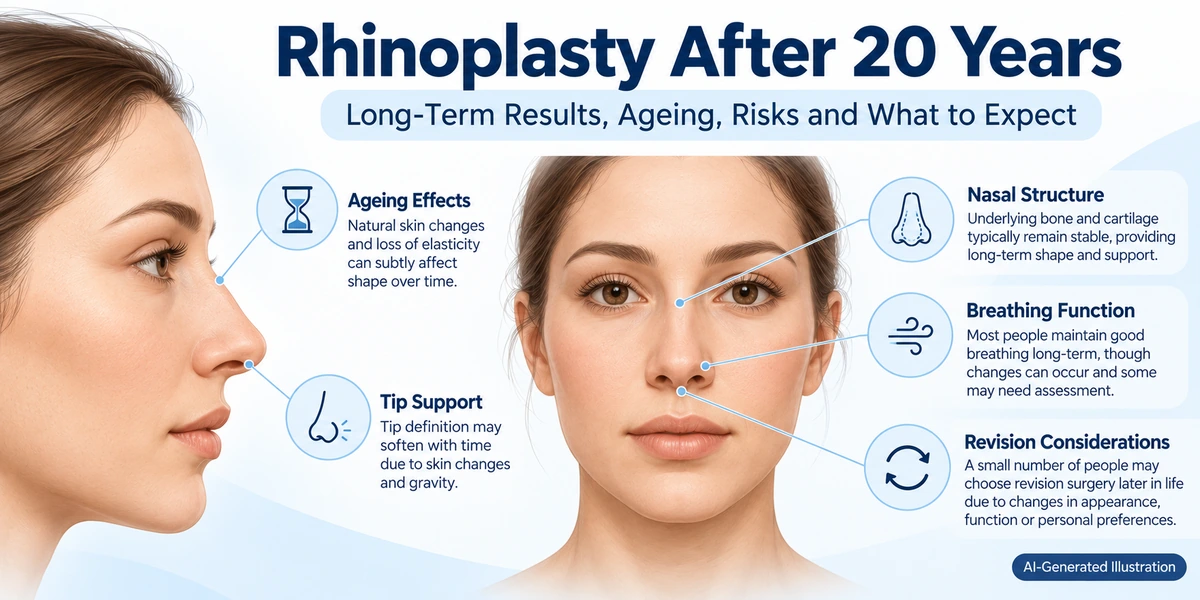
Rhinoplasty, commonly known as nose reshaping surgery, involves modifying the bone, cartilage or soft tissues of the nose to address its appearance, structure or certain breathing difficulties.
Although rhinoplasty produces long-lasting structural changes, the nose continues to undergo natural ageing throughout life. This raises an important question: What happens to rhinoplasty results after 20 years?
Two decades after surgery, many of the original structural modifications may remain, but the appearance of the nose can change gradually due to ageing, skin characteristics, tissue support, injury and other individual factors.
Understanding these changes is important because rhinoplasty does not completely prevent the natural ageing process or guarantee that the nose will maintain exactly the same appearance indefinitely.
This article explains the long-term effects of rhinoplasty, how the nose may change over time, factors influencing nasal stability, possible complications and when further medical evaluation may be appropriate.
What Is Rhinoplasty and How Does It Change the Nose?
Rhinoplasty is a surgical procedure that modifies the structure of the nose.
Depending on individual anatomy and the intended correction, the procedure may involve reshaping nasal cartilage, adjusting nasal bones, altering the nasal tip or addressing structural problems affecting breathing.
Rhinoplasty can be performed for cosmetic, reconstructive or functional reasons.
Common concerns addressed by rhinoplasty include:
Nasal bridge irregularities
Nasal tip shape or projection
Nasal asymmetry
Changes following facial injury
Certain structural abnormalities affecting nasal airflow
Selected congenital nasal differences
Surgical techniques vary according to the anatomical structures requiring correction.
Some procedures primarily involve the nasal bridge, while others require more extensive modification of the cartilage and supporting structures.
For additional information about nasal anatomy and surgical approaches, see this educational overview of rhinoplasty techniques.
What Happens to Rhinoplasty After 20 Years?
Rhinoplasty results are generally considered long-lasting because surgery changes the underlying nasal structures.
However, a nose that has undergone rhinoplasty is still affected by normal biological ageing.
Over a period of 20 years, gradual changes may occur in:
Skin thickness and elasticity
Nasal tip position
Soft tissue support
Cartilage characteristics
Facial proportions
Scar tissue
Nasal airway function
These changes do not necessarily mean that the original surgical correction has failed.
Instead, they may reflect the interaction between the surgically modified nasal structure and the natural ageing process.
According to the American Society of Plastic Surgeons, rhinoplasty results are generally long-lasting, although gradual changes in facial and nasal appearance can occur with ageing.
The degree of change varies considerably between individuals.
How Does the Nose Naturally Age After Rhinoplasty?
The nose changes throughout adulthood, whether or not a person has undergone rhinoplasty.
Several anatomical processes may influence its long-term appearance.
1. Changes in Skin Elasticity
As people age, the skin gradually loses some of its elasticity and structural support.
This process is influenced by biological ageing, sun exposure, genetics and other environmental factors.
Reduced skin elasticity may affect how the nasal skin rests over the underlying cartilage and bone.
In some individuals, these changes can alter the appearance of the nasal tip or make certain contour irregularities more noticeable.
2. Changes in Nasal Tip Position
The nasal tip is supported by cartilage, ligaments and surrounding soft tissues.
Age-related changes in these structures may contribute to a gradual downward appearance of the nasal tip in some individuals.
This is sometimes described as age-related nasal tip ptosis.
However, a downward change is not inevitable after rhinoplasty, and its extent varies.
The position and stability of the nasal tip can also depend on the original surgical technique and the amount of structural support preserved or reconstructed.
3. Cartilage and Structural Changes
Nasal cartilage provides shape and support to different parts of the nose.
Over time, the mechanical properties of cartilage and surrounding tissues may change.
The appearance of the nose may therefore evolve even when the surgically modified structures remain largely intact.
Previous cartilage reduction, graft placement or structural reconstruction can influence how these changes appear.
4. Changes in Surrounding Facial Structures
The nose is part of the overall facial structure.
Ageing may affect the cheeks, upper lip, skin and underlying facial tissues.
These changes can influence how the nose appears in relation to the rest of the face.
For example, changes in facial volume and skin support may alter perceived nasal proportions without significant changes in the nose itself.
Does Rhinoplasty Last Forever?
Rhinoplasty is generally considered a permanent structural procedure.
Unlike temporary cosmetic treatments, rhinoplasty changes the underlying nasal anatomy.
However, permanent structural modification does not mean that the appearance of the nose remains completely unchanged throughout life.
Several factors can affect long-term results:
The type and extent of the original procedure
Nasal cartilage strength
Skin characteristics
Scar tissue formation
Natural ageing
Previous or subsequent nasal trauma
Structural support of the nasal tip
Changes in surrounding facial tissues
Some people may notice relatively little change after 20 years.
Others may develop visible differences in nasal tip position, symmetry or contour.
It is therefore more accurate to describe rhinoplasty as a long-lasting surgical modification rather than a guarantee of an unchanging nasal appearance.
Can the Nose Change Shape 20 Years After Rhinoplasty?

Yes. Nasal appearance may change gradually over time.
However, the cause of a change cannot be determined solely by the number of years since surgery.
Possible explanations include natural ageing, changes in tissue support, scar-related changes, injury or previously unrecognised structural problems.
Nasal Tip Changes
The nasal tip may appear less projected, more rounded or slightly lower in some individuals.
These changes may be related to tissue support, skin characteristics or the long-term behaviour of modified cartilage.
Nasal Bridge Irregularities
Some individuals may notice contour irregularities along the nasal bridge.
Possible contributing factors include the original anatomy, bone or cartilage changes, healing patterns or the visibility of underlying structures through thinner skin.
Changes in Symmetry
Minor asymmetry is common in natural facial anatomy.
Over time, differences between the two sides of the nose may become more noticeable.
This does not automatically indicate a complication, but a new or progressive deformity may warrant evaluation.
Changes in Nasal Width
Changes in soft tissue and structural support can affect the perceived width or shape of the nose.
However, it is not accurate to assume that every nose becomes significantly wider after rhinoplasty.
How Do Different Rhinoplasty Techniques Affect Long-Term Results?
Long-term nasal stability depends partly on which structures were modified and how they were supported during surgery.
Open Rhinoplasty
Open rhinoplasty involves an incision across the columella, together with internal nasal incisions.
This approach provides direct access to the underlying nasal framework.
Long-term outcomes depend on the structural modifications performed, grafts used, scar formation and individual healing.
Closed Rhinoplasty
Closed rhinoplasty uses incisions inside the nostrils.
It avoids an external columellar incision but does not automatically guarantee better long-term stability or fewer complications.
The outcome depends on the anatomical correction and surgical technique.
Structural Rhinoplasty
Structural techniques aim to preserve or reconstruct support in areas such as the nasal tip and bridge.
Cartilage grafts or other support techniques may be used when clinically indicated.
Although structural support can be important for stability, no technique guarantees that age-related changes will never occur.
Rhinoplasty With Implants
Some rhinoplasty procedures use implants rather than relying exclusively on the patient’s own cartilage.
Implants introduce additional considerations, including long-term tissue reactions, displacement, infection and possible extrusion.
Individuals interested in understanding implant-related changes can read about silicone rhinoplasty after 10 years.
The long-term behaviour of an implant is not the same as that of a rhinoplasty performed entirely with the patient’s natural tissues.
What Are the Possible Long-Term Benefits of Rhinoplasty?
The potential benefits of rhinoplasty depend on why the procedure was performed and whether the intended changes remain stable.
Long-Lasting Structural Correction
Modifications to nasal bones and cartilage may remain for many years.
For individuals who underwent surgery to correct a structural irregularity, these changes can be long-lasting.
Changes in Nasal Proportions
Rhinoplasty may alter nasal height, projection, bridge contour or tip shape.
These modifications can remain noticeable over time, although facial ageing may influence their appearance.
Functional Improvement in Selected Cases
Rhinoplasty or septorhinoplasty may address certain structural causes of nasal obstruction.
However, not every breathing problem is caused by nasal anatomy, and breathing improvements cannot be guaranteed.
Allergies, inflammation and other nasal conditions may still affect airflow after surgery.
Individual Satisfaction
Some individuals remain satisfied with the appearance or function of their nose many years after surgery.
Others may experience changing preferences or new concerns as their face ages.
Satisfaction is subjective and should not be assumed from appearance alone.
Are There Any Long-Term Side Effects of Rhinoplasty After 20 Years?
Not everyone experiences long-term complications after rhinoplasty.
However, certain concerns may persist or become noticeable years after surgery.
1. Breathing Difficulties
Changes in the internal or external nasal structures may contribute to airflow obstruction.
Potential causes include nasal valve narrowing, septal abnormalities or inadequate structural support.
Breathing difficulty may also arise from unrelated conditions such as allergies or chronic inflammation.
2. Nasal Asymmetry
Some degree of asymmetry may remain after surgery or become more noticeable with ageing.
Significant or progressive asymmetry may require examination.
3. Persistent Sensory Changes
Rhinoplasty can affect sensation around the nasal tip and surrounding tissues.
Although temporary numbness often improves during healing, some sensory changes may persist.
4. Scar-Related Changes
Scar tissue can affect nasal contour and tissue mobility.
Most surgical scarring develops during the healing period, but its long-term appearance may influence nasal shape.
5. Structural Weakness
In selected cases, reduced cartilage support or changes in the nasal framework may contribute to instability.
This can affect nasal tip position, contour or breathing.
6. Problems Related to Nasal Implants
Implant-based rhinoplasty may carry additional risks, including infection, shifting, tissue thinning or extrusion.
These problems can require clinical assessment even years after the original operation.
7. Unsatisfactory Appearance
Some individuals may become concerned about long-term changes in the nose’s shape or symmetry.
Not every aesthetic concern represents a surgical complication, and further surgery is not automatically necessary.
For an overview of possible complications and recovery considerations, see the rhinoplasty risks and recovery guide from Cleveland Clinic.
Can Rhinoplasty Cause Breathing Problems Years Later?
Breathing difficulties can occasionally develop or become more noticeable after nasal surgery.
The nasal airway relies on several structures, including the septum, nasal valves, turbinates and surrounding cartilage.
In some circumstances, structural narrowing or reduced support may affect airflow.
However, breathing problems occurring decades after rhinoplasty should not automatically be attributed to the original procedure.
Other possible causes include:
Allergic rhinitis
Chronic sinus inflammation
Nasal polyps
Septal deviation
Nasal valve dysfunction
Age-related anatomical changes
A clinical examination may be needed to identify the cause.
Depending on the findings, assessment may include nasal endoscopy or other investigations.
Treatment should be based on the underlying problem rather than the assumption that revision surgery is always required.
Is Revision Rhinoplasty Necessary After 20 Years?
Revision rhinoplasty is a procedure performed to address selected concerns following previous nasal surgery.
It is not routinely required simply because 20 years have passed.
Revision may be considered when an individual has a clinically significant functional or structural problem, or an appearance-related concern that warrants surgical evaluation.
Possible reasons include:
Persistent nasal obstruction
Significant nasal asymmetry
Structural collapse
Implant-related complications
Changes following nasal trauma
Selected contour irregularities
Revision rhinoplasty may be more complex than primary rhinoplasty because earlier surgery can alter normal anatomy and create scar tissue.
In some cases, additional cartilage may be required to reconstruct or support the nasal framework.
The risks, possible benefits and limitations must be considered individually.
For a broader explanation of primary and revision approaches, see the overview of different rhinoplasty procedures.
Can Rhinoplasty Results Change Without Any Complications?
Yes.
The appearance of the nose may change gradually with age even when there is no surgical complication.
A person may notice subtle differences in nasal tip position, skin texture or facial proportions.
These changes can occur in people who have never undergone rhinoplasty.
Therefore, the presence of a visible change after 20 years does not necessarily mean that the original procedure was unsuccessful.
The important distinction is whether the change reflects expected ageing, a structural issue or a medical condition.
How Can Nasal Health Be Maintained After Rhinoplasty?
There is no proven method that completely prevents natural nasal ageing.
However, general health and sensible protective measures can support nasal and skin health.
Protect the Nose From Injury
Significant nasal trauma can affect bone, cartilage and soft tissues.
Appropriate protective measures during activities involving a risk of facial injury may help reduce this risk.
Practise Sun Protection
Long-term sun exposure contributes to skin ageing.
Appropriate sun protection may support skin health but does not prevent all changes in nasal cartilage or structure.
Avoid Smoking
Smoking affects tissue circulation and healing and can have broader effects on skin and respiratory health.
Avoiding tobacco exposure is beneficial for overall health.
Manage Nasal Conditions
Allergies, recurrent inflammation and other nasal conditions should be evaluated when symptoms persist.
Treating these conditions may improve breathing or comfort without additional cosmetic surgery.
Seek Assessment for New Symptoms
New nasal obstruction, persistent pain, recurrent bleeding or a progressive change in shape should be assessed rather than managed solely with cosmetic products or home remedies.
What Should Someone Expect 10, 15 or 20 Years After Rhinoplasty?
The long-term appearance of the nose varies considerably.
The following table summarises general considerations rather than predicting specific outcomes.
| Time after rhinoplasty | General considerations |
|---|---|
| First year | Healing, reduction of swelling and gradual refinement of nasal contour |
| 1–5 years | Structural changes are generally established, although individual scar and tissue changes may continue |
| 5–10 years | Natural ageing may gradually influence skin and facial proportions |
| 10–15 years | Some individuals may notice changes in nasal tip appearance or tissue support |
| 15–20 years | Long-term appearance reflects the original procedure, ageing, tissue characteristics and subsequent events |
| Beyond 20 years | Continued natural ageing; evaluation is appropriate if new functional or structural concerns develop |
These are broad periods for discussion, not fixed stages of deterioration.
A nose may remain relatively stable over decades, and there is no established rule that rhinoplasty results worsen after a particular number of years.
When Should Changes After Rhinoplasty Be Medically Evaluated?
A medical assessment may be appropriate if new or worsening symptoms develop, regardless of how long ago the surgery was performed.
Important symptoms include:
Persistent or increasing difficulty breathing through the nose
New or progressive nasal deformity
Repeated unexplained nosebleeds
Persistent nasal pain
Recurrent discharge or infection
Signs of implant displacement or tissue breakdown
Significant injury to the nose
New swelling or an unusual lump
Severe bleeding, significant breathing difficulty or rapidly worsening symptoms require urgent medical attention.
The appropriate investigation depends on the symptoms and examination findings.