
Scar Revision vs Scar Camouflage: Goals, Methods, and Limits
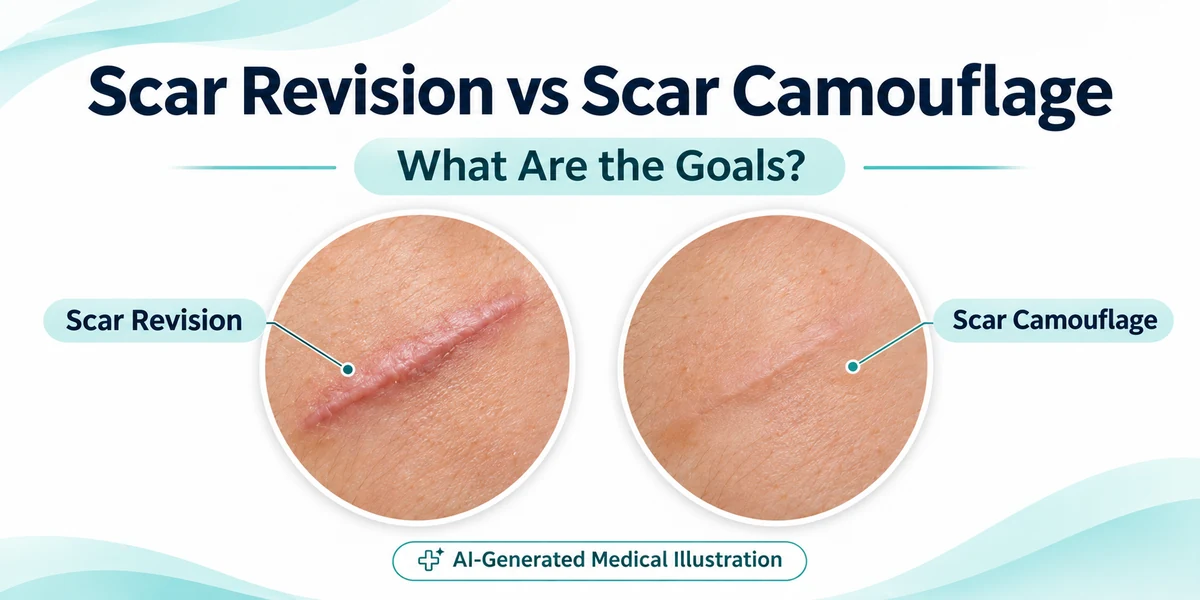
Scar revision and scar camouflage are two distinct strategies for improving the appearance of mature scars. Revision seeks to reshape, flatten, or restore function, while camouflage focuses on masking colour differences without altering the underlying tissue. Both approaches require careful assessment of scar maturity, type, skin tone, and individual healing tendencies. Choosing the right option depends on the scar’s characteristics, patient expectations, and potential risks.
What Is Scar Revision?
Scar revision encompasses surgical and nonsurgical techniques designed to modify scar architecture. Surgical options include excision, Z‑plasty, or tissue rearrangement to improve contour, reduce tension, or release contractures. Nonsurgical modalities—silicone gels, pressure therapy, intralesional steroids, and emerging fractional lasers—aim to soften hypertrophic or depressed scars during the remodeling phase.
What Is Scar Camouflage?
Scar camouflage employs medical micropigmentation (dermal tattooing) to blend a scar’s colour with surrounding skin. The pigment is deposited into the dermis, matching the patient’s natural hue and reducing visible contrast. Camouflage does not change scar thickness, texture, or function; it merely masks colour mismatches.
Why Are They Performed?
Both interventions address cosmetic concerns and psychosocial impact, but their primary objectives differ. Revision targets structural improvement—flattening raised tissue, correcting depressions, or releasing contractures that limit movement. Camouflage targets visual perception, aiming for a more uniform skin tone, especially in patients where surgery is contraindicated or unnecessary.
Who May Need Each Approach?
Patients with mature, stable scars (typically >12 months) who experience functional limitation, pronounced hypertrophy, or contracture often benefit from revision. Those with well‑healed scars that are primarily discoloured—especially on visible areas like the face—may prefer camouflage. Skin type influences choice; darker Fitzpatrick types are more prone to pigmentary changes and may achieve better results with camouflage, whereas lighter skin may respond well to revision techniques that address texture.
How Do They Work?
Surgical Revision Techniques
Excision removes scar tissue, allowing a new incision placed along relaxed skin tension lines to heal with a finer line. Z‑plasty reorients tissue to relieve tension and lengthen contracted areas. These methods inevitably create a new scar, but with careful planning the new line can be less conspicuous.
Nonsurgical Revision Techniques
Silicone gel creates a hydrated barrier that modulates collagen deposition, reducing hypertrophy Silicone scar management research. Intralesional corticosteroids suppress inflammation in hypertrophic scars, flattening raised tissue. Fractional laser resurfacing can improve texture by stimulating controlled dermal remodeling, though it is not the focus of this article.
Medical Micropigmentation (Camouflage)
Using a fine‑needle device, pigment is layered into the upper dermis. The practitioner matches colour using a test patch, considering the patient’s baseline skin tone and any post‑inflammatory hyper‑ or hypopigmentation. The result is a subtle blending that can last 1–3 years before touch‑ups are needed.

What Outcomes Are Realistic?
Scar revision can markedly improve contour, reduce thickness, and restore range of motion, yet the new scar will remain visible to some degree. Camouflage can dramatically lessen colour contrast, making the scar less noticeable in daily life, but it does not eliminate texture or functional issues. Both methods require realistic expectations; complete invisibility is rarely achievable.
Benefits and Limitations
Scar Revision Benefits: Improves physical function, reduces raised or depressed texture, can treat contractures, and may enhance overall cosmetic appearance.
Scar Revision Limitations: Involves surgical risk, may create a new scar, longer recovery, and outcomes depend on scar age and patient healing.
Camouflage Benefits: Minimally invasive, immediate visual improvement, suitable for patients avoiding surgery, and can be performed on most skin types.
Camouflage Limitations: Does not alter scar thickness or texture, pigment may fade or shift, and colour matching can be challenging in highly pigmented skin.
| Aspect | Scar Revision | Scar Camouflage |
|---|---|---|
| Primary Goal | Reshape, flatten, restore function | Mask colour difference |
| Method | Surgical excision, Z‑plasty, silicone, steroids | Medical micropigmentation |
| Ideal for | Raised, depressed, contracture, functional scars | Discoloured, stable scars |
| Recovery | Days to weeks, possible wound care | Minimal, occasional touch‑up |
| Limitations | New scar formation, surgical risk | No texture change, pigment fading |
Risks or Possible Complications
Surgical revision risks include infection, wound dehiscence, altered sensation, and hypertrophic or keloid formation—particularly in patients with a known keloid tendency Assessing Keloid Risk Before Surgery. Nonsurgical methods may cause irritation, allergic reaction to silicone, or pigmentary changes. Camouflage carries risks of pigment migration, allergic reaction to pigments, or suboptimal colour match, which may require repeat sessions.
Recovery or Follow‑Up
Post‑operative care after revision often involves wound protection, silicone sheeting, and scar massage. Follow‑up visits monitor healing and address any hypertrophic response. Camouflage patients are advised to keep the area moisturised, avoid excessive sun exposure, and schedule periodic touch‑ups to maintain colour fidelity.
When to Seek Medical Advice
If a scar limits movement, causes pain, shows rapid growth, or exhibits signs of infection, prompt evaluation is essential. Individuals considering camouflage should consult a qualified practitioner to assess scar stability and discuss pigment safety.
Medical References
Frequently Asked Questions
Can scar revision completely erase a scar?
No. Scar revision may improve the appearance, texture, thickness, or function of a scar, but it cannot completely erase scar tissue. A residual scar will generally remain, and the degree of improvement varies.
Is medical micropigmentation safe for all skin types?
Medical micropigmentation may be suitable for selected skin types, but it is not risk-free. Pigment matching can be more challenging in darker skin tones. Allergic reactions, infection, pigment changes, and unwanted colour differences are possible. Professional assessment is recommended before treatment.
How long does a camouflage pigment last?
The duration of scar camouflage pigment varies depending on pigment type, skin characteristics, sun exposure, and the technique used. Pigment may gradually fade or change colour over time. Some individuals may require touch-up sessions, while others may retain pigmentation for longer periods.
Do silicone gels work on old, mature scars?
Silicone gels and sheets are commonly used in scar management, particularly for raised scars. They are generally more beneficial during active scar maturation, although some mature scars may also respond. Results vary according to scar type, age, and individual healing characteristics.
What factors increase the risk of keloid formation after revision surgery?
A personal or family history of keloids, genetic predisposition, certain skin types, wound tension, and inflammation may increase the likelihood of keloid formation. A qualified clinician should assess these factors before considering scar revision surgery.
Can I combine scar revision and camouflage?
Yes, scar revision and camouflage may be combined in selected cases. Revision may address scar texture, contour, or functional concerns, while medical micropigmentation may help reduce visible colour differences. The sequence and suitability depend on scar maturity, skin condition, and professional assessment.
Is there any downtime after medical micropigmentation?
Medical micropigmentation may cause temporary redness, swelling, tenderness, or mild crusting. Recovery varies depending on the treatment area, skin sensitivity, and technique. Patients should follow the treating professional's aftercare instructions, including appropriate skin protection during healing.
Conclusion
Scar revision and scar camouflage serve complementary but distinct purposes: revision reshapes scar tissue to improve function and appearance, while camouflage blends colour to reduce visual prominence. Understanding each method’s mechanisms, suitability, and limitations helps patients set realistic expectations and choose the approach that aligns with their goals and medical profile.
Medical Disclaimer
This article is intended for general educational purposes only and does not replace individual medical advice, diagnosis or treatment. Suitability, risks and outcomes vary. Consult a qualified healthcare professional for medical guidance specific to your situation.