
Understanding Surgical Consent Forms: Risks & Rights
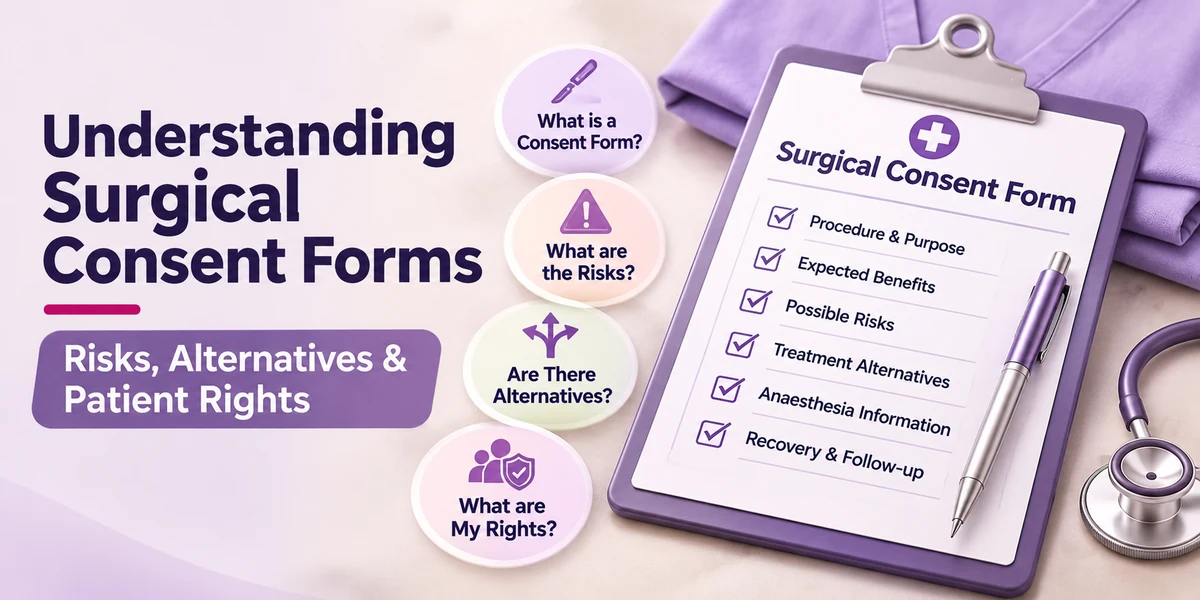
Understanding Surgical Consent Forms: Risks, Alternatives and Patient Rights
Surgical consent forms are documents used to record a patient’s agreement to a proposed operation after receiving information about the procedure, expected benefits, potential risks and available alternatives. However, informed consent involves more than signing a document. It requires a meaningful discussion between the patient and the healthcare professional, allowing the patient to understand the treatment and make a voluntary decision.
Before surgery, patients should understand what is being proposed, why it may be necessary, what complications could occur and whether other options are available. Understanding these details supports informed decision-making and realistic expectations.
What Is a Surgical Consent Form?
A surgical consent form is a written document that records a patient’s authorisation for a specified surgical procedure.
It is generally completed after the treating healthcare professional has explained the relevant aspects of the proposed treatment.
A surgical consent form may contain:
The patient’s identification details.
The name and nature of the proposed procedure.
The purpose of the operation.
Expected benefits and treatment limitations.
Important risks and possible complications.
Alternative treatment options.
Information about anaesthesia.
Patient and healthcare professional details.
Relevant signatures and dates.
The precise contents vary according to the procedure, healthcare facility and applicable requirements.
A signed form should support an informed consent discussion, not replace it.
The American College of Surgeons’ guidance on informed consent emphasises understanding the proposed operation and its associated risks.
Why Is Informed Consent Important Before Surgery?
Informed consent is an essential part of ethical medical practice because surgical procedures can involve uncertainty, complications and consequences that differ between individuals.
A proper consent discussion helps patients understand:
Why the procedure is being considered.
What the operation involves.
What benefits may reasonably be expected.
Which complications or limitations are relevant.
Whether non-surgical or alternative treatments are available.
What may happen if treatment is postponed or declined.
For elective operations, including many cosmetic procedures, patients generally have an opportunity to consider their options before deciding.
Informed consent also supports communication between patients, surgeons and anaesthesia professionals.
It does not eliminate surgical risk or guarantee a particular result.
What Information Should a Surgical Consent Form Include?

Although consent documentation varies, several components are important for an informed surgical decision.
1. Name and Purpose of the Procedure
The patient should understand the procedure being recommended and the reason it is being considered.
For example, rhinoplasty may involve changes to nasal structures for functional or aesthetic reasons. The extent of surgery depends on the individual’s anatomy and treatment objectives.
Patients should ask whether the planned operation involves additional procedures or specific anatomical structures.
2. Expected Benefits and Limitations
The surgeon should explain the intended purpose of treatment and the outcomes that may reasonably be anticipated.
However, surgical outcomes are influenced by factors such as:
Individual anatomy.
General health.
Medical history.
Tissue quality.
Healing response.
Procedure-related complexity.
Patients should understand the difference between an intended benefit and a guaranteed result.
3. Potential Risks and Complications
A meaningful consent discussion includes relevant surgical risks, including complications that may be uncommon but significant.
4. Available Treatment Alternatives
Patients should understand whether alternative surgical techniques, non-surgical management or observation may be appropriate.
5. Anaesthesia Information
Patients should receive information about the planned anaesthesia and its relevant risks through the appropriate clinical consent process.
6. Recovery and Follow-Up
The discussion should address expected postoperative care, activity restrictions, potential complications and follow-up requirements.
Understanding Surgical Risks and Possible Complications
All surgical procedures involve some degree of risk.
The likelihood and significance of complications depend on the operation, the patient’s health and other clinical factors.
Possible risks may include:
| Potential Risk | What Patients Should Understand |
|---|---|
| Bleeding | Some bleeding is expected during surgery, but excessive bleeding may require additional treatment. |
| Infection | Surgical wounds can become infected despite appropriate precautions. |
| Scarring | Surgical incisions can leave scars, and healing varies between individuals. |
| Anaesthesia complications | Reactions and complications may occur depending on the anaesthesia and patient’s health. |
| Changes in sensation | Temporary or occasionally persistent numbness or altered sensation may occur. |
| Delayed wound healing | Conditions such as diabetes, smoking and poor circulation can affect healing. |
| Unsatisfactory outcome | The result may differ from expectations and additional assessment or treatment may be necessary. |
| Blood clots | Certain operations and patient factors increase the risk of venous thromboembolism. |
Not every risk applies equally to every operation.
Patients should discuss the complications most relevant to their particular procedure and health condition.
For general information on surgical treatments and individual assessment, readers can explore plastic and cosmetic surgery information.
What Are the Alternatives to Surgery?
Surgery is not always the only available approach.
Depending on the condition, alternatives may include:
Medical treatment.
Physiotherapy or rehabilitation.
Lifestyle modification.
Non-surgical procedures.
Monitoring without immediate intervention.
A different surgical technique.
The suitability of each option depends on the underlying diagnosis, expected benefits and associated risks.
For example, certain aesthetic concerns may be addressed through non-surgical treatments, while structural or functional conditions may require a different approach.
Patients should ask whether the available alternatives address the same concern and what limitations each option carries.
Informed consent involves understanding reasonable alternatives, including the option of declining treatment where medically appropriate.
What Happens If a Patient Declines Surgery?
A patient with decision-making capacity may generally choose not to undergo a recommended elective procedure.
Before deciding, it is important to understand the possible consequences.
Depending on the condition, postponing or declining surgery may result in:
No significant change.
Persistence of existing symptoms.
Progression of the underlying condition.
Continued functional limitations.
A need for alternative treatment or monitoring.
For some conditions, delaying treatment may have serious consequences. For others, observation may be reasonable.
A healthcare professional should explain these possibilities according to the patient’s diagnosis.
The decision should be made voluntarily, without inappropriate pressure.
Informed Consent vs Signing a Consent Form: What Is the Difference?
Although the terms are sometimes used interchangeably, informed consent and consent documentation are not identical.
| Informed Consent | Surgical Consent Form |
|---|---|
| An ongoing communication and decision-making process | A written record of consent |
| Includes explanation of relevant risks, benefits and alternatives | Documents agreement to a specified procedure |
| Allows questions and clarification | Records relevant details and signatures |
| Requires voluntary decision-making | Helps demonstrate that consent was documented |
| May need updating if circumstances materially change | May require revision when the proposed procedure changes |
A patient may sign a form without fully understanding the procedure if communication is inadequate.
Similarly, a meaningful conversation should be documented appropriately when written consent is required.
Both communication and documentation are important.
What Are Patients’ Rights Regarding Surgical Consent in India?
Indian medical practice recognises the importance of patient autonomy and consent before surgical treatment.
The Supreme Court of India addressed surgical consent in Samira Kohli v. Dr. Prabha Manchanda & Anr. (2008).
The judgment emphasised that consent should be obtained from a patient capable of making the decision and that sufficient information should be provided for a balanced treatment decision.
It also distinguished consent for a diagnostic procedure from consent for an additional therapeutic operation, subject to limited emergency circumstances.
The Charter of Patients’ Rights and Responsibilities, published through the Ministry of Health and Family Welfare’s Clinical Establishments portal, also identifies informed consent as an important patient right.
Important Patient Rights
Patients should generally be able to:
Receive understandable information about the proposed treatment.
Ask questions about relevant risks and alternatives.
Discuss concerns before agreeing to elective surgery.
Make voluntary decisions where they have the legal capacity to do so.
Seek clarification about the procedure and postoperative care.
Understand the implications of refusing or postponing treatment.
The precise legal requirements depend on the circumstances, applicable laws, consent capacity and healthcare setting.
Can Patients Withdraw Consent After Signing?
Signing a surgical consent form does not necessarily mean that a patient has surrendered the ability to reconsider the decision.
A patient with decision-making capacity can generally withdraw consent before a proposed elective procedure begins.
However, the clinical and legal implications may be more complex if treatment has already started, the patient is under anaesthesia or an immediate emergency arises.
Patients who are uncertain about an operation should raise their concerns with the treating team as early as possible.
What Happens If the Surgical Plan Changes?
A consent form for one procedure should not automatically be treated as permission to undertake any additional unrelated operation.
Material changes to the planned treatment may require further discussion and appropriate consent.
Emergency situations, where delaying necessary intervention could seriously endanger life or health, may be subject to specific legal and clinical exceptions.
These decisions require careful professional judgment.
Why Is Anaesthesia Consent Important?
Anaesthesia allows many operations to be performed while managing pain, awareness and physiological responses.
Depending on the procedure, options may include:
Local anaesthesia.
Regional anaesthesia.
Sedation.
General anaesthesia.
The anaesthesia professional may discuss the planned technique, relevant health conditions, fasting instructions and possible complications.
Potential risks can include nausea, allergic reactions, respiratory complications and other events depending on the type of anaesthesia and the patient’s medical condition.
Patients should disclose important medical information, including previous anaesthesia difficulties, allergies, medications and relevant illnesses.
Consent for surgery and consent for anaesthesia may be documented separately according to institutional procedures.
What Questions Should Patients Ask Before Signing a Surgical Consent Form?
A structured discussion can help patients understand their treatment choices.
Preoperative Consent Checklist
| Patient Question | Why It Matters |
|---|---|
| What is the exact name of my procedure? | Clarifies what treatment is planned. |
| Why is this surgery recommended? | Explains its medical purpose. |
| What benefits are realistically expected? | Helps establish appropriate expectations. |
| What are the important risks in my case? | Supports understanding of individual complications. |
| Are non-surgical alternatives available? | Helps compare treatment choices. |
| What happens if I postpone surgery? | Clarifies the implications of delay. |
| What type of anaesthesia will be used? | Supports understanding of anaesthesia-related considerations. |
| What happens if an unexpected complication occurs? | Explains possible changes to treatment. |
| What recovery support will I need? | Helps with postoperative planning. |
| Who should I contact if problems develop? | Establishes a clear follow-up pathway. |
Patients may also wish to ask about the surgeon’s relevant qualifications, the healthcare facility and the expected postoperative support.
For related information, see questions to discuss during a plastic surgery consultation.
What If a Patient Cannot Understand the Consent Form?
Medical information may be difficult to understand because of unfamiliar terminology, language differences, stress or complexity.
Patients should be encouraged to request explanations in language they understand.
Helpful approaches may include:
Using clear, non-technical explanations.
Discussing one issue at a time.
Providing illustrations or written information.
Using appropriate interpretation services.
Allowing sufficient time for questions.
Asking patients to explain their understanding in their own words.
Where a patient lacks decision-making capacity, consent arrangements must follow the applicable legal framework, including rules for authorised representatives and emergency care.
A signature alone should not substitute for assessing whether meaningful understanding and valid consent are possible.
What Are the Limitations of Surgical Consent?
Even when informed consent is properly obtained, it cannot eliminate complications.
Consent does not:
Guarantee the success of surgery.
Ensure a complication-free recovery.
Predict the exact healing response.
Replace professional clinical judgment.
Automatically excuse negligent medical care.
Authorise unrelated procedures without an appropriate legal basis.
Patients should understand that surgical care involves both anticipated benefits and unavoidable uncertainties.
Professional responsibilities relating to patient safety, appropriate treatment and clinical standards remain important throughout the care process.
When Should Patients Seek Further Medical Advice?
Additional discussion may be appropriate if:
The proposed operation is not clearly understood.
Risks or alternatives have not been explained adequately.
Different healthcare professionals have provided conflicting information.
The patient feels pressured to make a decision.
New symptoms or health concerns arise before surgery.
The treatment plan changes.
The patient wishes to reconsider or obtain another medical opinion.
Patients considering elective surgery should have an opportunity to address important concerns before proceeding.
Medical References
Frequently Asked Questions
What is the purpose of a surgical consent form?
A surgical consent form records the patient's agreement to a specified operation. It should follow an appropriate discussion of the proposed procedure, expected benefits, important risks and reasonable alternatives.
Is signing a consent form enough for informed consent?
No. Informed consent involves understandable information, an opportunity to ask questions, decision-making capacity and voluntary agreement. The signed document records the decision but does not replace the consent discussion.
Can I refuse surgery after discussing it with my doctor?
A patient with decision-making capacity may generally decline elective surgery. The healthcare professional should explain the potential consequences and available alternatives so that the decision is informed.
Can I change my mind after signing a surgical consent form?
Patients can generally withdraw consent before an elective procedure begins. Different considerations may apply after treatment has started or during an emergency, so concerns should be communicated promptly.
Does surgical consent mean the surgeon is not responsible for complications?
No. Consent acknowledges relevant treatment risks but does not automatically remove professional responsibilities or excuse negligent care.
Should anaesthesia risks be discussed separately?
Anaesthesia-related risks should be explained as part of the appropriate clinical consent process. Depending on the facility and procedure, separate anaesthesia documentation may be used.
What should I do if I do not understand a consent form?
Ask the treating healthcare professional to explain unfamiliar terms, risks and alternatives in understandable language. Request additional clarification before making a decision.
Conclusion
Understanding surgical consent forms is an important part of informed healthcare decision-making. Patients should know what procedure is proposed, why it is recommended, what risks may occur and which alternatives are available.
Informed consent is not simply a signature. It is a process of communication that helps patients make voluntary decisions based on appropriate medical information.
A clear discussion of risks, treatment limitations, recovery expectations and patient rights supports responsible surgical planning.
Medical Reviewer
Dr. Vinod Vij — MBBS, MS (General Surgery), MCh (Plastic Surgery)
Medical review pending. Reviewer approval and review date must be confirmed before publication.
Medical Disclaimer
This article is intended for general educational purposes only and does not replace individual medical advice, diagnosis or treatment. It is not a substitute for professional legal advice. Consent requirements, treatment suitability, risks and clinical decisions vary according to the circumstances and applicable Indian law. Patients should consult qualified healthcare professionals for guidance relevant to their medical condition.