
Silicone Rhinoplasty After 10 Years
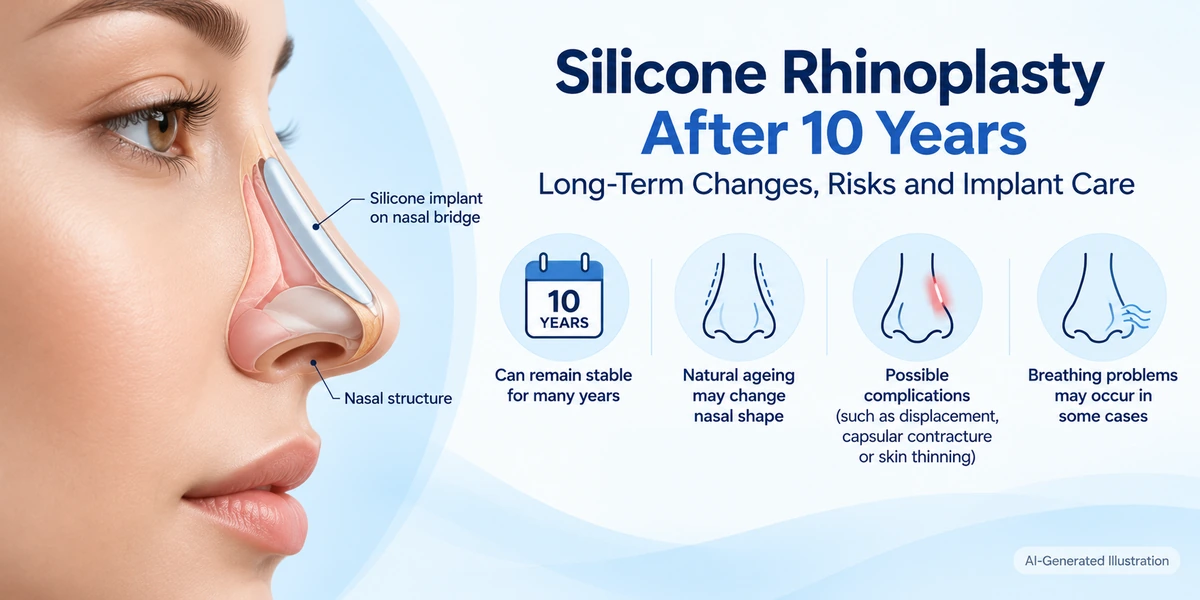
Silicone Rhinoplasty After 10 Years: Long-Term Changes, Risks and Implant Care
Silicone rhinoplasty is a type of nose reshaping surgery in which a synthetic silicone implant is used to alter or support selected parts of the nasal structure. It is most commonly associated with augmentation rhinoplasty, where additional projection or definition is required along the nasal bridge.
Although silicone is a durable material, the long-term outcome of nasal implant surgery depends on more than the implant itself. The surrounding skin, soft tissue, scar capsule and nasal structures may change with ageing or in response to the implant.
For individuals who underwent silicone rhinoplasty 10 years ago, important questions may arise: Is the implant still stable? Can its position change? What symptoms might indicate a complication? Is replacement necessary after a decade?
A silicone nasal implant may remain in place for many years without causing problems. However, an implant cannot be assumed to last indefinitely without complications, and there is no universal rule requiring replacement after exactly ten years.
This article explains the long-term changes that may occur following silicone rhinoplasty, the factors affecting implant stability, possible complications, available investigations and circumstances in which revision surgery may be considered.
What Is Silicone Rhinoplasty?
Silicone rhinoplasty is a surgical technique that uses a medical-grade silicone implant to modify the shape or projection of the nose.
Silicone implants are commonly used to augment the nasal dorsum, which is the bridge of the nose.
Depending on the surgical approach and individual anatomy, a preformed implant may be positioned within a surgically created pocket over the nasal supporting structures.
The implant is intended to alter the external nasal contour while the existing cartilage, bone and soft tissues continue to provide anatomical support.
Silicone rhinoplasty is one of several approaches to nasal reconstruction or augmentation.
Other methods may involve the patient’s own cartilage, including cartilage taken from the nasal septum, ear or rib.
The choice of material depends on the required anatomical change, available tissue, surgical history and potential risks.
How Does a Silicone Nose Implant Work?
A silicone nasal implant provides additional volume or projection in a selected part of the nose.
Unlike a cartilage graft taken from the patient’s body, silicone is an artificial implant.
After placement, the surrounding tissues heal and form a layer of scar tissue around the implant.
This layer is often called a fibrous capsule.
A relatively stable capsule may develop without causing noticeable problems. However, excessive tightening or abnormal changes in the capsule can affect the implant’s position or the external shape of the nose.
Silicone implants generally do not integrate into living tissue in the same way as certain porous materials.
Their long-term stability depends partly on the implant’s shape, position, surrounding tissue and the characteristics of the surgical pocket.
What Happens to Silicone Rhinoplasty After 10 Years?
Ten years after surgery, the appearance and condition of a silicone implant can vary considerably.
Some individuals have stable implants and no significant symptoms.
Others may develop changes in nasal shape, skin condition or breathing function.
1. The Implant May Remain Stable
Silicone is chemically stable and does not normally dissolve or get absorbed by the body.
Consequently, some implants remain in place for extended periods.
However, the implant’s continued presence does not establish that every surrounding tissue remains healthy or that no future complication can occur.
2. Natural Nasal Ageing Continues
Rhinoplasty does not stop the normal ageing process.
Over time, changes can occur in:
-
Skin elasticity
-
Soft-tissue thickness
-
Nasal cartilage support
-
Facial fat distribution
-
Nasal tip position
-
The relationship between the skin and underlying implant
These changes may gradually alter the nose’s appearance.
3. Scar Tissue May Change
A fibrous capsule forms around an implanted foreign material.
In some individuals, the capsule may become thicker or contract over time.
This process may create tension on nearby nasal structures.
4. Implant Position May Change
An implant can occasionally become displaced or appear crooked.
Implant displacement is not limited to the initial healing period.
Late changes may be associated with tissue contraction, trauma or alterations in supporting structures.
5. The Nasal Skin May Become Thinner
The skin covering a nasal implant can change with age.
In some circumstances, pressure from an implant or other tissue factors may contribute to thinning of the overlying skin.
This can make implant edges more noticeable and, in severe cases, increase concern about exposure.
6. Breathing Problems May Develop
Silicone implants are not intended to obstruct normal nasal breathing.
However, changes in nasal structure, internal scarring or unrelated nasal conditions may affect airflow.
New breathing difficulties require assessment rather than being automatically attributed to the age of the implant.
How Long Does a Silicone Rhinoplasty Implant Last?
There is no single lifespan that applies to every silicone nasal implant.
Some implants remain stable for many years, while others require removal or revision because of complications.
Longevity depends on several factors:
Implant Design
The implant’s shape, dimensions and material characteristics influence how it interacts with surrounding tissues.
Surgical Placement
Appropriate positioning and the relationship between the implant and nasal structures affect stability.
Skin and Soft-Tissue Coverage
Adequate soft-tissue coverage is important because pressure and thinning may increase the risk of visible implant edges or exposure.
Individual Healing
Scar formation and tissue responses vary between individuals.
Trauma
A significant injury may affect implant position or surrounding structures.
Infection
Infection can occur around implanted material and may require additional medical or surgical treatment.
Natural Ageing
Gradual changes in the nose and face may affect implant appearance over time.
A silicone implant does not need automatic replacement solely because it reaches ten years of age. Equally, no implant should be described as guaranteed to last a lifetime.
Is Silicone Rhinoplasty Permanent?
Silicone rhinoplasty is generally intended to create a long-lasting structural change.
However, the terms long-lasting and permanent should not be treated as interchangeable.
The implant may remain in place for many years, but complications or changes in nasal anatomy can make removal or revision necessary.
Some changes are cosmetic, while others involve tissue health or breathing function.
A stable and symptom-free implant may not require intervention.
The decision to continue observation, investigate a concern or consider revision depends on clinical findings rather than the number of years since surgery alone.
Does a Silicone Nose Implant Move After 10 Years?

Implant movement or displacement is a recognised complication of silicone augmentation rhinoplasty.
A displaced implant may cause the nasal bridge to appear uneven or asymmetrical.
Possible contributing factors include:
-
Changes in the surrounding fibrous capsule
-
An implant pocket that does not adequately support the implant
-
Previous nasal trauma
-
Changes in soft-tissue coverage
-
Alterations in the nasal supporting structures
A person may notice a new contour irregularity, a visibly crooked implant or increasing prominence of one implant edge.
However, not every change in nasal symmetry means the implant has moved.
Natural structural differences, tissue contraction or other nasal conditions can produce similar appearances.
Clinical examination is necessary to determine the cause.
What Is Capsular Contracture After Silicone Rhinoplasty?
Capsular contracture occurs when the scar tissue surrounding an implant tightens excessively.
The body normally forms a fibrous capsule around many implanted materials.
However, an abnormal contraction of this tissue may distort the nasal shape or place tension on nearby structures.
Possible Signs of Capsular Contracture
Symptoms and findings may include:
-
Progressive change in nasal shape
-
Shortening or upward rotation of the nasal tip
-
Increasing firmness
-
Tightness of the surrounding tissue
-
Implant displacement
-
Nasal asymmetry
-
Discomfort in selected cases
In more significant cases, contracture may contribute to a shortened or contracted nose.
Research on silicone augmentation rhinoplasty describes capsular contracture as an important cause of certain late nasal deformities.
The clinical study Contracted Nose after Silicone Implantation: A New Classification System and Treatment Algorithm explains the relationship between abnormal capsular tightening, nasal deformity and different approaches to surgical management.
Capsular contracture cannot be reliably diagnosed from a photograph or appearance alone.
Can a Silicone Nose Implant Cause Problems After 10 Years?
Yes. Some complications may develop or become noticeable many years after the original procedure.
However, these complications do not occur in everyone.
1. Implant Displacement
The implant may shift or become visibly misaligned.
This can change the nasal bridge or create asymmetry.
2. Implant Exposure or Extrusion
Implant extrusion occurs when an implant begins to protrude through the surrounding tissue.
This may follow skin thinning, pressure-related injury, infection or other tissue problems.
Visible implant material or an opening in the skin requires prompt medical attention.
3. Infection
Implanted material can be associated with infection.
Although many postoperative infections occur relatively early, late infections are also possible.
Symptoms may include redness, warmth, swelling, tenderness or discharge.
4. Skin Thinning
The skin covering the implant may become thin or stretched.
This can make the implant more visible beneath the surface.
Skin thinning is particularly concerning when accompanied by redness, persistent pressure or changes suggesting impending exposure.
5. Capsular Contracture
Excessive tightening of scar tissue can change the shape of the nose and affect nearby structures.
6. Visible Implant Edges
Changes in skin thickness, implant position or surrounding tissue may cause the outline of the implant to become more noticeable.
7. Nasal Asymmetry
Changes in the implant or supporting structures may produce an uneven nasal contour.
8. Breathing Difficulties
Internal narrowing, structural changes or conditions unrelated to the implant can affect nasal airflow.
9. Chronic Discomfort
Persistent pain or pressure around a nasal implant is not an expected finding simply because the implant is old.
Clinical assessment may be necessary to investigate the cause.
What Is the Difference Between Normal Ageing and an Implant Complication?
Normal ageing and implant-related problems may both change the appearance of the nose.
However, they have different possible implications.
| Feature | Natural ageing | Possible implant complication |
|---|---|---|
| Onset | Usually gradual | May be gradual or sudden |
| Nasal shape | General changes in skin and support | Localised distortion, displacement or prominence |
| Skin condition | Changes in elasticity and thickness | Marked thinning, redness or threatened exposure |
| Discomfort | Usually not a dominant feature | Pain or pressure may occur |
| Breathing | May change for several reasons | May be affected by structural complications |
| Evaluation | Clinical assessment if concerning | Examination and sometimes imaging are necessary |
This table is illustrative and cannot establish a diagnosis.
Some people may have both age-related changes and implant-related problems.
For a broader explanation of how the nose can change over time, see rhinoplasty after 20 years and its long-term effects.
Is Silicone Rhinoplasty Safe in the Long Term?
Silicone has been used in nasal augmentation procedures for many years.
However, long-term safety depends on the individual, implant characteristics, surgical technique and surrounding tissue response.
Potential complications include infection, implant displacement, extrusion, skin problems and capsular contracture.
A published retrospective analysis, Problems Associated with Alloplastic Materials in Rhinoplasty, examined complications among patients undergoing revision procedures involving different synthetic implant materials.
The study documented problems associated with silicone implants, including displacement, contracture, infection and skin complications.
Importantly, the study evaluated a population undergoing revision surgery. Its complication counts should not be interpreted as the rate of complications among all people who receive silicone implants.
Likewise, published rates from different studies cannot be combined into a universal long-term success percentage because patient selection, follow-up duration, implant design and surgical techniques differ.
Silicone Rhinoplasty After 10 Years: Common Symptoms and Their Possible Significance
| Observation | Possible explanation | Suggested response |
|---|---|---|
| No symptoms or visible changes | Implant may remain stable | Follow individual medical advice |
| Mild, gradual change in shape | Ageing or tissue remodelling | Clinical review if concerned |
| New nasal asymmetry | Implant displacement or structural change | Arrange medical assessment |
| Increasing tightness or shortening | Possible capsular contracture | Seek specialist evaluation |
| Visible implant edge | Thinning tissue or contour change | Arrange prompt assessment |
| Redness, warmth or discharge | Possible infection | Seek prompt medical care |
| Skin opening or exposed implant | Possible extrusion | Urgent medical assessment |
| New or worsening nasal obstruction | Structural or nasal airway problem | Nasal examination is indicated |
Symptoms alone do not identify the precise cause.
Can Silicone Rhinoplasty Affect Breathing After 10 Years?
Silicone augmentation is usually performed to modify the external nasal contour rather than to treat all causes of nasal airway obstruction.
However, nasal breathing depends on several anatomical structures, including the septum, turbinates, internal and external nasal valves, and supporting cartilage.
Breathing difficulties may develop because of:
Nasal Valve Narrowing
Structural narrowing or weakness in the nasal valve region can affect airflow.
Septal Deviation
A deviated septum may contribute to obstruction.
Scar Tissue
Internal scar formation may restrict normal nasal airflow in some circumstances.
Changes in Nasal Support
Alterations in cartilage position or support can affect nasal function.
Inflammation or Allergies
Allergic rhinitis, chronic nasal inflammation and other medical conditions can cause obstruction independently of a silicone implant.
Implant-Related Structural Changes
An implant-related deformity may contribute to functional problems in selected cases.
It is therefore important not to assume that every breathing problem years after surgery is caused by the implant.
How Is a Silicone Nose Implant Evaluated After 10 Years?
A clinician may assess implant stability, surrounding tissue condition and nasal function.
The evaluation depends on the person’s symptoms and surgical history.
1. Review of Surgical History
The clinician may ask about:
-
The date of the original procedure
-
Implant material and design
-
Previous nasal surgeries
-
Known postoperative complications
-
Previous infections or trauma
-
Changes in nasal appearance over time
Where available, previous operative records may help identify the type and placement of the implant.
2. External Nasal Examination
The clinician may examine the nasal bridge, tip, skin and surrounding tissues.
The assessment may include visible asymmetry, redness, tenderness, skin thinning and implant prominence.
3. Internal Nasal Examination
An examination inside the nose may help identify obstruction, mucosal abnormalities, scarring or other concerns.
A nasal endoscope may be used when clinically appropriate.
4. Assessment of Breathing Function
Nasal airflow and relevant structural features may be evaluated.
This is particularly important when the individual reports new or worsening obstruction.
5. Imaging
Imaging is not necessarily required for every stable nasal implant.
However, ultrasound, CT or other investigations may be considered when complications are suspected.
CT imaging may be useful for assessing selected structural abnormalities and surgical planning.
6. Infection Assessment
If infection is suspected, the clinician may consider appropriate cultures, laboratory tests or imaging depending on the clinical findings.
The investigations should be selected according to the suspected condition rather than performed routinely in every case.
Does a Silicone Nose Implant Need Replacement After 10 Years?
Not automatically.
There is no universal ten-year replacement schedule for silicone nasal implants.
The decision depends on whether there is a clinical reason to intervene.
Replacement or removal may be considered when an implant causes:
-
Recurrent or persistent infection
-
Exposure or impending extrusion
-
Significant displacement
-
Capsular contracture with nasal deformity
-
Persistent pain
-
Skin compromise
-
Functional problems
-
Other medically significant complications
Some individuals also seek assessment because their preferences or nasal appearance have changed.
However, revision surgery carries its own risks and should not be considered a routine maintenance procedure.
Can a Silicone Nose Implant Be Removed?
Silicone nasal implants can be surgically removed in selected circumstances.
However, removal does not necessarily restore the nose to its original preoperative shape.
After many years, the surrounding tissues may have changed.
There may be scar tissue, skin thinning or alterations in nasal cartilage support.
The procedure may therefore involve more than simply removing the implant.
Some individuals require additional reconstruction using cartilage or other techniques.
Others may not require replacement material.
The approach depends on the condition of the nasal structures and the reason for removal.
What Is Revision Silicone Rhinoplasty?
Revision rhinoplasty is a secondary operation performed after an earlier nasal procedure.
It may be considered to address functional concerns, implant complications or structural changes.
Revision involving a silicone implant may include:
Implant Removal
Removal may be necessary when infection, extrusion or significant tissue compromise occurs.
Scar Tissue Management
Abnormal scar tissue may require careful treatment, particularly in cases of capsular contracture.
Structural Reconstruction
The nasal framework may need support if existing cartilage is weakened, distorted or deficient.
Cartilage Grafting
Cartilage from the septum, ear or rib may be considered in selected cases.
Airway Correction
Functional surgery may be required when nasal obstruction is associated with identifiable anatomical problems.
Revision surgery is often more complex than primary rhinoplasty because of pre-existing scar tissue and changes to the original anatomy.
Possible complications include infection, bleeding, persistent asymmetry, breathing problems, poor wound healing and the need for further surgery.
Revision does not guarantee a specific cosmetic or functional outcome.
Silicone Implants vs. Cartilage Grafts in Rhinoplasty
Silicone implants and cartilage grafts have different characteristics.
| Feature | Silicone implant | Autologous cartilage graft |
|---|---|---|
| Material | Synthetic medical-grade silicone | Tissue taken from the individual’s body |
| Common purpose | Nasal augmentation | Structural support, contouring and reconstruction |
| Tissue response | Fibrous capsule forms around implant | Biological graft healing and remodelling |
| Implant-related infection or extrusion | Recognised risk | No synthetic implant extrusion, but graft-related complications remain possible |
| Additional donor site | Usually unnecessary | May be required |
| Long-term changes | Displacement, capsule problems or skin thinning may occur | Warping, resorption or contour changes may occur |
| Revision | Removal or replacement may be necessary | Revision depends on graft and structural condition |
Neither option is universally superior for every individual.
The selection depends on anatomy, previous surgery, tissue availability and treatment objectives.
For additional background on nasal surgery techniques and assessment, see the general educational guide to rhinoplasty surgery.
Silicone vs. Gore-Tex in Rhinoplasty
Silicone and expanded polytetrafluoroethylene, often known by the trade name Gore-Tex, are synthetic materials used in selected nasal augmentation procedures.
Silicone
Silicone implants are generally smooth, preformed devices.
They are not designed to become extensively incorporated into surrounding tissue.
Implant movement, capsular contracture, infection and exposure are recognised concerns.
Gore-Tex
Expanded polytetrafluoroethylene has a porous structure that allows varying degrees of tissue interaction.
Its behaviour differs from silicone, particularly with respect to tissue attachment and surgical removal.
However, Gore-Tex is also associated with potential complications, including infection and implant-related contour problems.
Which Material Lasts Longer?
There is no reliable universal answer that applies to all patients and procedures.
Comparisons depend on study design, implant type, anatomical location and duration of follow-up.
Material selection should consider individual anatomy and the possible consequences of future revision.
Can a Silicone Implant Change the Nasal Tip Over Time?
Yes, in selected circumstances.
Changes to the nasal tip can occur because of ageing, altered support, scar contracture or an implant-related complication.
The risk may vary according to implant design and placement.
Certain implant configurations that place pressure on delicate nasal tip structures have been associated with complications involving skin thinning, pressure injury and distortion.
A progressive change in tip position or the appearance of an unusually shortened nose requires clinical assessment.
What Does an Infected Nasal Implant Feel Like?
Possible symptoms of an implant-related infection include:
-
Increasing pain
-
Tenderness over the implant
-
Redness
-
Local warmth
-
Swelling
-
Discharge
-
Skin breakdown
-
Fever in some cases
Not every infection causes all these symptoms.
A localised problem may occur without marked systemic symptoms.
A person should not attempt to diagnose an implant infection through appearance alone or use leftover antibiotics without medical advice.
A suspected implant infection requires prompt clinical evaluation because foreign material can complicate infection management.
Can Silicone Rhinoplasty Cause Skin Thinning?
Skin thinning over an implant is a recognised concern in nasal augmentation.
Possible contributing factors include:
-
Pressure from an implant
-
The thickness of the original skin
-
Implant dimensions and placement
-
Changes in soft tissue over time
-
Scar contracture
-
Previous operations
The implant may become increasingly visible or palpable when the tissue covering it becomes thin.
Severe thinning can increase concern about eventual skin breakdown or implant exposure.
A new pale, shiny, red or unusually stretched area over a prominent implant should be assessed.
How Can Someone Care for Their Nose 10 Years After Silicone Rhinoplasty?
Long-term care focuses on recognising changes and maintaining general nasal health.
There is no proven home-care routine that can guarantee the lifelong stability of a silicone implant.
Monitor New Changes
Pay attention to progressive changes in nasal shape, new asymmetry, tenderness or alterations in skin colour.
Protect the Nose From Significant Trauma
Nasal injury may affect cartilage, bone or implant position.
Individuals involved in activities with a risk of facial impact should use appropriate protective measures.
Avoid Repeated Manipulation
Do not attempt to move or reshape an implant by pressing or massaging the nose.
Maintain General Skin Health
Gentle skincare and routine sun protection support skin health.
However, sunscreen does not prevent capsular contracture or guarantee implant integrity.
Avoid Smoking
Smoking is associated with impaired tissue circulation and wound healing.
Its avoidance is especially relevant if additional surgery becomes necessary.
Seek Assessment for Nasal Symptoms
Persistent nasal obstruction, recurrent infections or changes in the implant area require appropriate evaluation.
Follow Individual Medical Advice
Routine follow-up requirements vary.
An individual with a stable, symptom-free implant may not need the same investigations as someone experiencing pain, deformity or skin changes.
What Happens After 15 or 20 Years of Silicone Rhinoplasty?
A silicone implant may remain in place for longer than ten years.
However, time-related changes in the nose and surrounding soft tissues can continue.
Some individuals may experience no significant problems.
Others may develop late complications involving:
-
Capsular contracture
-
Implant displacement
-
Skin thinning
-
Visible implant edges
-
Infection
-
Nasal contour changes
-
Breathing difficulties
There is no reliable method of predicting the exact condition of every silicone implant after fifteen or twenty years.
The presence or absence of symptoms, clinical examination and available surgical records are more meaningful than the age of the implant alone.
Readers can explore additional educational articles about cosmetic surgery and postoperative recovery for broader information on healing and long-term surgical changes.
When Should You Seek Medical Advice?
An individual with a silicone nasal implant should seek medical evaluation if new or progressive symptoms develop.
Symptoms Requiring Medical Assessment
-
Increasing nasal asymmetry
-
New or persistent implant-related pain
-
Progressive tightness
-
Changes in nasal tip position
-
New or worsening breathing difficulty
-
Skin thinning or unusual colour changes
-
Persistent swelling
-
Implant prominence
-
Recurrent local irritation
Symptoms Requiring Prompt or Urgent Attention
-
Visible implant exposure
-
Rapidly worsening redness
-
Significant swelling with severe pain
-
Pus or discharge
-
Fever with nasal inflammation
-
Skin breakdown
-
Rapidly developing tissue colour changes
Severe or rapidly worsening infection symptoms require urgent medical attention.
Do not attempt to remove, reposition or manipulate an exposed implant.
Frequently Asked Questions
1. Is silicone rhinoplasty permanent?
Silicone rhinoplasty is intended to provide long-lasting changes, but no implant is guaranteed to remain complication-free for life. Removal or revision may become necessary in some individuals.
2. Can a silicone nose implant last more than 10 years?
Yes. Some silicone nasal implants remain stable for longer than ten years. However, the duration varies, and late complications can occur.
3. Does a silicone nose implant need replacement after 10 years?
Not automatically. There is no universal ten-year replacement schedule. Removal or revision is generally considered according to symptoms, clinical findings and individual circumstances.
4. Can a silicone nose implant move after 10 years?
Yes. Implant displacement can occur after the early healing period, although not every change in nasal appearance indicates movement. Clinical evaluation is needed to establish the cause.
5. Can silicone rhinoplasty cause breathing problems after 10 years?
Breathing problems may arise from structural changes, scar tissue, nasal valve narrowing or unrelated conditions. An examination is needed to determine whether the implant contributes.
6. What is capsular contracture after silicone rhinoplasty?
Capsular contracture is abnormal tightening of scar tissue surrounding the implant. It can cause firmness, nasal distortion or changes in tip position.
7. Is it normal to feel a silicone implant through the skin?
The implant may be palpable in some individuals, depending on anatomy and tissue thickness. However, newly increased prominence, thinning skin or tenderness should be assessed.
Conclusion
Silicone rhinoplasty can produce long-lasting changes in nasal shape, but its outcome after ten years depends on the implant, surrounding tissues, nasal anatomy and individual healing response.
Some individuals maintain stable implants without significant symptoms for many years. Others may experience displacement, capsular contracture, skin thinning, infection or changes in nasal contour.
A silicone implant does not require automatic replacement after ten years, but it should not be assumed to remain safe or effective indefinitely without regard to symptoms.
Natural ageing also continues after rhinoplasty and may influence the appearance of the nose even when the implant itself remains unchanged.
Understanding possible long-term changes, recognising warning signs and seeking appropriate evaluation when symptoms arise are important aspects of informed postoperative care.
Medical Disclaimer
This article is intended for general educational purposes only and does not replace individual medical advice, diagnosis or treatment. The information should not be used to determine personal suitability for surgery. A qualified medical professional should