
Hair Botox Treatment: Cost, Benefits, Results & Side Effects Explained
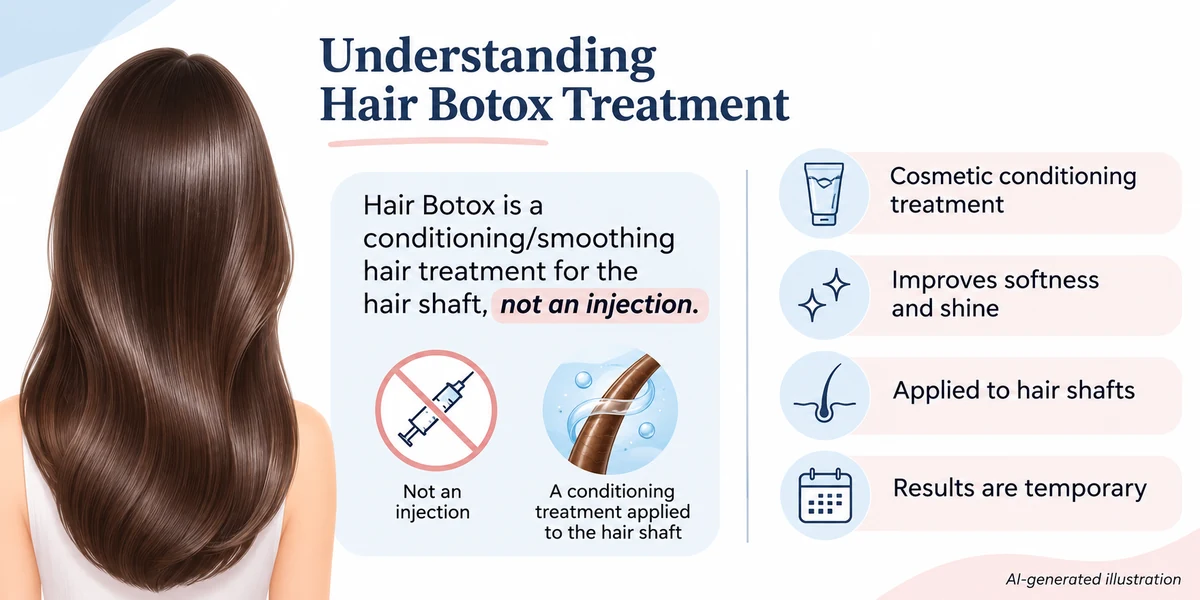
Hair Botox treatment is a cosmetic hair-conditioning or smoothing service intended to temporarily improve the appearance and manageability of the hair. Despite its name, conventional hair Botox does not involve Botox injections or botulinum toxin.
Products marketed as hair Botox may contain conditioning agents, proteins, amino acids, silicones, oils or other ingredients. Their formulations differ, and some procedures involve heat styling.
Hair Botox may make dry or frizzy hair appear smoother, but it does not permanently repair damaged hair follicles, reverse genetic hair loss or guarantee lasting results.
Understanding the product ingredients, treatment process, possible side effects and limitations is important before considering this cosmetic service.
What Is Hair Botox Treatment?
Hair Botox is a commercial term used for certain intensive hair-conditioning and smoothing treatments.
Unlike medical botulinum toxin treatment, it generally involves applying a cosmetic preparation to the hair shafts.
Depending on the product, the process may include washing, applying a conditioning formulation, leaving it on for a recommended period, rinsing and using heat to style or smooth the hair.
The term hair Botox does not describe one universally standardised formulation.
Therefore, products sold under this name should not automatically be assumed to contain the same ingredients or produce the same effects.
Does Hair Botox Contain Actual Botox?
Generally, no.
Medical Botox contains botulinum toxin type A, which is administered by injection for selected medical or cosmetic indications.
Hair Botox is normally a topical cosmetic treatment for the hair shaft.
| Feature | Hair Botox treatment | Medical Botox |
|---|---|---|
| Product category | Cosmetic hair-conditioning or smoothing product | Prescription botulinum toxin medicine |
| Main application | Hair shafts | Selected muscles or other medically indicated sites |
| Injection required | Generally no | Yes |
| Primary effect | Temporary hair-surface conditioning or smoothing | Modifies nerve signalling to targeted muscles |
| Treats hair loss | Not established | Not a routine treatment for hair loss |
| Medical procedure | Usually a salon service | Medical treatment |
The similar names should not be interpreted as evidence that the treatments work in the same way.
How Does Hair Botox Treatment Work?
Hair is made primarily of keratin, a structural protein.
The visible hair shaft is composed of non-living keratinised cells. Unlike living skin, it cannot biologically heal itself after damage.
Conditioning products may temporarily improve the appearance and feel of damaged strands by:
Coating parts of the hair surface
Improving lubrication
Reducing friction between strands
Making hair easier to comb
Temporarily reducing visible frizz
Improving perceived softness and shine
Some formulations contain hydrolysed proteins or other ingredients intended to condition damaged hair.
However, these effects should not be described as permanently rebuilding damaged hair or restoring destroyed hair follicles.
What Are the Possible Benefits of Hair Botox Treatment?
The possible cosmetic effects depend on the formulation and treatment method.
1. Reduced Frizz
Conditioning ingredients may temporarily smooth the hair surface and reduce the appearance of frizz.
2. Improved Hair Manageability
Some individuals may find that hair becomes easier to detangle, comb or style.
3. Temporary Softness
Conditioning agents may make dry hair feel softer.
4. Increased Shine
A smoother hair surface can change how light reflects from the strands, sometimes making hair appear shinier.
5. Reduced Friction and Breakage
Appropriate conditioning can reduce friction during grooming, potentially helping limit mechanical hair breakage.
However, a particular treatment cannot guarantee prevention of future hair damage.
6. Temporary Improvement in the Appearance of Damaged Hair
The treatment may temporarily reduce the visible appearance of roughness and dryness.
It cannot permanently reverse structural damage caused by repeated bleaching, heat or chemical processing.
Who May Consider Hair Botox Treatment?
Some people consider intensive conditioning or smoothing products for concerns such as:
Dry or rough hair
Frizz
Tangling
Difficulty managing hair during styling
Hair-shaft damage associated with heat styling
The appearance of dull or weathered hair
However, suitability depends on the product ingredients, hair condition, scalp health and potential sensitivity.
People with active scalp inflammation, a history of allergic reactions or substantial hair breakage should exercise particular caution.
A cosmetic hair treatment is not medically necessary for normal hair texture, curls or frizz.
How Is Hair Botox Treatment Performed?
The exact procedure depends on the product instructions.
Step 1: Hair and Scalp Assessment
The condition of the hair shafts and scalp is evaluated.
Existing dryness, breakage, irritation and previous chemical treatments should be considered.
Step 2: Washing
The hair may be washed to remove product buildup.
Some formulations recommend particular cleansing preparations.
Step 3: Product Application
The conditioning or smoothing product is applied according to its instructions.
Certain products are applied mainly to the hair lengths rather than directly to the scalp.
Step 4: Processing Period
The preparation remains on the hair for the time specified by its manufacturer.
Longer exposure does not necessarily produce a better result.
Step 5: Rinsing or Heat Styling
Depending on the product, the hair may be rinsed, blow-dried or treated with a heated styling device.
Heat can contribute to hair-shaft damage and may create exposure concerns with certain chemical formulations.
Step 6: Aftercare
The product manufacturer may provide instructions about washing, shampoo use and further styling.
These instructions vary and should not be treated as universal medical recommendations.
Hair Botox vs Keratin Treatment: What Is the Difference?
Both terms are used in the cosmetic hair-care industry, but products can differ considerably.
| Feature | Hair Botox | Keratin smoothing treatment |
|---|---|---|
| Main marketing purpose | Conditioning, softness and frizz reduction | Smoothing, frizz reduction or straightening |
| Standardised formulation | No | No single formulation |
| Contains actual Botox | Generally no | No |
| Ingredients | Vary by product | Vary by product |
| Heat treatment | May be used | Often used |
| Permanent repair of hair | Not established | Not established |
| Potential risks | Irritation, allergy, heat damage or chemical exposure | Irritation, allergy, heat damage or chemical exposure |
| Duration of visible effects | Variable | Variable |
Hair Botox is not automatically formaldehyde-free or safer than keratin treatment.
Some hair smoothing products release formaldehyde when heated. The risk must be assessed from the actual formulation, ingredients and use conditions rather than the salon treatment name.
Is Hair Botox Treatment Safe?
Safety depends on the specific product and how it is used.
A conditioning treatment using suitable products may be tolerated by many individuals. However, adverse effects remain possible.
Important factors include:
Ingredient composition
Known allergies
Scalp sensitivity
Previous colouring or chemical treatments
Heat exposure
Application method
Ventilation during the service
Manufacturer safety instructions
Products marketed as natural, protein-based or chemical-free are not necessarily free from irritating or hazardous ingredients.
Why Ingredient Checking Matters
Some hair smoothing products contain or release formaldehyde, particularly when heated.
Exposure may cause irritation of the eyes, nose, throat or skin, and respiratory symptoms.
The US Food and Drug Administration advises checking ingredient information and taking exposure concerns seriously.
Formaldehyde-free claims should also be assessed carefully because some formulations may contain substances capable of releasing formaldehyde during use.
What Are the Possible Side Effects of Hair Botox?
Potential adverse effects depend on the ingredients and process.
1. Scalp Irritation
Some products may cause itching, burning, redness or discomfort.
2. Allergic Contact Dermatitis
Certain ingredients, including fragrances and preservatives, may trigger allergic skin reactions.
3. Hair Breakage
Repeated high-temperature styling or unsuitable chemical processing may contribute to brittle hair and breakage.
4. Temporary Loss of Volume
Some conditioning treatments can weigh down fine hair, making it appear flatter.
5. Eye or Respiratory Irritation
Products that release irritating vapours during heating may cause watery eyes, coughing or throat irritation.
6. Unwanted Hair Texture Changes
The hair may feel heavy, stiff, unusually coated or different from the expected texture.
7. Unsatisfactory Cosmetic Results
The degree of smoothing and the duration of effects vary.
A particular improvement in shine, softness or frizz cannot be guaranteed.
Can Hair Botox Cause Hair Fall?
Hair Botox is not an established cause of every type of hair loss, but some treatment-related problems may contribute to apparent thinning or shedding.
For example:
Excessive heat may cause hair-shaft breakage.
Scalp irritation may occur after exposure to unsuitable products.
Allergic or inflammatory reactions may require medical attention.
Pre-existing hair loss may continue independently of the cosmetic treatment.
It is important to distinguish broken hair shafts from hair shedding at the root.
Persistent shedding, bald patches or scalp inflammation should be evaluated by a dermatologist.
For more information, read Hair Fall Treatment for Men: Causes and Treatment Options.
Can Hair Botox Treat Hair Loss or Promote Hair Regrowth?
There is no established evidence that salon hair Botox treatments reliably reverse androgenetic alopecia, alopecia areata or scarring hair loss.
The treatment primarily targets the visible hair shafts.
It does not directly correct common causes of hair loss such as genetic susceptibility, immune-related conditions or permanent follicular damage.
Some people may notice less breakage after appropriate conditioning, but this should not be confused with increased hair follicle growth.
If thinning is related to repeated pulling from tight hairstyles, removing the source of tension is essential.
Related reading: Traction Alopecia: Causes, Treatment and Hair Regrowth.
How Long Does Hair Botox Treatment Last?
There is no universally established duration because hair Botox is not a standardised procedure.
The visible cosmetic effects depend on:
The ingredients used
Hair porosity and condition
Frequency of washing
Subsequent heat or chemical treatments
Hair-care products
Environmental exposure
Individual hair characteristics
Some commercial products advertise effects lasting several weeks or months, but these claims cannot be applied to every formulation.
As the coating or conditioning effect decreases with washing and styling, hair may gradually return towards its previous texture and manageability.
Hair Botox Treatment: Effects and Limitations
| Possible effect | Important limitation |
|---|---|
| Hair may feel softer | Does not permanently repair damaged hair |
| Frizz may appear reduced | Effects vary with humidity and washing |
| Hair may look shinier | Visible shine is not proof of improved follicle health |
| Combing may become easier | Hair can still break with aggressive styling |
| Some strands may appear smoother | Does not reliably straighten every hair type |
| Temporary cosmetic improvement | Does not treat underlying medical hair loss |
These distinctions help separate visible hair conditioning from medical treatment.
Is Hair Botox Suitable for Coloured or Chemically Treated Hair?
Some conditioning formulations are marketed for previously coloured or chemically processed hair.
However, hair that has undergone bleaching, relaxing, permanent colouring or repeated heat exposure may be more vulnerable to additional damage.
The safety of combining treatments depends on:
Previous chemical exposure
Condition of the hair shafts
Product compatibility
Heat settings
Processing times
Potential scalp sensitivity
Repeated processing should not be assumed to be safe simply because the service is described as conditioning.
Hair Botox Aftercare: How to Reduce Additional Hair Damage
General protective hair-care practices may include:
Gentle Washing
Use an appropriate shampoo and avoid aggressive rubbing of the hair lengths.
Regular Conditioning
Conditioners and detangling products may reduce friction and help prevent breakage.
Careful Drying
Avoid vigorously rubbing wet hair with a towel.
A soft towel or microfibre wrap may reduce unnecessary friction.
Limiting Excessive Heat
Frequent use of straighteners, curling irons and high-temperature dryers can damage hair shafts.
When heat styling is necessary, use appropriate temperature settings and limit exposure.
Avoiding Repeated Chemical Processing
Frequent straightening, bleaching and other chemical procedures may increase cumulative hair damage.
Reducing Traction
Avoid hairstyles and accessories that repeatedly pull on the hair.
For general guidance on different causes of thinning and medical management, see Treatment Options for Male Hair Loss at Age 25.
Hair Botox Treatment: Safety and Hair-Care Checklist

Before considering the treatment, review the following:
Identify the concern: Distinguish frizz or hair breakage from true hair loss.
Check ingredients: Ask for the actual product name and ingredient information.
Avoid misleading claims: Hair Botox is not the same as injected Botox.
Review chemical exposure: Do not assume all smoothing products are formaldehyde-free.
Consider allergies: Disclose previous reactions to cosmetics or hair products.
Assess scalp health: Avoid applying unsuitable products to an irritated scalp.
Understand heat-related risks: High temperatures may damage fragile hair.
Follow manufacturer instructions: Processing methods and aftercare vary.
Use gentle hair care: Reduce excessive heat, traction and harsh handling.
Watch for warning signs: Burning, persistent itching, coughing or unusual shedding require attention.
Seek medical assessment: Persistent hair loss or scalp inflammation needs an appropriate diagnosis.
These steps may reduce avoidable risks but cannot guarantee that a cosmetic treatment will be free of adverse effects.
When Should You Seek Medical Attention?
Seek professional medical assessment if a hair treatment is followed by:
Persistent scalp burning or redness
Blisters or significant skin irritation
Severe itching or rash
Unusual hair shedding
Bald patches
Increasing scalp pain
Persistent coughing or respiratory irritation
Difficulty breathing, swelling of the face or throat, or other symptoms of a severe allergic reaction require emergency medical care.
Frequently Asked Questions
1. What is hair Botox treatment?
Hair Botox is a cosmetic conditioning or smoothing treatment applied to the hair shafts. It generally does not contain botulinum toxin or involve injections.
2. Does hair Botox permanently repair damaged hair?
No. Conditioning ingredients may temporarily improve softness, shine and manageability, but the hair shaft cannot biologically repair itself like living tissue.
3. Is hair Botox better than keratin treatment?
Neither is automatically better or safer. Products marketed under both names vary in ingredients, treatment methods and risks. The actual formulation should be reviewed.
4. How long do hair Botox results last?
The duration varies according to the product, hair condition, washing frequency and styling habits. There is no universal timeline applicable to all hair Botox treatments.
5. Can hair Botox cause hair loss?
Certain treatment-related problems, including excessive heat damage or scalp irritation, may contribute to hair breakage or other concerns. Persistent shedding requires medical assessment.
6. Does hair Botox help hair grow back?
Hair Botox is not an established treatment for medical hair loss. It may improve the appearance of the hair shafts but cannot reliably regenerate damaged follicles.
7. What are the main risks of hair Botox treatment?
Possible risks include scalp irritation, allergic reactions, hair breakage, unwanted texture changes and exposure to irritating chemicals or vapours, depending on the product used.
Conclusion
Hair Botox treatment is a cosmetic term for certain hair-conditioning or smoothing services.
It may temporarily improve the appearance of dry, frizzy or difficult-to-manage hair, but it should not be described as a medical hair-regrowth treatment or a permanent repair for damaged hair.
Because formulations vary, the treatment name alone does not establish safety.
Understanding ingredients, heat exposure, possible adverse effects and the difference between hair-shaft breakage and medical hair loss is important before considering treatment.
Disclaimer: All content and visuals on this website are for educational and informational purposes only. Images may be AI-generated or illustrative. Individual treatment results may vary. This information does not replace professional medical advice, diagnosis or consultation.