
Decoding Swelling 6 Months After Liposuction
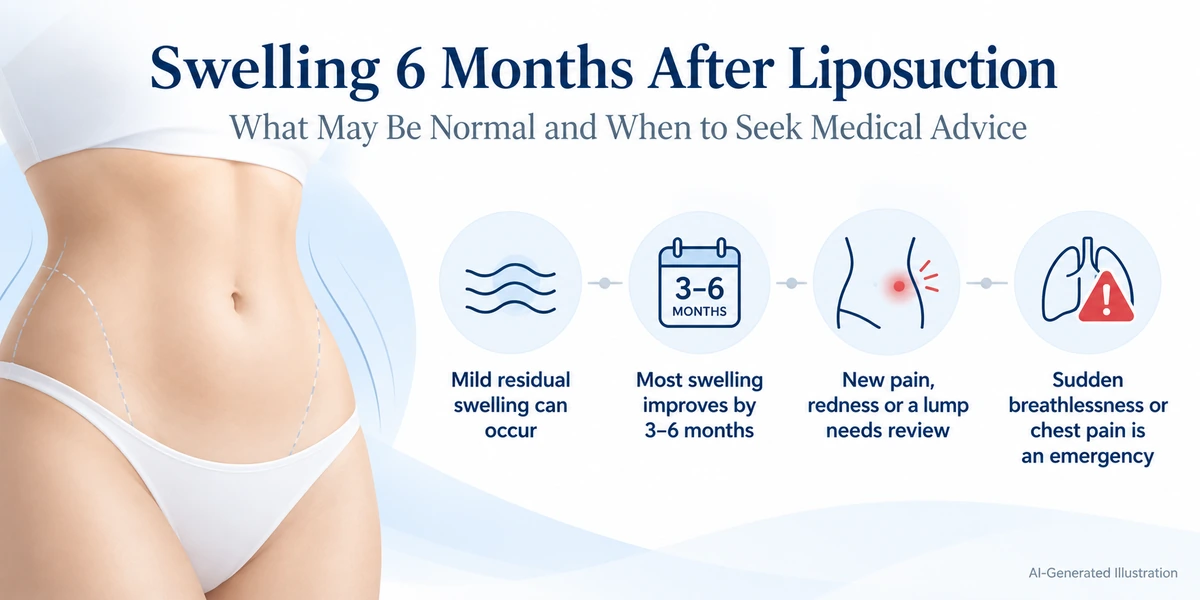
Swelling is a common part of recovery after liposuction surgery. It develops as the body responds to tissue injury, inflammation and temporary changes in fluid movement within the treated area.
During the first few weeks after the procedure, swelling is generally expected. As healing progresses, much of the swelling gradually decreases, and changes in the treated area’s shape become easier to assess.
However, some individuals continue to notice swelling 6 months after liposuction. The affected area may feel puffy, firm, uneven or different from surrounding tissue.
Although mild residual swelling can sometimes occur during prolonged recovery, swelling that remains noticeable at six months should be evaluated in the context of the individual’s surgical history, healing progress and associated symptoms.
Persistent fullness may be related to residual oedema, tissue fibrosis, fluid accumulation or other conditions that cannot be reliably distinguished by appearance alone.
This article explains why swelling may persist six months after liposuction, how postoperative healing progresses, possible complications, appropriate recovery measures and the signs that require medical assessment.
What Is Liposuction?
Liposuction is a surgical procedure that removes selected deposits of subcutaneous fat from specific areas of the body.
A narrow surgical instrument called a cannula is introduced through small incisions to remove fat using suction.
Different liposuction techniques may use additional methods to assist fat removal, including fluid infiltration, ultrasound energy or other technologies.
Common treatment areas include:
-
Abdomen and waist
-
Hips and flanks
-
Thighs
-
Upper arms
-
Back
-
Chest
-
Chin and neck
Liposuction is intended for body contouring rather than treatment of obesity.
The procedure removes a portion of fat cells from the targeted area, but it does not prevent future changes in body weight or fat distribution.
Recovery depends on several factors, including how much tissue was treated, the number of areas involved, the surgical technique and individual healing characteristics.
Why Does Swelling Occur After Liposuction?
Postoperative swelling, medically called oedema, develops when fluid accumulates in the tissues.
Liposuction affects fat, connective tissue, blood vessels and small lymphatic channels within the treated area.
Following surgery, the body begins an inflammatory and repair response.
Several processes can contribute to swelling.
1. Tissue Inflammation
The surgical removal of fat produces controlled tissue injury.
The resulting inflammatory response increases blood flow and temporarily changes fluid movement between blood vessels and surrounding tissues.
This can cause swelling, tenderness and firmness.
2. Changes in Lymphatic Drainage
The lymphatic system helps transport excess tissue fluid back into the circulation.
Liposuction can temporarily disrupt small lymphatic vessels.
During recovery, fluid drainage may be less efficient in some treated areas.
3. Fluid Introduced During Surgery
Many liposuction techniques involve injecting a fluid solution into the treatment area.
Some postoperative fullness may initially be related to the distribution and absorption of this fluid.
However, this is mainly an early postoperative consideration and should not be assumed to explain swelling persisting six months later.
4. Tissue Healing and Collagen Formation
Connective tissues undergo repair after surgery.
Collagen deposition and remodelling can produce temporary firmness or uneven texture.
These changes may be confused with swelling.
5. Individual Healing Differences
People vary in their inflammatory response, circulation, tissue characteristics and speed of recovery.
Consequently, swelling may resolve at different rates.
Is Swelling Normal 6 Months After Liposuction?
Some individuals continue to notice minor changes in tissue fullness or firmness at six months.
However, most routine postoperative swelling is expected to have improved substantially by this stage.
The Cleveland Clinic’s medical guide to liposuction recovery explains that swelling and fluid retention generally decrease as recovery progresses and that visible results may take approximately three to six months to develop.
Therefore, six months is a useful point for reviewing healing progress, but it is not a universal deadline for complete tissue recovery.
When May Residual Swelling Be Less Concerning?
Residual swelling may be less concerning when it is:
-
Mild
-
Gradually decreasing
-
Not associated with increasing pain
-
Not accompanied by redness or warmth
-
Not associated with fever or discharge
-
Consistent with the documented recovery pattern
Even in these circumstances, persistent swelling should be discussed during postoperative follow-up.
When Is Swelling More Concerning?
Swelling warrants assessment when it:
-
Appears suddenly after previous improvement
-
Continues increasing
-
Is distinctly one-sided
-
Causes increasing pain
-
Forms a new localized bulge
-
Occurs with redness or warmth
-
Is associated with fever or wound discharge
A clinical examination may be necessary to distinguish normal tissue changes from complications.
Causes of Swelling 6 Months After Liposuction
Several conditions may contribute to persistent fullness, firmness or swelling after liposuction.
These causes differ in their significance and treatment requirements.
1. Residual Postoperative Oedema
Some tissue fluid may remain during prolonged healing.
This can be more noticeable following extensive procedures or in individuals with slower fluid clearance.
Residual oedema may cause:
-
Mild puffiness
-
A sensation of heaviness
-
Temporary changes in tissue firmness
-
Variation in appearance throughout the day
Nevertheless, persistent oedema should not be diagnosed without assessing other possible causes.
2. Fibrosis and Scar Tissue Formation
Fibrosis refers to the development of fibrous connective tissue during healing.
Following liposuction, collagen and scar tissue may form within the treated area.
This can create:
-
Firmness
-
Tightness
-
Small palpable irregularities
-
Reduced tissue flexibility
-
Uneven surface texture
Fibrosis is not identical to fluid-related swelling, although the two can coexist.
Some firmness gradually improves as tissue remodelling continues.
Persistent or painful fibrosis may require professional assessment.
3. Seroma Formation
A seroma is a collection of fluid beneath the skin.
It may occur when fluid accumulates in a space created during surgery.
A seroma may cause:
-
Localized swelling
-
A soft or fluctuant bulge
-
Asymmetry
-
A feeling of fluid movement
-
Discomfort or pressure
Some seromas resolve spontaneously, while others require drainage or additional treatment.
Persistent, recurrent or encapsulated fluid collections may need further evaluation.
4. Haematoma
A haematoma is a collection of blood within tissue.
Haematomas usually develop closer to the time of surgery rather than first appearing six months later.
However, a new haematoma or unresolved collection may occasionally be relevant when investigating a lump or swelling.
Associated symptoms may include pain, firmness and skin discolouration.
5. Skin Laxity
Liposuction removes fat but does not reliably remove or tighten excess skin.
When the overlying skin does not retract as expected, the treated area may appear loose, folded or uneven.
This appearance can sometimes be mistaken for persistent swelling.
Skin laxity and oedema require different assessments and should not be treated as the same condition.
6. Residual Fat or Contour Irregularity
Some fullness may result from remaining subcutaneous fat rather than swelling.
Uneven fat distribution or postoperative contour irregularities can affect how the treated area appears.
These findings may become more apparent as routine swelling decreases.
Clinical assessment is needed before attributing persistent fullness to residual fat.
7. Weight Changes
Weight gain after liposuction can increase the size of remaining fat cells.
This may change the appearance of the treated area.
Liposuction removes fat cells from selected areas but does not prevent future weight gain.
Changes caused by weight gain are different from postoperative oedema.
8. Other Medical Conditions
Not all swelling occurring months after surgery is caused by the operation.
Other conditions may contribute to fluid retention or tissue enlargement.
Depending on the symptoms and location, clinicians may consider:
-
Venous circulation problems
-
Lymphatic disorders
-
Medication-related swelling
-
Infection
-
Inflammatory conditions
-
Systemic causes of oedema
New or persistent swelling should therefore be assessed on its own clinical features.
Liposuction Swelling Recovery Timeline
The following table outlines common recovery patterns.
| Recovery stage | Common observations |
|---|---|
| First 48–72 hours | Swelling, bruising, fluid drainage and tenderness may be prominent |
| Week 1 | Swelling and bruising remain noticeable; discomfort may begin improving |
| Weeks 2–3 | Early swelling may gradually decrease; tissue firmness can remain |
| Weeks 4–6 | Further reduction in swelling and improvement in daily movement |
| Months 2–3 | Treated areas may become less swollen, although firmness or irregularities may persist |
| Months 3–6 | Continued tissue settling; overall contour becomes easier to assess |
| Beyond 6 months | Additional remodelling may occur, but persistent or new swelling warrants clinical review |
These are approximate stages rather than guaranteed recovery milestones.
The timing varies according to surgical technique, treatment extent and individual healing.
Why Does the Stomach Still Look Big After Liposuction?
Some individuals remain concerned about abdominal fullness several months after surgery.
However, a larger-than-expected abdominal appearance does not always indicate persistent swelling.
Possible explanations include:
Residual Oedema
Fluid remaining in the tissues may temporarily increase abdominal fullness.
Remaining Subcutaneous Fat
Liposuction removes selected fat deposits rather than every fat cell in the treatment area.
Visceral Fat
Fat located deeper inside the abdominal cavity, around internal organs, is not removed through routine subcutaneous liposuction.
This can contribute to abdominal prominence.
Loose Skin
Skin may remain loose after fat removal, particularly when elasticity is limited.
Abdominal Wall Characteristics
Rectus diastasis, abdominal wall laxity or other structural conditions may influence abdominal contour.
Weight Changes
An increase in body weight can change the size and distribution of remaining fat deposits.
These factors require different approaches to evaluation.
For a related discussion of abdominal surgery recovery, see what to expect three weeks after tummy tuck surgery.
Tummy tuck surgery and liposuction are different procedures, and their healing timelines should not be considered interchangeable.
Is a Hard Stomach Normal 6 Months After Liposuction?
Some individuals notice persistent firmness in the abdomen or other treated areas.
Possible causes include scar tissue, fibrosis, fat necrosis, fluid collections or other tissue changes.
Mild firmness can occur during tissue remodelling.
However, a hard or painful lump should not automatically be considered normal.
What Does Fibrosis Feel Like?
Fibrotic tissue may feel:
-
Firm
-
Thickened
-
Uneven
-
Tight
-
Less mobile than surrounding tissue
The appearance and texture vary.
Can Fibrosis Improve Over Time?
Some postoperative fibrosis softens as collagen remodelling progresses.
However, improvement is variable.
Persistent thickening, pain or significant irregularity may require assessment.
Should Hard Areas Be Massaged?
Aggressive massage should not be used to treat an unexplained lump.
Massage may be inappropriate when swelling results from a seroma, infection, vascular problem or another condition.
Any manual treatment should follow an appropriate diagnosis and medical advice.
What Is the Difference Between Swelling, Fibrosis and a Seroma?
These conditions can sometimes appear similar externally.
| Feature | Swelling or oedema | Fibrosis | Seroma |
|---|---|---|---|
| Main process | Fluid accumulation within tissue | Scar-related connective tissue formation | Localized pocket of fluid |
| Typical texture | Puffy or swollen | Firm or thickened | May feel soft or fluctuant |
| Distribution | May affect a broader area | Often localized or uneven | Usually a more defined collection |
| Symptoms | Fullness or heaviness | Tightness or firmness | Bulge, pressure or discomfort |
| Evaluation | Clinical assessment | Examination; imaging if needed | Often assessed with ultrasound |
These are general characteristics, not diagnostic rules.
More than one condition may occur together.
A clinician may recommend imaging, such as ultrasound, if a fluid collection is suspected.
Can Swelling Last for a Year After Liposuction?
In selected cases, tissue remodelling and minor changes in swelling can continue beyond six months.
However, swelling persisting for twelve months should not automatically be regarded as a routine part of recovery.
By that point, most people are expected to have experienced substantial improvement.
Persistent swelling may require investigation for fluid collections, fibrosis, lymphatic problems or unrelated medical conditions.
The appropriate response depends on the location, severity, progression and associated symptoms.
What Can Help Manage Swelling After Liposuction?
Appropriate management depends on the underlying cause.
Measures used during early recovery may not be equally useful six months later.
1. Follow Individual Postoperative Guidance
The treating healthcare professional can assess whether healing is progressing as expected.
Persistent or recurrent swelling may require a change in management or further investigation.
2. Use Compression Garments Only as Advised
Compression garments are frequently used during the initial recovery period.
They may help support tissues and manage swelling.
However, routine use for six months is not necessary for everyone.
Continuing or restarting compression should be based on individual advice rather than the assumption that tighter compression will eliminate swelling.
A poorly fitted garment can cause discomfort, pressure marks or skin irritation.
3. Maintain Gentle Physical Activity
Appropriate movement supports general circulation and mobility.
Walking may be useful when medically permitted.
However, excessive exercise or activities that worsen pain and swelling should be avoided until the cause has been assessed.
4. Maintain Balanced Nutrition
Adequate protein, vitamins, minerals and calories support normal tissue repair.
No specific food or supplement has been shown to guarantee the disappearance of postoperative swelling.
5. Stay Appropriately Hydrated
Normal hydration supports physiological function.
Excessive water intake is not a proven treatment for persistent postoperative oedema.
6. Avoid Smoking and Nicotine Exposure
Smoking and nicotine can affect blood circulation and tissue repair.
Avoiding these exposures supports overall healing.
7. Use Prescribed Medicines Correctly
Medication use should follow medical instructions.
Do not independently take diuretics, anti-inflammatory medicines, antibiotics or supplements to treat unexplained swelling.
8. Attend Follow-Up Assessments
Clinical review can help identify:
-
Fluid collections
-
Scar tissue abnormalities
-
Persistent inflammation
-
Contour irregularities
-
Unrelated causes of swelling
Early identification of an abnormal recovery pattern may help avoid delayed treatment.
Does Lymphatic Massage Help Swelling After Liposuction?
Manual lymphatic drainage is sometimes discussed as a postoperative treatment.
The technique involves gentle movements intended to support lymphatic fluid movement.
However, evidence regarding its effectiveness after liposuction remains limited, and benefits should not be assumed for every patient.
At six months, a person with persistent swelling should first have the underlying cause assessed.
Massage may be inappropriate in the presence of infection, untreated blood clots or certain fluid collections.
It should not replace diagnosis or necessary medical treatment.
Can Compression Garments Reduce Swelling After 6 Months?
Compression is commonly recommended during early liposuction recovery.
The American Society of Plastic Surgeons’ liposuction recovery guidance describes postoperative compression and individualized activity instructions as aspects of recovery care.
However, there is no universal requirement to wear compression garments for six months.
The duration depends on the procedure, the individual and the treating professional’s assessment.
At six months, persistent swelling should not simply be managed by increasing garment pressure without investigating its cause.
Can Swelling Return After It Has Gone Away?
Yes, but recurrent swelling requires evaluation.
Possible explanations include changes in activity, localized inflammation, fluid accumulation or unrelated medical conditions.
A new bulge after a period of improvement is different from gradually decreasing postoperative swelling.
Sudden swelling, particularly when painful or associated with redness, should not be attributed automatically to liposuction recovery.
Can Liposuction Cause Long-Term Lymphatic Problems?
Liposuction can disrupt small lymphatic vessels within the treated area.
In most cases, postoperative fluid movement improves as tissues recover.
Persistent lymphatic dysfunction is possible but should not be assumed solely because swelling remains at six months.
Some individuals may require assessment for lymphatic or venous disorders, particularly when swelling affects a limb or occurs with other suggestive symptoms.
Appropriate evaluation depends on the location and clinical findings.
Does Liposuction Cause Permanent Swelling?
Permanent swelling is not an expected or intended outcome of liposuction.
However, persistent tissue changes or complications can sometimes create long-term fullness.
These may include fibrosis, chronic fluid collections or lymphatic dysfunction.
Other conditions unrelated to the procedure may also cause swelling.
Any apparent permanent change requires proper evaluation to establish its cause.
Does the Belly Button Change During Liposuction Recovery?
Abdominal liposuction may cause temporary swelling or changes in the skin around the belly button.
Its appearance can be influenced by:
-
Tissue swelling
-
Skin elasticity
-
Remaining fat distribution
-
Scar-related changes
-
Abdominal wall anatomy
Liposuction does not routinely involve the same belly-button repositioning performed in some tummy tuck procedures.
For additional information about abdominal contour changes, read belly button changes after liposuction.
Persistent swelling, unusual discharge, significant pain or a newly developing bulge near the belly button should be medically evaluated.
When Does Skin Tighten After Liposuction?
Skin may gradually adapt to the underlying tissue changes as postoperative swelling decreases.
However, the degree of skin retraction depends on factors such as age, skin elasticity, prior stretching and the amount of fat removed.
Liposuction does not reliably correct significant excess skin.
Some individuals continue to have loose or folded skin after healing.
The appearance of loose skin should not automatically be interpreted as swelling.
Can Fat Grow Back After Liposuction?
Liposuction removes fat cells from selected treatment areas.
However, the procedure does not remove every fat cell and does not prevent future weight gain.
Remaining fat cells can enlarge if body weight increases.
This can change the appearance of both treated and untreated areas.
Normal ageing, hormonal changes and pregnancy may also influence body shape.
Therefore, long-term abdominal fullness may reflect changes in fat distribution rather than postoperative swelling.
Does Liposuction Affect Future Pregnancy?
Liposuction does not generally prevent pregnancy.
However, pregnancy can change abdominal skin, fat distribution and body contours.
These changes may affect the appearance of a previously treated area.
Timing of elective procedures should be considered individually, taking medical history and future pregnancy plans into account.
The effects of pregnancy on prior liposuction results cannot be predicted precisely.
What Happens Years After Liposuction?
Long-term changes following liposuction depend on several factors.
These may include:
-
Normal ageing
-
Changes in body weight
-
Skin elasticity
-
Hormonal influences
-
Pregnancy
-
Residual fat distribution
-
Scar tissue characteristics
The treated area may maintain some contour changes, but its appearance is not guaranteed to remain unchanged indefinitely.
A stable weight and balanced lifestyle may support general health, but they cannot prevent all age-related or hormonal changes.
For related information about healing after abdominal body-contouring surgery, see recovery and scar changes three months after tummy tuck surgery.
What Complications May Cause Persistent Swelling?
Most postoperative swelling improves without serious complications.
However, persistent or worsening swelling may occasionally be associated with conditions requiring treatment.
Seroma
A localized fluid collection may create a soft or fluctuant bulge.
Some collections require aspiration or other intervention.
Infection
Infection may cause warmth, pain, redness, discharge or fever.
A late infection is less typical than an early postoperative infection but can occur.
Fat Necrosis
Fat necrosis occurs when areas of fat tissue are injured and undergo inflammatory changes.
It may cause a firm lump or localized contour change.
Fibrosis
Excessive or irregular scar tissue may cause persistent firmness or unevenness.
Venous or Lymphatic Problems
Circulatory or lymphatic disorders may cause swelling, especially in the limbs.
Blood Clots
Deep vein thrombosis can cause swelling, pain, warmth or tenderness in a leg.
Although clot risk is particularly relevant during the earlier postoperative period, symptoms of a possible clot require urgent assessment whenever they occur.
A pulmonary embolism may cause sudden shortness of breath, chest pain, coughing blood or fainting.
These symptoms require emergency medical care.
When Should You Seek Medical Attention for Swelling?
At six months after liposuction, persistent swelling should be discussed with a qualified healthcare professional, particularly if it has not continued to improve.
Seek timely assessment if you experience:
-
New or increasing swelling
-
Persistent localized fluid-like fullness
-
A new or enlarging lump
-
Increasing pain or tenderness
-
Redness or warmth
-
Fever
-
Drainage or skin breakdown
-
Progressive asymmetry
-
Significant changes in skin colour
Seek emergency medical care for sudden breathlessness, chest pain, fainting or symptoms suggestive of a blood clot.
Do not attempt to drain a suspected seroma or treat severe swelling with unprescribed medication.
How Is Persistent Swelling Evaluated?

A healthcare professional may begin by reviewing the surgical and medical history.
The assessment may consider:
Surgical Details
The treatment areas, surgical technique, procedure date and any known postoperative complications.
Symptom History
When the swelling began, whether it improved or worsened, and whether there is pain, redness or fever.
Physical Examination
The clinician may examine the area for tenderness, tissue firmness, fluctuance, skin changes or asymmetry.
Ultrasound
Ultrasound may help identify localized fluid collections or other tissue abnormalities.
Additional Tests
Blood tests or other imaging may be considered if infection, vascular problems or systemic causes are suspected.
The choice of investigations depends on the clinical findings.
Frequently Asked Questions
1. Is swelling normal 6 months after liposuction?
Mild residual swelling may occasionally persist, but most routine swelling should have improved substantially. Persistent, new or worsening swelling should be evaluated rather than automatically considered normal.
2. How long does swelling last after liposuction?
Swelling usually decreases over weeks and months. Many individuals notice substantial improvement within three to six months, although healing patterns vary.
3. Can liposuction swelling last for a year?
Some tissue changes may continue beyond six months, but swelling lasting a year should not automatically be considered routine. Medical assessment may be needed to exclude other causes.
4. Why is my stomach still big after liposuction?
Persistent abdominal fullness may result from swelling, remaining fat, visceral fat, skin laxity, abdominal wall characteristics or weight changes. Examination may be necessary to identify the cause.
5. Why is my stomach hard 6 months after liposuction?
Firmness may be related to fibrosis, scar tissue or other postoperative changes. A new, painful or enlarging hard area should be assessed.
6. Can compression garments help after 6 months?
Compression garments are commonly used during early recovery. Continued use at six months should be based on individualized medical advice and the underlying cause of swelling.
7. Does lymphatic drainage massage reduce swelling after liposuction?
It may be considered in selected cases, but evidence of effectiveness is limited. Persistent swelling should be assessed before massage is started.
Conclusion
Swelling after liposuction develops as part of the body’s normal response to surgical tissue injury.
Although the greatest changes often occur during the first few weeks, tissue healing and contour changes can continue over several months.
At six months, most routine swelling is expected to have improved substantially. Minor residual swelling or firmness may sometimes remain, but persistent symptoms should be assessed according to their pattern and associated findings.
Not every area of fullness represents oedema. Fibrosis, seroma formation, skin laxity, residual fat, weight changes and unrelated medical conditions can produce similar appearances.
Understanding these differences is important because each condition may require a different approach.
Appropriate follow-up, individualized postoperative care and prompt assessment of unusual symptoms remain essential for safe recovery.
Medical Disclaimer
This article is intended for general educational purposes only and does not replace individual medical advice, diagnosis or treatment. The information should not be used to determine personal suitability for surgery. A qualified medical professional should