
Facial Contouring Surgery in Navi Mumbai | Dr. Vinod Vij
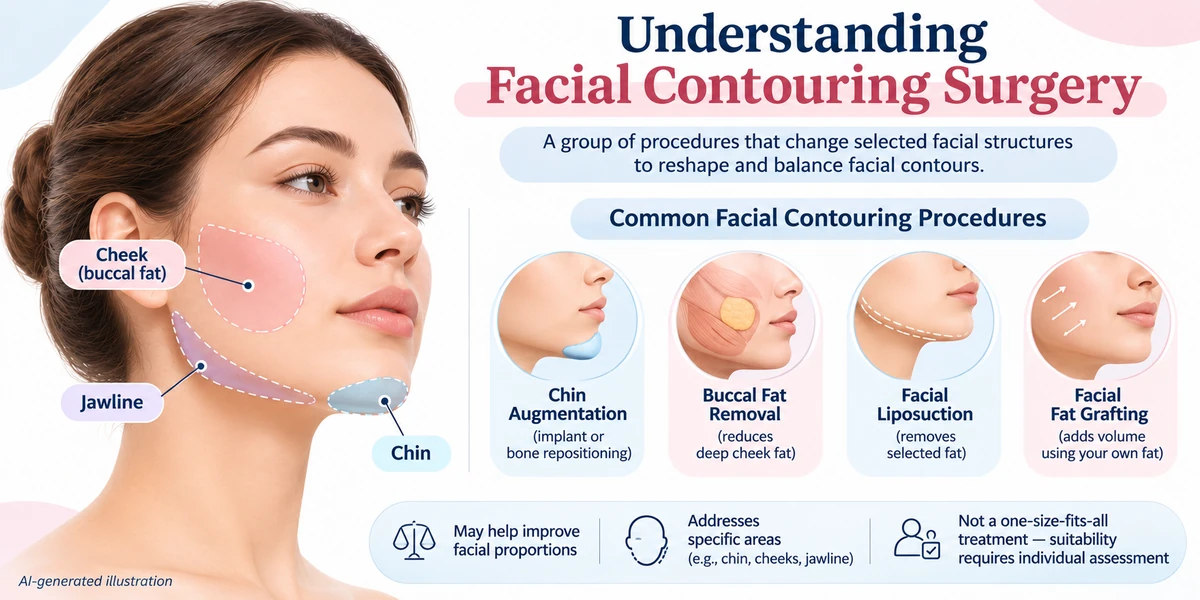
Facial contouring surgery refers to a group of procedures that change selected facial structures, including the chin, cheeks and jawline. Depending on individual anatomy, treatment may involve adding volume, removing selected fat deposits, reshaping bone or repositioning tissues.
Common facial contouring procedures include chin augmentation, buccal fat removal, selected facial liposuction, facial fat grafting and bone-based chin or jaw procedures.
Each addresses a different anatomical concern. For example, buccal fat removal targets deep cheek fat, while a chin implant increases local chin projection. Neither procedure can correct every type of facial asymmetry or jawline concern.
There is no single facial contouring procedure suitable for every face shape. The choice depends on anatomy, medical fitness, potential risks and realistic expectations.
This article explains the types of facial contouring surgery, how suitability is assessed, procedure differences, recovery, complications and long-term considerations.
What Is Facial Contouring Surgery?
Facial contouring is a broad term for surgical procedures that alter the shape, projection or volume of specific facial areas.
The procedures may involve:
Adding volume using implants or transferred fat
Removing selected deep or superficial fat
Reshaping or repositioning the chin bone
Modifying other facial skeletal structures in selected cases
Repositioning soft tissues when appropriate
Some procedures are performed for reconstructive reasons, while others are elective cosmetic operations.
Facial contouring is not necessarily medically required. Natural differences in face shape, cheek fullness, jawline definition and facial symmetry are common.
The potential benefit of surgery should always be considered alongside its risks and limitations.
What Determines Facial Shape?
Facial appearance results from several interacting anatomical structures.
1. Facial Bone Structure
The cheekbones, upper jaw, lower jaw and chin contribute to facial width, projection and proportions.
Differences in skeletal anatomy can make a face appear rounder, narrower, longer or more angular.
2. Deep Facial Fat
Deep fat compartments, including the buccal fat pads, contribute to facial volume.
Their size varies naturally between individuals.
3. Superficial Facial Fat
Fat closer to the skin can influence cheek fullness, the lower face and selected jawline areas.
Its distribution may change with body weight and ageing.
4. Facial Muscles
The masseter muscles are important for chewing.
Prominent masseter muscles can contribute to a wider lower-face appearance.
5. Skin and Soft-Tissue Characteristics
Skin elasticity, thickness and supporting tissues affect facial contours.
Skin laxity may produce a less-defined lower face even when excess fat is not present.
6. Ageing and Weight Changes
Ageing can alter facial fat distribution, bone support and skin elasticity.
Weight changes may also influence facial volume.
Because these factors differ between individuals, a treatment that addresses one anatomical structure may have little effect on another.
What Are the Different Types of Facial Contouring Surgery?
The term covers several surgical approaches.
1. Chin Implant Surgery
A chin implant is placed over the chin bone to increase chin projection or alter its contour.
It may be considered in selected individuals with an underprojected chin.
However, it does not move the entire lower jaw or correct an abnormal dental bite.
2. Sliding Genioplasty
Sliding genioplasty is a bone-based procedure that changes the position of a portion of the chin bone.
Unlike a chin implant, this operation involves cutting and repositioning bone.
It may be relevant when an anatomical assessment identifies a need for bony chin repositioning.
3. Buccal Fat Removal
Buccal fat removal involves removing a selected portion of the deep buccal fat pad through an incision inside the mouth.
It may be considered for persistent lower-cheek fullness caused by prominent buccal fat.
Excessive removal can contribute to unwanted hollowing as facial tissues change with age.
4. Facial Liposuction
Facial liposuction removes selected superficial fat deposits using a surgical cannula.
It may be considered in anatomically suitable areas where superficial fat contributes to fullness.
It does not directly remove the deep buccal fat pad.
5. Facial Fat Grafting
Facial fat grafting involves collecting fat from another body area and transferring it into selected facial tissues.
It may be considered when adding volume is appropriate.
Some transferred fat may survive long-term, but graft survival and the final amount of volume are variable.
6. Selected Jaw or Skeletal Procedures
More extensive structural concerns may require assessment by an appropriately trained maxillofacial or craniofacial surgeon.
These procedures may involve the underlying jawbones and differ significantly from soft-tissue contouring.
A recessed lower jaw with an abnormal bite, for example, cannot be corrected simply by removing facial fat or adding a chin implant.
Facial Contouring Procedures: Comparison Table
| Procedure | Main anatomical target | Important limitation |
|---|---|---|
| Chin implant | Chin projection | Does not reposition the lower jaw |
| Sliding genioplasty | Chin bone | Requires bone surgery and healing |
| Buccal fat removal | Deep cheek fat | Excessive removal may create hollow cheeks |
| Facial liposuction | Selected superficial fat | Does not correct bone structure or significant skin laxity |
| Facial fat grafting | Selected areas of volume loss | Fat survival is variable |
| Jaw surgery | Specific skeletal discrepancies | Requires specialised assessment and involves substantial surgical risks |
No single approach is appropriate for every facial concern.
Which Facial Contouring Procedure Is Suitable for Different Face Shapes?
The appearance of the face alone does not establish the underlying cause.
Round or Full Face
A naturally round face may result from prominent buccal fat, superficial fat, muscles or skeletal proportions.
Buccal fat removal may be considered only when the deep fat pad is a relevant cause of fullness.
If the fullness is caused by other structures, removing buccal fat may not address the concern.
Small or Underprojected Chin
A chin implant, filler or sliding genioplasty may be discussed depending on the anatomy.
When a recessed lower jaw or abnormal bite is present, additional specialist assessment may be required.
Wide Lower Face
A wider lower face may reflect prominent masseter muscles, jawbone structure or fat distribution.
Removing cheek fat does not reduce the underlying muscle or bone.
Soft or Less-Defined Jawline
A less-defined jawline may result from submental fat, skin laxity, chin projection or skeletal factors.
The appropriate assessment should identify which structure contributes to the appearance.
Thin or Hollow Face
Fat-removal surgery may be unsuitable for individuals with limited facial volume.
Additional tissue removal may increase hollowing, especially as ageing progresses.
In selected cases, volume-restoring procedures may be considered instead.
Can Buccal Fat Removal and Facial Liposuction Treat the Same Concern?
These procedures target different fat compartments.
| Feature | Buccal fat removal | Facial liposuction |
|---|---|---|
| Fat compartment | Deep buccal fat | Selected superficial fat |
| Surgical access | Usually inside the mouth | Small skin access points |
| Possible indication | Prominent lower-cheek buccal fat | Localised superficial fat |
| Important complications | Nerve injury, salivary duct injury, hollowing | Contour irregularities, nerve or vessel injury |
| Long-term consideration | Permanent loss of selected deep fat | Permanent removal of selected superficial fat |
| Main limitation | Does not reduce all cheek fat | Does not directly remove buccal fat |
The procedures are not interchangeable.
For a more detailed comparison, read Chubby Cheeks Treatment: Buccal Fat Removal vs Facial Liposuction.
What Is the Difference Between Adding and Removing Facial Volume?
Facial contouring procedures can have opposite effects.
Volume-reducing procedures remove selected tissue from areas where fullness is a concern.
Volume-adding procedures increase projection or restore selected areas of volume loss.
Examples include:
| Treatment goal | Possible approaches |
|---|---|
| Reduce selected deep cheek fullness | Buccal fat removal |
| Reduce accessible superficial fat | Facial liposuction |
| Increase chin projection | Chin implant or selected bone procedures |
| Add selected facial soft-tissue volume | Facial fat grafting |
| Correct skeletal chin position | Sliding genioplasty |
| Address jaw alignment problems | Specialist orthodontic or orthognathic assessment |
Removing fat does not necessarily improve facial proportions. Equally, adding volume does not correct every underlying anatomical concern.
For further reading, see Facial Fat Grafting vs Dermal Fillers: Differences, Risks and Recovery.
Who May Be a Suitable Candidate for Facial Contouring Surgery?
Suitability requires an individual medical assessment.
Relevant factors may include:
The underlying anatomical concern
General medical health
Age and skeletal maturity
Previous facial procedures
Current medications and allergies
Smoking or nicotine exposure
Skin and soft-tissue condition
Wound-healing risk
Understanding of complications
Realistic expectations
Ability to follow postoperative instructions
The proposed procedure should address the actual anatomical issue rather than an assumed or self-diagnosed cause.
A person can also be medically suitable for surgery but reasonably choose not to undergo it.
Who May Not Be Suitable for Facial Contouring?
Elective surgery may be inappropriate or require postponement when:
Active infection or inflammation is present
Significant medical conditions are not adequately controlled
The anatomical cause of the concern remains unclear
The proposed operation would not address the underlying issue
Facial fat is already limited and further removal could cause hollowing
A skeletal jaw problem needs a different assessment
There is increased risk of poor wound healing
The person has unrealistic expectations
There is insufficient recovery support
The individual feels pressured to proceed
Suitability cannot be reliably determined from photographs alone.
How Is Facial Contouring Surgery Performed?
There is no universal facial contouring operation.
The surgical process depends on the chosen technique.
Step 1: Medical Assessment
The surgeon reviews medical history, medications, allergies and previous procedures.
The facial bones, fat compartments, skin and soft tissues are assessed.
Step 2: Treatment Planning
The anatomical concern and available options are discussed.
Treatment may involve removing, adding or repositioning tissues.
Step 3: Anaesthesia Planning
Local anaesthesia, sedation or general anaesthesia may be used according to the operation and individual medical requirements.
Step 4: Surgical Procedure
The technique differs according to the planned correction.
For example, chin implant surgery involves placing an implant over bone, whereas buccal fat removal involves accessing selected deep cheek fat.
Step 5: Wound Closure and Dressings
The incisions are closed and appropriate dressings may be applied.
Step 6: Recovery and Follow-Up
Postoperative instructions may cover wound care, diet, medications, sleeping positions, activity restrictions and follow-up appointments.
The exact process must be explained before informed consent.
What Are the Risks of Facial Contouring Surgery?
All facial contouring operations carry potential risks.
General Surgical Risks
Depending on the procedure, complications may include:
Bleeding or hematoma
Infection
Swelling and bruising
Poor wound healing
Permanent scarring
Numbness or altered sensation
Asymmetry
Persistent pain
Anaesthesia-related complications
Blood clots
Need for revision surgery
Chin Implant Risks
Additional concerns may include implant displacement, infection around the implant, nerve irritation, bone resorption and the need for implant removal.
Buccal Fat Removal Risks
The procedure can injure nearby facial nerve branches or the salivary duct.
Excessive fat removal may produce unwanted cheek hollowing.
Facial Liposuction Risks
Possible complications include contour irregularities, uneven fat removal, skin laxity and injury to nearby anatomical structures.
Facial Fat Grafting Risks
Potential complications include variable fat survival, fat necrosis, nodules, donor-site problems and vascular injury.
Rare but severe vascular complications from facial fat injection have included blindness and stroke.
Bone Surgery Risks
Bone-based procedures involve additional concerns such as nerve injury, infection, bone-healing problems and changes in the bite or skeletal relationships, depending on the operation.
Risks should be discussed specifically for the proposed procedure rather than treating facial contouring as one uniform treatment.
Facial Contouring Recovery Timeline
Recovery varies considerably according to the operation.
| Recovery period | Possible experiences | General care considerations |
|---|---|---|
| First 24–72 hours | Swelling, tenderness, bruising | Rest and follow prescribed instructions |
| Days 4–7 | Early discomfort may begin improving | Protect incisions and avoid unnecessary pressure |
| Weeks 1–2 | Some routine activities may become easier | Follow dietary and activity restrictions |
| Weeks 2–4 | Swelling may continue settling | Resume activities only as medically advised |
| Weeks 4–6 | Further soft-tissue recovery | Follow procedure-specific exercise restrictions |
| Months 2–3 | Facial contour may continue changing | Attend follow-up appointments |
| Months 3–6 and beyond | Scar maturation and further tissue changes | Discuss persistent concerns with the treating team |
These are general examples, not guaranteed recovery milestones.
More extensive skeletal procedures or combined operations may require longer recovery.
What Is Normal During Recovery?
Temporary swelling, bruising, tenderness and altered sensation may occur after some facial contouring procedures.
The exact symptoms depend on the treated tissues.
For example:
Buccal fat removal may cause temporary discomfort while chewing.
Chin implant surgery may produce tightness or altered chin sensation.
Facial liposuction may cause swelling, firmness or temporary numbness.
Fat grafting may involve discomfort at both the donor and recipient sites.
Symptoms should generally show improvement over time.
Increasing pain, severe asymmetry or rapidly worsening swelling requires medical assessment.
Normal Recovery vs Warning Signs
| May occur during early recovery | Requires medical assessment |
|---|---|
| Gradually improving swelling | Rapidly increasing swelling |
| Temporary tenderness | Severe or worsening pain |
| Mild bruising | Persistent or excessive bleeding |
| Temporary numbness | New facial weakness or worsening sensory symptoms |
| Healing incisions | Fever, pus, spreading redness or wound separation |
| Gradual changes in contour | Sudden concerning asymmetry or tissue discolouration |
Emergency warning: Sudden visual changes, difficulty breathing, stroke-like symptoms or rapidly expanding swelling require emergency medical care.
Serious complications can occur even when a procedure is performed with appropriate precautions.
Can Multiple Facial Contouring Procedures Be Combined?
Selected operations may sometimes be combined when medically appropriate.
However, combining procedures may increase:
Operating time
Anaesthesia exposure
Surgical complexity
Swelling and bruising
Recovery requirements
Risk of complications
Combining fat reduction and volume augmentation does not automatically produce a better outcome.
The overall risks and expected benefits should be evaluated individually.
How Long Do Facial Contouring Results Last?
The duration of anatomical changes depends on the procedure.
Chin Implants
Implants are generally intended for long-term placement, but complications or changing circumstances may require revision or removal.
Buccal Fat Removal
The surgically removed portion of the fat pad does not simply regenerate.
However, natural ageing can alter facial appearance, and excessive removal may become more noticeable over time.
Facial Liposuction
Removed fat cells are not simply replaced, but remaining tissues can change with body weight and ageing.
Facial Fat Grafting
Some transferred fat may survive long-term.
However, the amount of surviving fat varies, and additional treatment may sometimes be considered.
Bone-Based Procedures
Repositioned bone can create lasting anatomical changes, but healing, soft-tissue appearance and other factors continue evolving.
Long-lasting anatomical changes are not the same as guaranteed lifelong cosmetic results.
Does Facial Contouring Prevent Facial Ageing?
No facial contouring procedure stops natural ageing.
Over time, changes can occur in:
Facial fat compartments
Skin elasticity
Bone structure
Muscle characteristics
Connective tissues
Overall facial proportions
Some procedures remove or reposition tissues permanently, but the surrounding anatomy continues to change.
This is particularly important when considering procedures that reduce facial fat.
Can Facial Contouring Be Done Without Surgery?
Some facial concerns may be addressed through non-surgical treatments, although these have different effects and risks.
Possible options include selected dermal fillers, other medically indicated injectable treatments or choosing no intervention.
Non-surgical methods cannot necessarily produce the same anatomical changes as surgery.
For example, a filler does not reposition the jawbone, and topical products do not reliably eliminate the deep buccal fat pad.
Dermal fillers also carry rare but serious risks, including vascular occlusion, tissue injury, blindness and stroke.
A non-surgical procedure should not automatically be considered safer simply because it avoids an incision.
How Should You Prepare for a Facial Contouring Consultation?
The consultation should determine whether treatment is medically appropriate and explain reasonable alternatives.
Important questions include:
What anatomical structure is causing the concern?
Is surgery necessary?
Which procedure is being considered and why?
What alternatives are available, including no treatment?
What permanent anatomical changes may occur?
Where will the surgical incisions be placed?
What are the possible complications?
What anaesthesia will be required?
How long might recovery take?
How could natural ageing affect the result?
What happens if complications develop?
Could revision surgery become necessary?
A consultation should provide balanced information and sufficient time for decision-making.
Facial Contouring Surgery: Safety and Assessment Checklist

Before considering elective facial contouring:
Confirm the anatomical concern: Identify whether the issue involves bone, deep fat, superficial fat, muscle or skin.
Review medical suitability: Discuss medical history, allergies, medications and previous surgery.
Consider alternatives: Include non-surgical approaches and no intervention.
Understand the proposed procedure: Know whether tissue will be added, removed or repositioned.
Review permanent changes: Understand potential long-term effects of fat removal, implants or bone surgery.
Discuss procedure-specific complications: Include nerve injury, infection, asymmetry, scarring and vascular risks.
Clarify anaesthesia requirements: Review the planned approach and its risks.
Understand recovery restrictions: Discuss wound care, diet, physical activity and return to work.
Consider future ageing: Ask how facial volume and skin characteristics may change.
Review revision possibilities: Understand that additional treatment may sometimes be necessary.
Know emergency warning signs: Seek urgent assessment for severe pain, rapidly increasing swelling or neurological symptoms.
Attend follow-up visits: Follow personalised postoperative instructions.
This checklist supports informed decision-making but cannot eliminate surgical risks.
Frequently Asked Questions
1. What is facial contouring surgery?
Facial contouring surgery includes procedures that change selected facial structures, such as the chin, cheeks and jawline. Techniques may involve fat removal, volume addition, implant placement or bone repositioning.
2. Which facial contouring procedure is suitable for a round face?
There is no single procedure suitable for every round face. Treatment depends on whether fullness is caused by buccal fat, superficial fat, facial muscles, bone structure or skin characteristics.
3. Can facial contouring surgery improve jawline definition?
Selected procedures may alter chin projection or lower-face contours. However, they cannot correct every cause of a less-defined jawline, including certain skeletal or skin-related concerns.
4. Is buccal fat removal the same as facial liposuction?
No. Buccal fat removal targets a deep cheek fat pad, while facial liposuction removes selected superficial fat deposits. The procedures have different indications, techniques and complications.
5. How long does facial contouring recovery take?
Recovery depends on the procedure and individual healing. Initial swelling and discomfort may improve over several days or weeks, while tissue settling and scar maturation may continue for months.
6. Are facial contouring surgery results permanent?
Some procedures create long-lasting anatomical changes, but facial appearance continues changing with ageing, weight fluctuations and other tissue changes. A particular cosmetic result cannot be guaranteed permanently.
7. What are the main risks of facial contouring surgery?
Possible risks include bleeding, infection, scarring, altered sensation, asymmetry, poor wound healing and revision surgery. Procedure-specific risks may include facial nerve injury, salivary duct injury, implant complications or vascular injury.
Conclusion
Facial contouring surgery includes different procedures intended to modify selected anatomical features of the face.Chin augmentation, buccal fat removal, facial liposuction, fat grafting and bone-based surgery address different structures and should not be considered interchangeable. A naturally round face, less prominent chin or soft jawline does not automatically require treatment.Understanding the cause of the facial concern, medical suitability, alternatives, potential complications and long-term anatomical changes is essential for informed decision-making. No facial contouring procedure guarantees perfect symmetry, a particular appearance or freedom from complications.
Disclaimer: All content and visuals on this website are for educational and informational purposes only. Images may be AI-generated or illustrative. Individual treatment results may vary. This information does not replace professional medical advice, diagnosis or consultation.