
Chubby Cheeks Treatment: Buccal Fat Removal vs Facial Liposuction
Chubby cheeks treatment depends on what causes facial fullness. Buccal fat removal targets a deep fat compartment inside the cheek, while facial liposuction removes selected superficial fat deposits. Neither procedure is suitable for every round face, and both carry surgical risks.
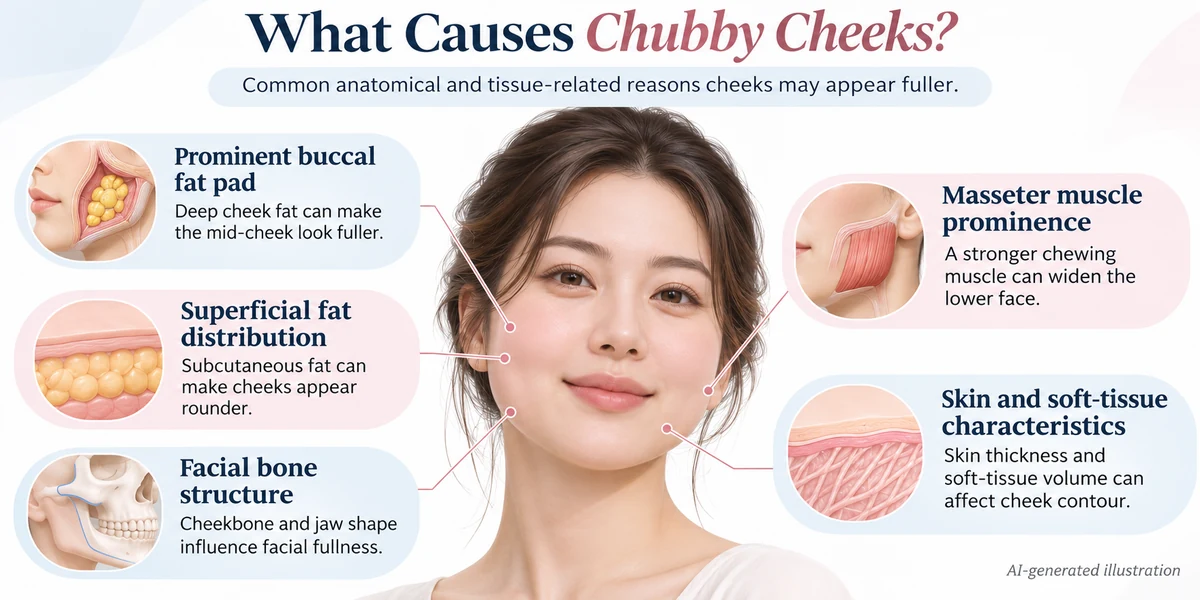
Full cheeks can result from genetics, facial bone structure, fat distribution, prominent jaw muscles and other anatomical factors. Some people naturally have a round face despite maintaining a stable body weight.
Because different structures contribute to facial appearance, removing cheek fat without understanding the underlying anatomy may produce limited changes or unwanted hollowing.
This educational guide compares buccal fat removal and facial liposuction, including their differences, potential indications, limitations, recovery, complications and long-term effects.
What Causes Chubby or Round Cheeks?
Cheek fullness can have several explanations.
1. Naturally Prominent Buccal Fat Pads
The buccal fat pads are deep facial fat compartments located within the cheeks.
Their size varies naturally between individuals.
Larger buccal fat pads may contribute to fullness in the lower-cheek region.
2. Superficial Facial Fat
Fat located closer to the skin can influence the appearance of the cheeks and lower face.
Its distribution may change with body weight and individual anatomy.
3. Facial Bone Structure
Cheekbone projection and lower-jaw shape can affect how wide or rounded the face appears.
Removing fat does not change the underlying bone structure.
4. Masseter Muscle Prominence
The masseter muscles are involved in chewing.
Naturally large or prominent masseter muscles may contribute to a wider lower-face appearance.
Fat-removal surgery does not directly reduce these muscles.
5. Skin and Soft-Tissue Characteristics
Skin thickness, elasticity and surrounding soft tissues influence facial contours.
Loose skin may create fullness or sagging that should not be confused with excess fat.
6. Temporary Facial Swelling
Facial swelling from dental problems, infections, medications, allergies or other medical conditions can sometimes resemble increased cheek fullness.
New, painful, unexplained or persistent swelling requires medical assessment rather than cosmetic fat removal.
How Can You Identify the Cause of Cheek Fullness?
The appearance of the cheeks alone is not enough to determine the appropriate treatment.
| Facial appearance | Possible contributing factor | Important consideration |
|---|---|---|
| Persistent fullness in the lower cheeks | Prominent buccal fat pads | Deep facial fat assessment |
| Generalised facial fullness | Superficial fat distribution | Overall facial and body composition |
| Wide or square lower face | Masseter muscle or jawbone structure | Muscle and skeletal assessment |
| Fullness beneath the chin | Submental fat | Different anatomical treatment area |
| Sagging or loose facial contours | Skin laxity and tissue descent | Fat removal may not address the concern |
| Sudden or painful cheek swelling | Dental or medical condition | Medical evaluation required |
The cause should be evaluated through clinical history and examination, rather than relying only on photographs.
What Is Buccal Fat Removal?
Buccal fat removal is a surgical procedure that removes a selected portion of the deep buccal fat pad.
The buccal fat pad lies within the cheek, beneath more superficial tissues and near important anatomical structures.
Surgical access is commonly through an incision inside the mouth.
The procedure is primarily considered for selected cases of persistent lower-cheek fullness associated with prominent buccal fat pads.
It does not cause overall weight loss and is not designed to remove all facial fat.
How Is Buccal Fat Removal Performed?
The general surgical process involves:
Reviewing facial anatomy, medical history and suitability.
Selecting an appropriate anaesthesia technique.
Making a small incision inside the cheek.
Carefully accessing the buccal fat pad.
Removing a planned portion of fat.
Closing the incision with sutures.
Providing oral hygiene and postoperative care instructions.
The surgeon must account for nearby facial nerve branches and salivary structures.
Excessive fat removal may increase the risk of unwanted facial hollowing.
For further information, read Buccal Fat Removal: Who May Be a Suitable Candidate?.
What Is Facial Liposuction?
Facial liposuction is a surgical technique used to remove selected superficial fat deposits from anatomically suitable regions of the face or adjacent neck.
It typically involves introducing a small cannula through a surgical access incision.
The procedure differs from buccal fat removal because it does not directly remove the deep buccal fat pad.
Facial liposuction may be considered for selected superficial fat deposits, depending on anatomy and skin quality.
Not every facial area is suitable for liposuction because the face contains important nerves, blood vessels and other structures.
How Is Facial Liposuction Performed?
The general process may involve:
Medical and facial assessment.
Identification of suitable superficial fat deposits.
Anaesthesia and surgical preparation.
Creation of small access incisions.
Controlled fat removal using an appropriate cannula.
Wound closure or dressing.
Postoperative care and monitoring.
Compression garments may be advised for selected treatment areas.
The technique, surgical access and recovery requirements depend on the anatomy involved.

Buccal Fat Removal vs Facial Liposuction: Key Differences
| Feature | Buccal fat removal | Facial liposuction |
|---|---|---|
| Main target | Deep buccal fat pad | Selected superficial fat |
| Common anatomical concern | Persistent lower-cheek fullness | Localised accessible superficial fat |
| Surgical access | Incision inside the mouth | Small skin access incisions |
| External scars | Usually no external incision from the procedure | Small permanent access-point scars |
| Fat compartment | Deep | Superficial |
| Main limitation | Does not reduce all facial fat | Does not directly remove buccal fat |
| Important risks | Nerve injury, salivary duct injury, hollowing | Contour irregularities, nerve or vessel injury, skin laxity |
| Recovery | Oral wound healing and cheek swelling | Skin and soft-tissue healing, swelling and possible compression |
Neither procedure guarantees a slimmer-looking face, sharper cheekbones or improved jawline definition.
Which Treatment Is More Suitable for Chubby Cheeks?
The decision depends on the location and cause of facial fullness.
When Buccal Fat Removal May Be Considered
In selected healthy adults, the procedure may be considered when lower-cheek fullness is associated with relatively prominent deep buccal fat pads.
Important factors include existing facial volume, age-related tissue changes, medical fitness and the risk of excessive hollowing.
When Facial Liposuction May Be Considered
Liposuction may be considered when an appropriate superficial fat compartment contributes to the concern and the overlying skin has sufficient elasticity.
It may be unsuitable when fullness mainly results from muscle prominence, bone structure or skin laxity.
When Neither Procedure May Be Appropriate
Surgical fat removal may not be suitable when:
The face is already naturally thin.
Facial fullness is mainly caused by prominent muscles or bone structure.
The concern is loose skin rather than excess fat.
Swelling is caused by an untreated medical condition.
The expected benefit is limited.
Surgical risks outweigh possible benefits.
The person does not wish to accept permanent anatomical changes.
Choosing not to undergo treatment is a valid option.
Can Buccal Fat Removal Make the Face Look Older?
It can contribute to an older or more hollow appearance in some individuals, although this is not inevitable.
Facial ageing involves changes in fat compartments, skin, connective tissue and underlying bone structure.
Removing too much cheek fat may reduce the volume that contributes to a naturally full appearance.
This concern may become more noticeable as facial tissues change with age.
People with relatively narrow faces or limited cheek volume may be particularly vulnerable to unwanted hollowing.
For additional educational information, read Buccal Fat Removal: Long-Term Results and Facial Ageing.
Does Facial Liposuction Tighten Loose Skin?
Facial liposuction primarily removes fat. It is not a substitute for treating significant skin laxity.
After fat removal, the overlying skin may contract to some degree, depending on its elasticity and individual healing.
However, loose or poorly elastic skin may remain or become more noticeable.
Liposuction cannot guarantee skin tightening or a particular facial contour.
Can Buccal Fat Removal and Facial Liposuction Be Combined?
In selected circumstances, a surgeon may assess more than one source of facial fullness.
However, combining procedures can increase surgical complexity, recovery demands and the possibility of removing too much volume.
Performing both operations should not be considered automatically preferable.
The individual benefit and risks of each procedure must be evaluated.
What Are the Risks of Buccal Fat Removal?
Buccal fat removal carries recognised surgical risks.
Bleeding and Hematoma
Bleeding or accumulation of blood may occur around the surgical area.
Infection
The intraoral incision may become infected.
Facial Nerve Injury
Nearby facial nerve branches can be injured, potentially causing temporary or permanent facial muscle weakness.
Salivary Duct Injury
Injury to a salivary duct may affect normal saliva drainage and require additional treatment.
Altered Sensation
Temporary or persistent numbness can occur.
Asymmetry
Differences in fat removal or healing may create uneven cheek contours.
Excessive Hollowing
Removing excessive fat can result in a sunken or gaunt appearance that may be difficult to correct.
Poor Wound Healing
The incision may heal slowly or separate.
Persistent Swelling or Pain
Some individuals develop prolonged discomfort or swelling.
Revision Surgery
Further surgery may occasionally be considered, but it carries additional risks and cannot guarantee correction.
What Are the Risks of Facial Liposuction?
Facial liposuction also involves surgical complications.
Possible risks include:
Bleeding
Infection
Swelling and bruising
Temporary or persistent numbness
Injury to nearby nerves or blood vessels
Fluid accumulation
Poor wound healing
Irregular contours or depressions
Persistent asymmetry
Loose or uneven skin
Anaesthesia-related complications
Possible revision surgery
The exact risk profile depends on the facial area, surgical technique, extent of fat removal and individual medical factors.
These risks should be discussed before treatment.
Recovery After Buccal Fat Removal vs Facial Liposuction
Recovery varies between procedures and individuals.
| Recovery period | Buccal fat removal | Facial liposuction |
|---|---|---|
| First 1–3 days | Swelling, tenderness and intraoral wound discomfort | Swelling, bruising and tenderness |
| Days 4–7 | Gradual improvement in early discomfort | Early swelling may begin to settle |
| Weeks 1–2 | Continued healing; dietary precautions may be required | Continued soft-tissue healing; compression may be advised |
| Weeks 2–4 | Further reduction in swelling | Gradual improvement in swelling and contour |
| Months 1–3 | Facial contour may become clearer | Residual swelling and tissue changes may continue |
| Months 3–6 | Further tissue settling may occur | Contour and scar changes may continue |
These are illustrative timelines, not guaranteed milestones.
Recovery may take longer if complications occur or additional procedures are performed.
What Is Normal During Recovery?
Temporary swelling, bruising and tenderness may occur after either procedure.
Following buccal fat removal, speaking, chewing or opening the mouth may feel uncomfortable during early healing.
Following liposuction, the treated area may feel swollen, firm, tender or temporarily numb.
Symptoms should generally improve rather than become progressively more severe.
What Aftercare May Be Recommended?
Aftercare depends on the surgical technique.
After Buccal Fat Removal
Instructions may include:
A liquid or soft-food diet during early healing
Prescribed oral hygiene measures
Avoiding unnecessary pressure on the cheeks
Taking medication only as directed
Limiting strenuous activity
Attending scheduled follow-up appointments
After Facial Liposuction
Instructions may include:
Protecting surgical access sites
Wearing a compression garment when prescribed
Avoiding unnecessary pressure or trauma
Following activity restrictions
Taking prescribed medicines appropriately
Attending postoperative assessments
Do not begin massage or use unprescribed scar products on healing tissues without medical advice.
Normal Healing vs Warning Signs
| May occur during recovery | Requires medical assessment |
|---|---|
| Swelling that gradually decreases | Rapidly increasing or one-sided swelling |
| Mild or moderate tenderness | Severe or worsening pain |
| Temporary bruising | Persistent or excessive bleeding |
| Temporary changes in sensation | New facial weakness or worsening numbness |
| Mild incision discomfort | Pus, fever, spreading redness or wound separation |
| Gradual changes in facial contour | Sudden or progressive concerning asymmetry |
Emergency warning: Difficulty breathing, chest pain, fainting or symptoms suggesting a serious allergic reaction require emergency medical care.
Are the Results Permanent?
The fat removed surgically does not simply regenerate in the treated area.
However, this does not mean facial appearance remains unchanged throughout life.
Changes may occur because of:
Natural ageing
Weight fluctuations
Changes in remaining facial fat compartments
Skin laxity
Changes in underlying facial structure
Other medical or cosmetic procedures
The visible outcome cannot be guaranteed to remain identical over time.
Can Cheek Fat Be Reduced Naturally?
Facial fat distribution is influenced by genetics, body composition and other factors.
Changes in overall body weight may affect facial fullness in some individuals, but there is no reliable way to selectively remove deep buccal fat through facial exercises, massage or topical products.
Facial exercises have not been established as a method for specifically eliminating the buccal fat pads.
A healthy body weight does not guarantee a particular cheek shape.
Naturally full cheeks are not a medical condition that automatically requires correction.
Why Is Long-Term Facial Volume Important?
Facial volume contributes to natural contours.
Removing fat may alter the relationship between the cheekbones, lower cheeks and jawline.
However, a reduction that initially appears subtle may become more noticeable as the face ages.
This is particularly relevant to buccal fat removal because the deep fat compartment is permanently altered.
Some procedures instead add facial volume to address selected concerns.
For an explanation of volume-adding treatments, read Facial Fat Grafting vs Dermal Fillers.
These approaches have different purposes and should not be considered interchangeable with fat removal.
Chubby Cheeks Treatment: Safety and Assessment Checklist
Before considering facial fat-removal surgery:
Identify the cause of facial fullness: Distinguish deep fat, superficial fat, muscle, bone structure and skin laxity.
Review medical suitability: Discuss medical conditions, medications, allergies and previous procedures.
Consider natural facial variation: A round face does not necessarily require treatment.
Understand anatomical differences: Buccal fat removal and liposuction treat different tissues.
Discuss permanent tissue removal: Understand how facial volume may change with ageing.
Review possible complications: Include infection, nerve injury, asymmetry and contour irregularities.
Assess long-term hollowing risk: Avoid assuming more fat removal will produce a better result.
Understand scars and wound care: Discuss intraoral incisions or skin access points.
Review recovery precautions: Understand diet, compression, medications and activity restrictions.
Recognise warning signs: Report severe pain, significant swelling, fever or facial weakness.
Discuss alternatives: Include observation and no treatment.
These considerations support informed decision-making but do not eliminate surgical risk.
Frequently Asked Questions
1. What is the difference between buccal fat removal and facial liposuction?
Buccal fat removal removes selected deep cheek fat through an incision inside the mouth. Facial liposuction removes selected superficial fat deposits using a cannula. The procedures target different fat compartments.
2. Is buccal fat removal better than liposuction for chubby cheeks?
Neither is automatically better. Suitability depends on whether the fullness is caused by deep buccal fat, superficial fat or another anatomical factor.
3. Can facial liposuction remove buccal fat?
Standard facial liposuction does not directly remove the deep buccal fat pad. Buccal fat removal requires a different surgical approach.
4. Can chubby cheeks be reduced without surgery?
Facial fullness may change with overall body weight in some individuals. However, exercises, massage and creams have not been reliably shown to remove deep buccal fat. Naturally full cheeks do not require treatment.
5. How long does recovery take after cheek fat removal?
Initial healing commonly takes several weeks. Swelling and changes in facial contour may continue for months. Recovery depends on the procedure and individual healing.
6. Can buccal fat removal make the cheeks look hollow over time?
Yes. Removing excessive buccal fat may contribute to unwanted hollowing, particularly as facial tissues change with age. The risk varies with anatomy and the amount removed.
7. What are the main risks of buccal fat removal and facial liposuction?
Possible risks include bleeding, infection, swelling, altered sensation, asymmetry and wound-healing problems. Buccal fat removal can injure facial nerves or salivary ducts, while liposuction may cause contour irregularities and injury to nearby structures.
Conclusion
Chubby cheeks can result from natural facial anatomy, including deep buccal fat, superficial fat, facial bone structure, prominent muscles and skin characteristics.
Buccal fat removal and facial liposuction are different procedures designed for different anatomical concerns.
Neither treatment is universally suitable, and both involve permanent tissue changes and possible complications.
Excessive fat removal can contribute to unwanted hollowing or contour irregularities, particularly as the face changes over time.
Understanding the source of facial fullness, treatment alternatives, recovery requirements and long-term limitations is important before considering elective surgery.
Disclaimer: All content and visuals on this website are for educational and informational purposes only. Images may be AI-generated or illustrative. Individual treatment results may vary. This information does not replace professional medical advice, diagnosis or consultation.