
Hair Transplant after 20 Years: Assessing the Long Term Impact
Hair transplantation is a surgical procedure that relocates hair follicles from one area of the scalp to another. It is commonly used to address selected forms of permanent hair loss, particularly androgenetic alopecia, also known as pattern hair loss.
One of the most common questions about the procedure concerns how transplanted hair changes over time.
What happens to a hair transplant after 20 years?
A hair transplant can provide long-lasting hair growth because the follicles are usually taken from areas of the scalp that are relatively resistant to pattern hair loss.
However, long-lasting does not mean that every transplanted hair will remain unchanged for life.
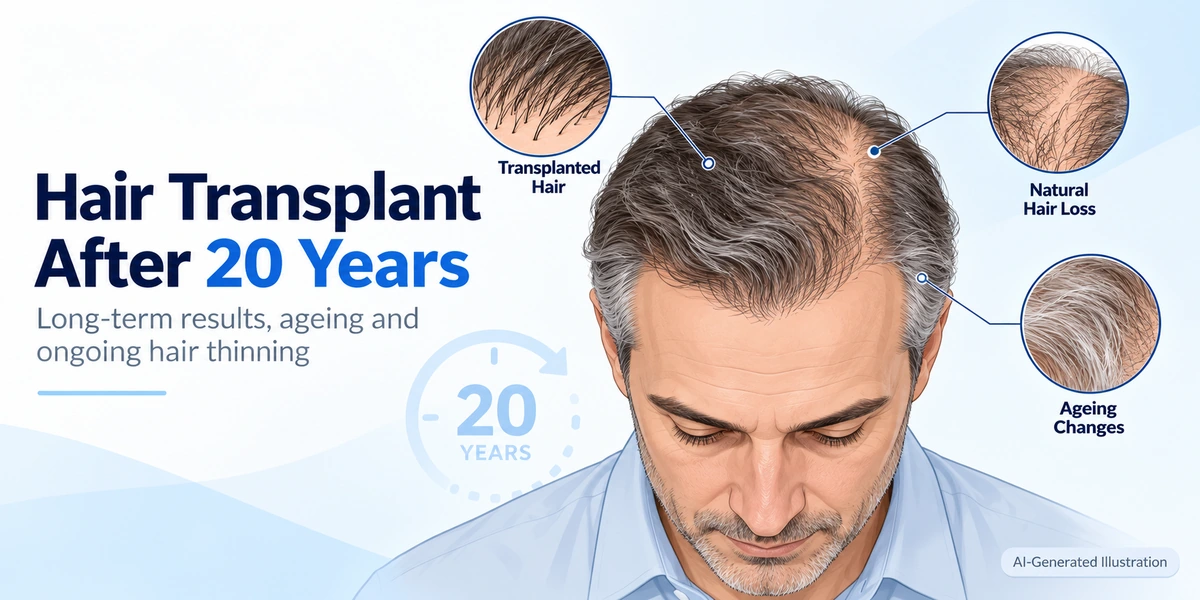
Over two decades, natural ageing, progressive hair loss, changes in hair thickness, greying and the condition of the donor area may influence the overall appearance of a transplant.
Some individuals maintain substantial transplanted hair growth after 20 years. Others notice increasing scalp visibility, changes in hairline appearance or thinning of the surrounding natural hair.
This article explains how hair transplants age, whether transplanted follicles can lose hair, why density may change after many years, how to evaluate long-term results and what medical or surgical options may be considered when further hair loss develops.
What Is a Hair Transplant?
A hair transplant is a surgical procedure that moves living hair follicles from a donor area to a recipient area affected by hair loss.
The donor area is usually located at the back or sides of the scalp, where hair follicles are often less susceptible to the effects of androgenetic alopecia.
Once transferred, the follicles may establish a blood supply and begin producing hair in their new location.
The procedure does not create new hair follicles. It redistributes existing follicles from one part of the scalp to another.
Two widely used methods are:
Follicular Unit Transplantation (FUT)
FUT involves removing a narrow strip of scalp tissue containing hair follicles from the donor area.
The strip is divided into follicular units, which are then transplanted into the recipient area.
The donor site generally heals with a linear scar.
Follicular Unit Extraction (FUE)
FUE involves extracting individual follicular units from the donor area.
These follicles are implanted into the recipient area after preparation.
FUE leaves multiple small extraction scars rather than a single linear donor scar.
Both techniques have potential benefits and limitations.
The appropriate technique depends on donor hair characteristics, the extent of hair loss, scalp condition and individual circumstances.
What Happens to a Hair Transplant After 20 Years?
Two decades after a hair transplant, several changes may be visible.
Some changes involve the transplanted follicles, while others affect the natural hair surrounding them.
1. Transplanted Hair May Continue Growing
Many transplanted follicles retain characteristics of their original donor area.
If those follicles remain healthy and functional, they may continue producing hair for many years.
However, graft survival and lifelong hair production are not guaranteed.
2. Natural Hair Loss May Continue
Hair transplantation does not stop the biological process responsible for androgenetic alopecia.
Hair that was not transplanted may continue thinning over time.
This can create a visible difference between relatively preserved transplanted hair and the surrounding natural hair.
3. Hair Density May Appear Lower
The overall density of the scalp may change because of:
-
Progressive loss of non-transplanted hair
-
Age-related changes in hair thickness
-
Changes in donor-area density
-
Individual variation in transplanted follicle survival
-
Additional hair or scalp conditions
A reduction in visible density does not necessarily mean that all transplanted grafts have failed.
4. Hair May Become Grey or White
Transplanted hair can lose pigment as part of normal ageing.
The colour of transplanted hair generally follows the biological characteristics of the donor follicle.
5. The Hairline May Look Different
A transplanted hairline that appeared proportionate at a younger age may look different after surrounding hair loss progresses.
The position of the hairline may remain relatively stable while the density behind it decreases.
6. Scalp and Hair Characteristics May Change
Changes in scalp health, hair texture, hair shaft diameter and underlying medical conditions may affect the appearance of hair after many years.
These changes require individual assessment.
How Long Does a Hair Transplant Last?
Hair transplants are generally described as long-lasting procedures.
However, there is no universal number of years that every transplanted follicle will survive.
The duration of visible results depends on:
Donor Hair Characteristics
Follicles taken from relatively stable donor areas may retain resistance to pattern hair loss.
However, the donor area itself is not completely immune to ageing or hair loss.
Underlying Hair Loss
Androgenetic alopecia may progress for years after the operation.
This can reduce the density of non-transplanted hair.
Age
Hair characteristics can change with advancing age.
General Health
Certain illnesses, nutritional deficiencies, medications and scalp conditions can affect hair growth.
Surgical Factors
Graft handling, placement, recipient-site conditions and donor-area management may affect initial follicle survival.
Long-Term Medical Management
When clinically appropriate, treatment of progressive pattern hair loss may help preserve surrounding natural hair.
The American Academy of Dermatology’s guidance on hair transplantation explains that hair loss can continue after surgery and that treatment may be recommended to manage further thinning.
Do Hair Transplant Grafts Last Forever?
Not necessarily.
The idea that transplanted hair lasts forever is based on the observation that follicles from certain donor areas tend to be more resistant to androgen-related miniaturisation.
This characteristic is sometimes described as donor dominance.
When a follicle is moved to a new location, it may retain much of the biological behaviour associated with its original donor site.
However, this principle does not establish lifelong survival in every person.
Over time, transplanted hair may be affected by:
-
Age-related follicular changes
-
Progressive donor-area thinning
-
Scalp disorders
-
Inflammation or scarring
-
Certain medications
-
Nutritional or medical conditions
-
Individual variation in hair-growth biology
A transplanted follicle may remain functional for decades, but no procedure can guarantee that every graft will produce hair indefinitely.
Why Does Hair Become Thin After 20 Years of a Hair Transplant?
Thinning observed decades after a transplant can have several explanations.
1. Continued Androgenetic Alopecia
Pattern hair loss is a progressive condition.
Hair surrounding the transplanted area may continue to undergo miniaturisation, gradually producing finer and shorter hairs.
2. Age-Related Hair Changes
Hair shaft diameter and the number of actively growing follicles may change with age.
These changes can affect both transplanted and non-transplanted hair.
3. Donor-Area Changes
Donor hair is often more resistant to pattern hair loss, but resistance is relative rather than absolute.
Some individuals develop thinning in areas previously considered stable.
4. Additional Hair Loss Conditions
New hair loss may be unrelated to the original androgenetic alopecia.
Examples include:
-
Telogen effluvium
-
Alopecia areata
-
Scarring alopecias
-
Thyroid-related hair loss
-
Nutritional deficiencies
-
Medication-associated hair loss
5. Changes in Hair Shaft Characteristics
Thinner hair shafts provide less visual coverage, even when the number of follicles has not changed substantially.
6. Changes in Scalp Visibility
Greying, scalp pigmentation and styling can influence how dense the hair appears.
A clinical examination may be needed to determine whether a change represents follicular loss, miniaturisation or another process.
Transplanted Hair vs. Natural Hair After 20 Years
One of the most important distinctions in long-term hair transplant outcomes is the difference between transplanted hair and hair that remains in its original location.
| Feature | Transplanted hair | Non-transplanted natural hair |
|---|---|---|
| Origin | Relocated from donor region | Remains in original scalp location |
| Pattern hair loss resistance | Often relatively greater if taken from a stable donor area | Depends on the individual’s follicle sensitivity |
| Age-related changes | Can occur | Can occur |
| Greying | Possible | Possible |
| Long-term thinning | Possible | Possible |
| Response to medical conditions | May be affected | May be affected |
| Lifelong growth guarantee | No | No |
A transplant may provide lasting coverage in one part of the scalp while untreated hair continues thinning elsewhere.
This is why planning for the possible progression of hair loss is an important aspect of hair transplantation.
Does Transplanted Hair Fall Out After 20 Years?
Yes, transplanted hair can shed or become thinner.
However, shedding should be distinguished from permanent follicle loss.
All healthy scalp follicles undergo a normal growth cycle.
Anagen Phase
The follicle actively produces a hair shaft.
Catagen Phase
Hair growth slows and the follicle enters a transitional stage.
Telogen Phase
The follicle enters a resting phase.
Exogen Phase
The existing hair shaft is shed.
Normal shedding does not necessarily mean that the follicle has permanently stopped functioning.
However, progressive hair thinning, patchy loss or scarring may indicate a medical condition.
Sudden or significant hair loss after many years should not automatically be attributed to the original transplant procedure.
How Does Ageing Affect Transplanted Hair?
Ageing affects hair follicles and the surrounding scalp.
Possible long-term changes include:
Reduced Hair Shaft Diameter
Some hairs become finer with age.
Finer strands may reduce the visual appearance of density.
Changes in Hair Growth Cycles
The duration of active growth and the proportion of actively growing follicles may change.
Reduced Pigment Production
Melanin production can decrease, resulting in grey or white hair.
Changes in Scalp Skin
Skin elasticity, vascular characteristics and other age-related changes can influence scalp appearance.
Altered Hair Texture
Hair may become coarser, finer, drier or otherwise different over time.
Not every individual experiences these changes to the same degree.
Do Hair Transplants Turn Grey After 20 Years?
Yes.
Transplanted hair can become grey or white in the same way as naturally growing hair.
Hair colour is produced by melanocytes associated with the follicle.
With ageing, pigment production may decrease.
Because transplanted follicles retain many of their original biological characteristics, their hair can undergo natural pigment changes after transplantation.
Does Grey Hair Mean the Transplant Has Failed?
No.
Greying is a pigment change and does not, by itself, mean that the follicle has stopped producing hair.
Can Transplanted Hair Be Dyed?
Established transplanted hair can generally be managed similarly to other scalp hair, including colouring when appropriate.
However, products may cause scalp irritation or allergic contact dermatitis.
Individuals with sensitive skin or scalp disorders should seek suitable advice.
What Happens to the Hairline After 20 Years?
The hairline is an important feature of long-term transplant appearance.
A transplanted hairline may remain relatively stable while surrounding natural hair continues thinning.
This can create a contrast between the frontal hairline and the areas behind it.
Possible changes include:
-
Reduced density immediately behind the hairline
-
Increased temple recession
-
Greater crown thinning
-
An isolated appearance of the transplanted frontal region
-
Changes in the relationship between hairline position and facial ageing
A hairline designed for an individual’s younger facial proportions may also appear different with age.
Not every older hairline requires surgical correction.
The need for treatment depends on individual preferences, donor availability, scalp characteristics and the extent of hair loss.
Can the Crown Become Bald After a Hair Transplant?
Yes.
The crown, also called the vertex, may continue thinning after a transplant.
This is especially relevant when the original operation focused primarily on the frontal hairline.
Pattern hair loss can progress at different rates in different scalp regions.
Some individuals experience relatively stable frontal coverage while crown hair becomes progressively thinner.
The presence of transplanted hair at the front does not prevent future crown hair loss.
Additional treatment depends on the cause of thinning, the condition of the donor area and the expected long-term progression.
Does a Hair Transplant Stop Future Baldness?
No.
Hair transplantation relocates existing follicles but does not eliminate the genetic or hormonal factors responsible for pattern hair loss.
The remaining natural hair may continue thinning.
This is an important consideration for individuals who undergo transplantation at a relatively young age.
A person who receives a transplant in their twenties may experience substantial changes in untreated hair by their forties or fifties.
The extent and speed of progression vary.
For a related explanation of early-onset androgenetic alopecia and available management options, see treatment options for male hair loss at age 25.
Hair Transplant Results: 1 Year vs. 5 Years vs. 10 Years vs. 20 Years
Hair transplantation outcomes can change substantially across different periods.
| Time after transplantation | Possible observations |
|---|---|
| 6–12 months | New hair growth develops and density becomes easier to assess |
| 1–2 years | Initial transplant appearance is usually more established |
| 5 years | Transplanted hair may remain stable, while natural hair loss may continue |
| 10 years | Changes in native hair density or hairline balance may become noticeable |
| 15 years | Further ageing, greying and loss of surrounding hair may affect appearance |
| 20 years | Long-term graft retention, donor-area changes and progressive hair loss determine current coverage |
These are broad considerations rather than predictable changes for every person.
Some individuals have minimal additional hair loss over many years, while others experience substantial progression.
For further information about an earlier stage of long-term recovery, read what happens 15 years after a hair transplant.
How Does the Donor Area Change After 20 Years?
The donor area is essential to the long-term result of hair transplantation.
Although follicles at the back and sides of the scalp often show greater resistance to pattern hair loss, the donor region has a limited supply of hair.
Age-Related Donor Thinning
Some individuals experience changes in donor density as they age.
Previous Follicle Extraction
A hair transplant permanently removes selected follicles from their original donor positions.
These follicles do not normally regenerate at the extraction sites.
Donor-Area Scarring
FUE can leave small circular scars, while FUT commonly leaves a linear scar.
Scars may become more visible if surrounding hair thins or is cut very short.
Overharvesting
Excessive removal of follicles can reduce donor-area density and create uneven coverage.
Limited Future Donor Supply
After one or more procedures, fewer suitable follicles may remain available for additional transplantation.
These considerations are particularly important when evaluating someone for a second transplant decades later.
Can a Second Hair Transplant Be Done After 20 Years?
A second hair transplant may be possible after 20 years, but eligibility depends on individual circumstances.
The fact that a person underwent transplantation two decades earlier does not automatically rule out another procedure.
However, additional surgery requires evaluation.
Donor Hair Availability
The donor region must contain sufficient healthy follicles for safe harvesting.
Extent of Current Hair Loss
The area requiring treatment should be assessed.
Scalp Health
Scarring, inflammation and other scalp conditions may affect suitability.
Previous Surgical Technique
The presence of FUT scars, FUE extraction scars or other tissue changes may influence planning.
Hair Characteristics
Hair calibre, density, curl and colour contrast can affect the amount of visible coverage obtainable.
Medical Conditions
Certain health conditions may require evaluation or treatment before elective surgery.
Future Hair Loss
The possibility of continuing hair loss remains important even after a second procedure.
Additional transplantation may improve selected areas, but a full or permanently dense scalp cannot be guaranteed.
What If Hair Density Is Poor 20 Years After the Transplant?
Reduced density after many years requires an assessment of the underlying cause.
Possible explanations include:
-
Loss of surrounding natural hair
-
Donor-area thinning
-
Hair miniaturisation
-
An additional hair-loss condition
-
Scalp inflammation
-
Age-related changes in hair calibre
-
Limited original graft coverage
The evaluation may include scalp examination, dermoscopy or trichoscopy and selected laboratory tests.
A second operation should not be assumed to be necessary before determining why hair density has changed.
For information about the early stages of transplant growth and delayed density, see why hair density may still be low five months after a hair transplant.
Early postoperative growth and changes occurring two decades later have different possible explanations.
How Is a Hair Transplant Evaluated After 20 Years?
A healthcare professional may assess both transplanted and natural hair.
1. Review of Medical and Surgical History
The assessment may include:
-
Date of transplantation
-
Original hair-loss pattern
-
FUE or FUT technique
-
Previous transplant procedures
-
Medication use
-
Current health conditions
-
Changes in hair density over time
2. Scalp Examination
The scalp may be examined for hair distribution, visible scarring, inflammation and areas of reduced density.
3. Trichoscopy
Trichoscopy uses magnification to examine hair shafts and scalp structures.
It may help identify miniaturisation, variation in hair diameter and signs of particular scalp conditions.
4. Donor-Area Assessment
Donor hair density and distribution may be evaluated, especially if further transplantation is being considered.
5. Hair-Loss Pattern Assessment
The clinician may assess the relationship between transplanted hair and natural hair loss.
6. Additional Investigations
Blood tests or, occasionally, scalp biopsy may be considered when a separate medical condition is suspected.
The investigation plan should be based on clinical findings.
Can Medicines Help Maintain Hair Transplant Results?
Medicines may be used in selected patients to treat ongoing androgenetic alopecia.
However, the need for treatment depends on diagnosis, health status and individual risk factors.
Minoxidil
Minoxidil is used for certain forms of pattern hair loss.
It may help stimulate or maintain hair growth in suitable individuals.
Possible adverse effects include scalp irritation, unwanted hair growth and temporary changes in shedding.
Oral minoxidil is sometimes prescribed under medical supervision, but its use for hair loss may be off-label and requires consideration of systemic adverse effects.
Finasteride
Finasteride reduces the conversion of testosterone to dihydrotestosterone, or DHT.
It may slow the progression of male pattern hair loss in selected individuals.
Potential adverse effects can include sexual dysfunction and mood-related symptoms, among others.
It is not appropriate for everyone, and pregnancy-related medication precautions are important.
Other Treatments
Additional medical options may be considered according to diagnosis and the individual’s circumstances.
No medicine can guarantee lifelong preservation of natural hair.
The American Hair Loss Association’s review of long-term hair-loss planning discusses the importance of anticipating progressive hair loss rather than treating transplantation as a one-time solution for every person.
Is PRP Helpful 20 Years After a Hair Transplant?
Platelet-rich plasma, or PRP, is sometimes considered as a treatment for selected hair-loss conditions.
It involves processing a person’s blood to concentrate platelets before administering the preparation to targeted areas.
Some studies suggest possible benefits for certain forms of pattern hair loss.
However, evidence remains variable, treatment protocols are not fully standardised, and results are inconsistent.
PRP does not create new donor follicles or guarantee restoration of hair lost over many years.
It should not be regarded as a proven method for permanently preserving every transplanted graft.
How Can Someone Care for Transplanted Hair After 20 Years?
Hair that has been growing for two decades generally does not require the same postoperative wound-care routine needed immediately after transplantation.
Long-term care focuses on hair and scalp health, identifying additional hair loss and managing relevant medical conditions.
Use Gentle Hair-Care Practices
Avoid excessive pulling, harsh traction and styling methods that damage hair shafts.
Manage Scalp Conditions
Persistent dandruff, inflammation, itching or scalp lesions may require assessment.
Avoid Unnecessary Traction
Tight hairstyles can contribute to traction-related hair loss.
Maintain Balanced Nutrition
Adequate protein, calories and essential nutrients support normal hair growth.
Supplements should be considered when deficiencies or other indications are identified.
Avoid Smoking
Smoking is associated with adverse effects on overall health and may affect skin and tissue circulation.
However, stopping smoking cannot guarantee a specific change in hair density.
Protect Exposed Scalp Skin
Areas with limited hair coverage may be vulnerable to ultraviolet exposure.
Appropriate sun protection helps reduce skin damage.
Review Progressive Hair Loss
New or worsening hair thinning may benefit from clinical assessment.
Use Medicines Only When Appropriate
Treatments should be selected according to the underlying diagnosis, benefits, risks and medical history.
Can Lifestyle Changes Prevent Hair Loss After a Transplant?
Healthy habits support general well-being and normal hair function.
However, lifestyle measures alone cannot reliably prevent hereditary pattern hair loss.
Nutrition
Nutritional deficiencies can contribute to shedding.
Correcting a confirmed deficiency may improve deficiency-related hair loss.
Sleep
Adequate sleep supports general health, but there is no established sleep routine that guarantees lifelong graft survival.
Stress Management
Severe physical or psychological stress can contribute to temporary shedding in some individuals.
Stress management may support well-being but does not reverse every cause of hair loss.
Physical Activity
Regular exercise supports general health.
It does not specifically prevent androgenetic alopecia.
Avoiding Harmful Hair Practices
Reducing traction, excessive heat and harsh chemical exposure can help prevent hair-shaft damage.
These measures may improve hair condition without necessarily altering the underlying biological cause of pattern baldness.
What Complications Can Remain Visible After 20 Years?
Some long-term findings relate to the original surgery rather than ongoing follicular ageing.
Donor-Area Scars
FUT and FUE produce different scar patterns.
These scars remain even after many years.
Uneven Hair Distribution
Older transplant designs or changes in surrounding natural hair may make the transplanted area appear uneven.
An Unnatural Hairline
Some individuals may have an unusually straight, low or irregular hairline.
This is not necessarily harmful but may become more noticeable as hair loss progresses.
Donor-Area Thinning
Limited donor density can become more apparent over time.
Changes in Scalp Sensation
Some people may experience persistent altered sensation following scalp surgery.
Scar-Related Hair Loss
Scarring can affect hair growth within damaged tissue.
Additional Scalp Conditions
Inflammatory or scarring hair disorders may develop independently of the transplant.
Persistent pain, redness, scarring, discharge or new patchy hair loss should be medically assessed.
Can a Hair Transplant Look Unnatural After 20 Years?
Yes, in some individuals.
A transplant that originally blended with surrounding hair may become more noticeable as natural hair continues thinning.
Other contributing factors may include:
-
An unusually low hairline
-
Wide spacing between transplanted follicular units
-
Differences in hair direction
-
Changes in surrounding hair density
-
Hairline design that does not account for future hair loss
-
Visible donor-area scars
-
Variation in hair calibre or colour
These changes do not necessarily indicate that transplanted grafts have stopped growing.
Management depends on the specific findings.
Some individuals may choose no additional treatment, while others may consider medical management, styling changes or surgical evaluation.
Can Transplanted Hair Become Thinner Than Before?
Yes.
Although donor follicles are selected for relative resistance to pattern hair loss, they may undergo changes with ageing or disease.
Individual hair shafts can become finer.
Reduced thickness may affect visible scalp coverage.
However, apparent thinning can also result from loss of the surrounding natural hair rather than thinning of the transplanted follicles themselves.
A clinical examination can help distinguish these possibilities.
Is a Hair Transplant at Age 25 Still Effective at Age 45?
A transplant performed at age 25 may still show substantial hair growth at age 45.
However, long-term appearance depends on the progression of underlying hair loss.
At 25, the future pattern and extent of androgenetic alopecia may not yet be fully apparent.
A person may therefore lose additional natural hair behind or around a transplanted region during the following two decades.
Long-term planning is particularly important for younger individuals with progressive hair loss.
Some may benefit from medical management before or after transplantation, while others may eventually require additional assessment.
No individual outcome can be predicted solely from the age at which transplantation was performed.
Can Women Also Experience Changes 20 Years After a Hair Transplant?
Yes.
Women who have undergone hair transplantation may also experience changes in hair density over time.
Possible influences include:
-
Female pattern hair loss
-
Menopause-related hormonal changes
-
Ageing
-
Thyroid conditions
-
Nutritional deficiencies
-
Inflammatory scalp disorders
-
Medication effects
The donor area may behave differently in people with diffuse thinning.
For this reason, suitability for further transplantation requires careful assessment of donor stability and the cause of hair loss.
What Age Is Too Late for a Hair Transplant?
There is no single age at which hair transplantation becomes impossible for everyone.
Suitability depends more on factors such as:
-
General medical fitness
-
Donor-area quality
-
Hair-loss diagnosis
-
Scalp health
-
Medication use
-
Bleeding and healing risks
-
Realistic expectations
-
The amount of coverage that can safely be achieved
Older individuals may be suitable for transplantation in selected circumstances.
However, age-related changes in hair and health may affect treatment planning.
Is a Second Hair Transplant Always Necessary After 20 Years?
No.
Some individuals maintain acceptable hair coverage without further procedures.
Others may experience progressive natural hair loss but prefer not to undergo additional treatment.
Further surgery may be considered when there is a specific concern and sufficient donor hair remains available.
However, revision or repeat transplantation involves additional risks, including:
-
Donor depletion
-
Scarring
-
Infection
-
Bleeding
-
Poor graft growth
-
Uneven coverage
-
Unfavourable hairline changes
-
Need for further procedures
The decision should be individualized.
When Should Someone Seek Medical Advice?
Changes in hair appearance are common with ageing, but some findings warrant evaluation.
Seek medical advice if you notice:
-
Sudden or substantial hair shedding
-
Rapidly expanding bald patches
-
Scalp redness or inflammation
-
Persistent itching, burning or pain
-
Pustules or discharge
-
New areas of scarring
-
Unexplained donor-area thinning
-
Significant changes in hair texture or density
-
Hair loss accompanied by other systemic symptoms
These findings may indicate a condition that requires diagnosis rather than routine hair-care changes.
Frequently Asked Questions
1. Does a hair transplant last 20 years?
A hair transplant may continue producing hair after 20 years, especially when follicles were taken from relatively stable donor areas. However, long-term survival and unchanged density cannot be guaranteed.
2. Does transplanted hair fall out after 20 years?
Transplanted hair undergoes normal shedding cycles and may also become thinner because of ageing or certain medical conditions. Not every episode of shedding represents permanent graft loss.
3. Can natural hair continue falling after a transplant?
Yes. Hair transplantation does not stop progressive androgenetic alopecia. Non-transplanted hair may continue thinning over time.
4. Do hair transplants turn grey after 20 years?
Yes. Transplanted follicles can undergo normal age-related pigment changes, producing grey or white hair.
5. Can a second hair transplant be done after 20 years?
A second transplant may be possible if sufficient healthy donor hair remains and the individual is medically suitable. Clinical assessment is necessary.
6. Why does my hair transplant look thin after 20 years?
Reduced density may result from ongoing loss of natural hair, age-related thinning, donor-area changes or another hair-loss condition.
7. Is transplanted hair permanent?
Transplanted follicles are often relatively resistant to pattern hair loss and may grow for decades. However, permanent survival of every graft is not guaranteed.
Conclusion
A hair transplant may continue producing hair for 20 years or longer, particularly when follicles are taken from donor regions relatively resistant to androgenetic hair loss.
However, a transplant does not prevent the normal ageing process or stop future thinning of surrounding natural hair.
Over two decades, changes in hair density, colour, thickness and donor-area characteristics may affect the overall appearance of the procedure.
Some individuals maintain substantial hair coverage, while others experience increasing scalp visibility or an imbalance between transplanted and non-transplanted hair.
Long-term outcomes depend on the original hair-loss condition, donor hair quality, surgical planning, subsequent hair-loss progression and general scalp health.
When noticeable thinning develops years after transplantation, clinical evaluation can help identify the cause and determine whether observation, medical treatment or further surgery may be appropriate.
Disclaimer: All content and visuals on this website are for educational and informational purposes only. Images may be AI-generated or illustrative. Individual treatment results may vary. This information does not replace professional medical advice, diagnosis or consultation.