
What Makes a Hair Transplant Hairline Look Natural?

Temple Hair Transplant in Navi Mumbai: Grafts & Cost
October 3, 2026
How Is the Hair Transplant Donor Area Assessed in Navi Mumbai?
October 7, 2026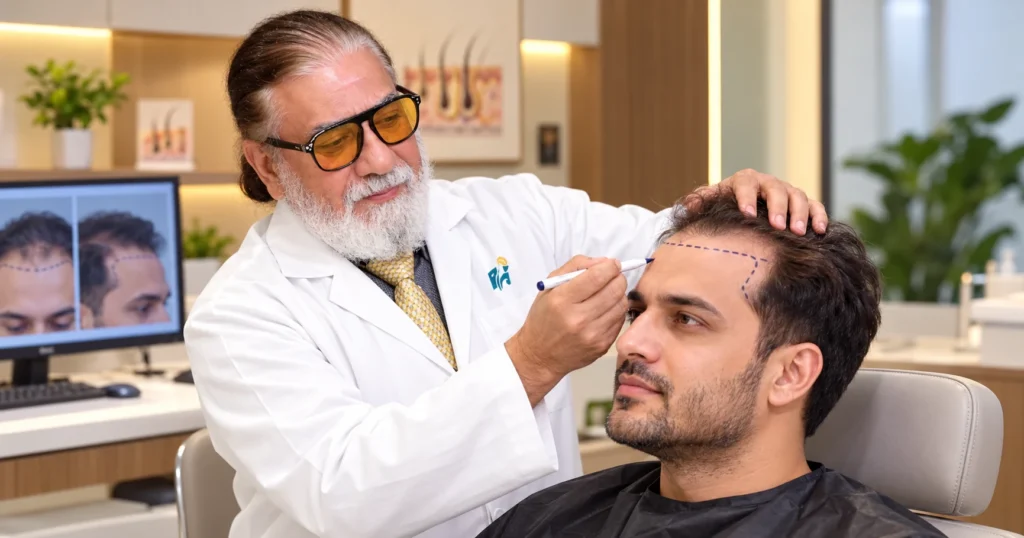
A natural hairline design before a hair transplant involves carefully planning the position, shape, density and direction of transplanted hair. Surgeons assess facial proportions, age, existing hair loss and donor hair availability to create a balanced, age-appropriate hairline that blends naturally with surrounding hair.
For individuals considering Hair Transplant Hairline Design in Navi Mumbai, understanding this process is essential. A successful hair transplant depends not only on the number of grafts implanted but also on their distribution, placement and long-term suitability.
What Is Hair Transplant Hairline Design?
Hair transplant hairline design is the process of planning and marking a new frontal hairline before hair restoration surgery. It involves evaluating facial anatomy, hair-loss patterns, donor hair characteristics and the patient’s aesthetic preferences.
The goal is to create a natural-looking transition between the forehead and existing scalp hair while preserving sufficient donor follicles for potential future treatment.
A personalised hairline design considers:
- Facial shape and forehead proportions.
- Age and possible future hair loss.
- Existing frontal hairline and temple recession.
- Hair thickness, texture and growth direction.
- Donor hair density and availability.
- Appropriate graft distribution and density.
Patients considering surgical hair restoration can explore Hair Transplant in Navi Mumbai to understand the procedure and available treatment options.
Why Is Natural Hairline Design Important?
The frontal hairline is one of the most noticeable features of a person’s appearance. Even a technically successful hair transplant may look unnatural if the hairline is positioned incorrectly or follicles are implanted at unsuitable angles.
Modern hair transplantation techniques allow individual follicular units to be positioned more precisely. According to the American Academy of Dermatology, advances in hair transplantation have made natural-looking results possible.
Appropriate hairline design helps create facial balance, a softer frontal appearance and natural hair density while considering the possibility of continued hair loss.
How Is a Natural Hairline Designed Before Surgery?
Natural hairline design involves several stages of assessment and surgical planning.
Step 1: Facial Proportion Assessment
The surgeon examines the forehead, eyebrows, temples and overall facial structure to determine an appropriate hairline position.
Facial measurements may guide the design, but there is no single ideal hairline height suitable for every patient.
The proposed hairline should complement the individual’s facial anatomy rather than follow a fixed measurement.
Step 2: Age and Future Hair Loss Evaluation
Age and the progression of hair loss are important considerations when designing a new hairline.
An excessively low hairline may require more donor grafts and could appear unnatural if surrounding hair continues to recede.
For younger patients experiencing progressive hair loss, a conservative design may be more appropriate.
The surgeon also considers family history, current hair-loss patterns and potential future treatment requirements.
Step 3: Donor Hair Assessment
Hair transplantation involves relocating healthy follicular units from a donor area, usually the back or sides of the scalp.
Before finalising the design, the surgeon evaluates donor hair density, thickness, texture and scalp condition.
Because donor follicles are limited, their careful allocation is essential.
Using excessive grafts in the frontal area may reduce the number available for future restoration.
Step 4: Hairline Shape and Position
The proposed hairline is marked on the patient’s forehead before surgery.
Natural hairlines generally contain subtle irregularities rather than forming perfectly straight edges.
The surgeon also considers how the frontal hairline connects with the temple regions.
Patients should have an opportunity to review the proposed shape and discuss their expectations before treatment.
Step 5: Graft Density and Distribution
Hair transplant density refers to the number of follicular grafts placed within a particular area of the scalp.
The frontal edge generally requires a softer appearance, while greater density may be planned behind the leading hairline.
Single-hair follicular units are commonly selected for the frontal edge. Follicular units containing multiple hairs may be positioned farther behind to provide additional volume.
The appropriate density depends on hair calibre, donor availability, existing hair and scalp characteristics.
Step 6: Hair Growth Direction and Angle
Natural hair does not grow in the same direction across the entire scalp.
Frontal hair, temple hair and surrounding scalp hair have different growth patterns.
During transplantation, the surgeon must consider the implantation angle and direction of the follicles.
Careful planning helps transplanted hair blend more naturally with existing hair as it grows.
What Makes a Hair Transplant Hairline Look Natural?
A natural-looking hairline requires balanced positioning, subtle irregularity and appropriate graft selection.
Simply transplanting more follicles does not necessarily produce a better appearance.
Natural vs Artificial-Looking Hairline
| Feature | Natural Hairline | Artificial-Looking Hairline |
|---|---|---|
| Hairline shape | Soft, slightly irregular | Excessively straight |
| Position | Appropriate for age and facial proportions | Unnaturally low |
| Frontal density | Gradual transition | Abrupt, dense edge |
| Graft selection | Single-hair grafts at the front | Larger grafts placed prominently |
| Hair direction | Follows natural growth patterns | Incorrect or uniform angles |
| Temple connection | Blends with surrounding hair | Visibly disconnected |
| Long-term planning | Considers future hair loss | Ignores possible progression |
The goal is not to create a perfectly straight hairline, but one that appears balanced and natural for the individual.
How Does Hairline Design Differ for Men and Women?

Hairline planning differs according to natural hair-growth patterns, facial proportions and the underlying cause of hair loss.
Male Hairline Design
Men commonly experience frontal recession and thinning around the temples because of androgenetic alopecia.
Hairline restoration may involve rebuilding the frontal region, improving temple transitions or correcting an uneven hairline.
The design should account for possible progression of male pattern baldness.
Female Hairline Design
Women may experience widening of the central part, diffuse thinning or frontal hairline recession.
Some women may benefit from hairline restoration, but the underlying cause of hair loss should be assessed before considering surgery.
The proposed hairline should complement existing hair distribution and individual facial anatomy.
How Many Grafts Are Needed for Hairline Restoration?
There is no fixed number of grafts required for a natural hairline transplant.
The number depends on the extent of recession, treatment area, existing hair density, donor availability and desired coverage.
A patient requiring correction of a small frontal gap may need considerably fewer grafts than someone experiencing extensive frontal baldness.
The surgeon determines the estimated graft requirement after examining the scalp.
Important: More grafts do not automatically mean better results. Appropriate distribution, graft survival and preservation of donor hair are equally important.
How Does FUE Help Create a Natural Hairline?
Follicular Unit Excision (FUE), also commonly called Follicular Unit Extraction, is a hair transplantation technique in which individual follicular units are removed from the donor region.
These follicles are then implanted into areas affected by hair loss.
FUE allows suitable follicular units to be selected for different parts of the planned hairline.
Single-hair grafts may be used along the frontal edge, while grafts containing multiple hairs can provide additional density behind it.
FUE avoids the long linear donor scar associated with traditional strip harvesting, although small extraction scars may still occur.
However, the technique alone does not guarantee natural-looking results. Surgical planning, graft handling, recipient-site preparation and postoperative care also influence outcomes.
Common Hairline Design Mistakes to Avoid
Poor hairline planning can affect the appearance and long-term suitability of a hair transplant.
Common concerns include:
- An excessively low hairline: May appear unnatural as the patient ages.
- A perfectly straight frontal edge: Can create an artificial appearance.
- Incorrect graft angles: May cause transplanted hair to grow in an undesirable direction.
- Uniform frontal density: Can produce an abrupt transition between the forehead and scalp.
- Ignoring temple recession: May leave the frontal hairline disconnected from surrounding hair.
- Excessive donor graft usage: Can limit future hair restoration options.
Patients experiencing temple recession can also explore Temple Hair Transplant in Navi Mumbai to understand how the temple points are assessed and restored.
Can an Unnatural Hairline Be Corrected?
Yes, selected patients may benefit from corrective hair transplant surgery.
The appropriate treatment depends on the original hairline position, graft distribution, hair direction and remaining donor availability.
Possible approaches include additional graft placement to soften an unnatural edge, selective graft removal or other revision procedures.
If a transplanted hairline is positioned too low, correction may require removing or redistributing existing grafts rather than simply adding more hair.
Revision surgery may be more complex because previous procedures can affect scalp tissue and donor availability.
A detailed surgical assessment is necessary before deciding on corrective treatment.
Who Is a Suitable Candidate for Hairline Restoration?
Hairline restoration may be considered for individuals experiencing frontal hair loss who have sufficient donor hair and realistic treatment expectations.
Potential candidates include people with:
- Receding frontal hairlines.
- Male or female pattern hair loss.
- Temple recession.
- Uneven hairline contours.
- Adequate donor hair availability.
- Stable or appropriately managed hair-loss conditions.
However, not everyone experiencing hair loss is suitable for transplantation.
Patients with certain scalp conditions, active inflammation, insufficient donor hair or rapidly progressive hair loss may require medical treatment or further evaluation before surgery.

Hair Transplant Recovery and Expected Results
Hair transplant recovery occurs gradually, and individual healing times vary.
First 7–14 Days
Temporary swelling, redness, tenderness and small crusts around the transplanted follicles may occur.
Patients should follow their surgeon’s instructions regarding scalp washing, sleeping position and physical activity.
Weeks 2–8
Some transplanted hair shafts may shed during the early recovery period.
This shedding is common and does not necessarily indicate that the transplanted follicles have failed.
Months 3–6
New hair growth may become noticeable, although it is often initially fine and uneven.
Hair density generally improves gradually.
Months 6–12
Many patients experience increasingly visible coverage and improvement in their hairline appearance.
The American Academy of Dermatology explains that many patients see results between six and nine months, although others may require twelve months or longer. American Academy of Dermatology
Months 12–18
Further improvements in thickness, texture and overall maturation may occur.
Final results depend on individual healing, hair characteristics and treatment extent.
Hairline Transplant Cost in Navi Mumbai
The cost of hairline restoration depends on several factors, including treatment area, graft count, surgical technique and procedure complexity.
An indicative hair transplant cost in Navi Mumbai may range from ₹30,000 to ₹2,00,000 or more, depending on individual requirements and the clinic.
This is a broad indicative estimate, not a confirmed quotation from Dr. Vinod Vij.
The final treatment cost should be discussed during a consultation after examining the scalp and determining the appropriate treatment plan.
Patients should also clarify whether their quotation includes consultation fees, medication, postoperative care and follow-up appointments.
Why Is Long-Term Hairline Planning Important?
A transplanted hairline may retain its appearance while surrounding natural hair continues to thin.
This can create gaps between the transplanted and existing hair over time.
Long-term planning helps surgeons allocate donor follicles appropriately and design a hairline that remains suitable as the patient’s hair-loss pattern changes.
Depending on the diagnosis, medical treatment may be recommended to manage ongoing thinning.
The International Society of Hair Restoration Surgery provides patient education about hair transplantation and surgical considerations.
Patients comparing surgical and non-surgical treatments can read PRP vs Hair Transplant: Which Is Better for Your Hair Loss Stage? for additional information.
Hairline Design Consultation With Dr. Vinod Vij in Navi Mumbai
Dr. Vinod Vij is a plastic and cosmetic surgeon practising in Navi Mumbai. His qualifications include MBBS, MS in General Surgery and MCh in Plastic Surgery.
He provides hair restoration consultations at Clinique Aesthetica, Vashi.
During a consultation, patients can discuss their hair-loss concerns, preferred hairline appearance, available treatment options and realistic expectations.
A comprehensive assessment should consider donor hair characteristics, hair-loss progression, surgical suitability and potential risks.
Frequently Asked Questions
A surgeon evaluates facial proportions, age, existing hair loss, donor hair availability and natural growth patterns. The proposed hairline is then marked and reviewed before surgery to determine its position, shape and planned graft distribution.
There is no universal ideal position. An appropriate hairline depends on facial anatomy, age, existing hair, future hair-loss risk and individual preferences. A balanced design is more important than following a fixed measurement.
The number varies according to the extent of recession, donor hair availability and desired coverage. Some patients require a relatively small restoration area, while others need more extensive transplantation. A scalp examination is necessary for an individual estimate.
Yes, natural-looking results are possible with appropriate patient selection, careful planning and suitable graft placement. However, individual outcomes vary, and no particular density or appearance can be guaranteed.
Costs depend on graft requirements, surgical technique and treatment complexity. A personalised consultation is necessary to determine an accurate quotation and understand what the treatment package includes.
Conclusion
Natural hairline design is an essential part of successful hair transplant planning.
A balanced hairline requires careful assessment of facial proportions, donor hair availability, graft density, natural growth direction and potential future hair loss.
Patients considering Hair Transplant Hairline Design in Navi Mumbai should discuss their treatment goals with a qualified surgeon and understand the procedure’s benefits, limitations and possible risks.
Book a Hair Transplant Consultation With Dr. Vinod Vij
Considering hairline restoration or correction?
Consult Dr. Vinod Vij, Plastic & Cosmetic Surgeon in Navi Mumbai, for an individual assessment of your hair-loss pattern, donor hair availability and possible treatment options.
Website: drvinodvij.com
Location: Clinique Aesthetica, Vashi, Navi Mumbai.
Medical Disclaimer: This article is intended for general educational purposes only. It does not replace professional medical advice, diagnosis or treatment. Hair transplant suitability, recovery, costs and results vary between individuals.
