
Lip Reduction Surgery in Navi Mumbai: Procedure, Recovery, Cost & Results
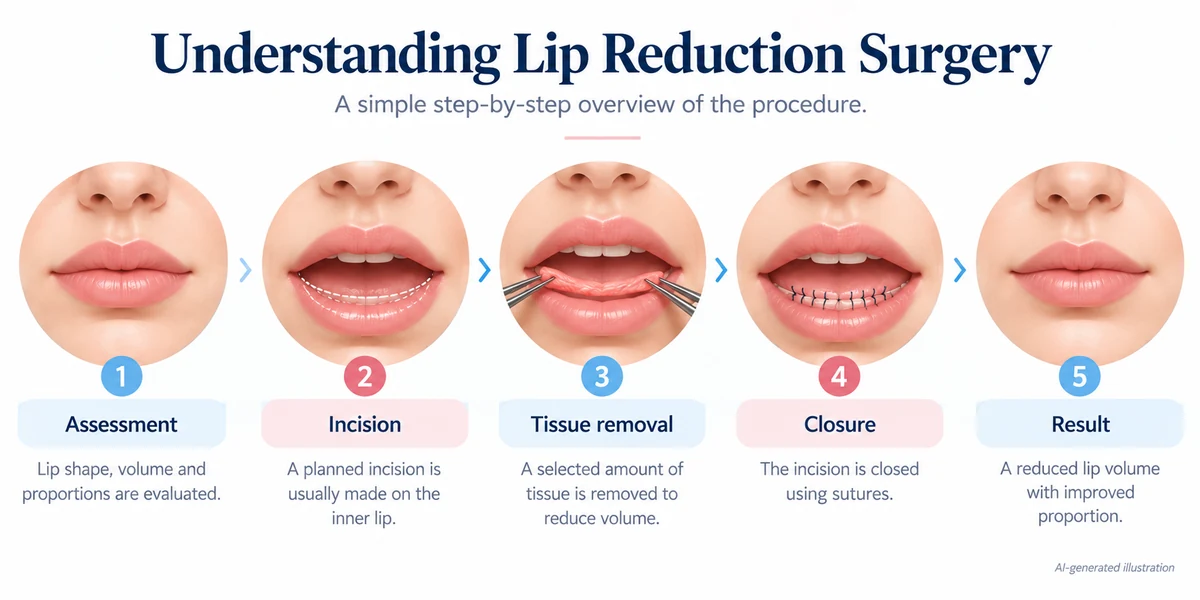
Lip reduction surgery, also called reduction cheiloplasty, is an elective procedure that removes selected tissue from the upper lip, lower lip or both to reduce lip volume. It may be considered for certain anatomical or functional concerns, but naturally full lips do not require medical treatment simply because of their size.
The procedure commonly involves an incision on the inner surface of the lip, removal of a planned amount of tissue and closure using sutures. As with any surgery, it involves permanent tissue changes, scarring and possible complications.
This article explains how lip reduction works, who may be suitable, the difference between surgical and non-surgical approaches, recovery expectations and important safety considerations.
What Is Lip Reduction Surgery?
Lip reduction surgery is a procedure that decreases the volume of selected lip tissues.
It may involve:
Upper lip reduction
Lower lip reduction
Reduction of both lips
Correction of selected areas with excess tissue
Reconstructive adjustment in certain clinical circumstances
The amount and location of tissue removal depend on individual anatomy and the intended surgical plan.
The operation should preserve essential functions such as lip closure, speaking, eating and normal facial movement.
Although the incision is often inside the mouth, the procedure is not scar-free.
Why Do Some People Have Thick or Prominent Lips?
Lip size and shape vary naturally. Fuller lips are not inherently abnormal.
Several factors can contribute to increased lip volume.
1. Genetics and Natural Anatomy
Some individuals naturally have fuller upper or lower lips because of inherited facial characteristics.
These features typically do not require treatment.
2. Differences Between Upper and Lower Lips
One lip may have more volume than the other.
Mild differences are common and may not affect normal function.
3. Previous Lip Fillers
Lip enlargement may result from earlier injectable filler procedures.
When filler is responsible, surgical removal of natural lip tissue may not be appropriate.
4. Injury or Scar Tissue
Previous injuries, surgery or scar formation may affect lip thickness and shape.
5. Inflammatory or Medical Conditions
Certain infections, allergic reactions, inflammatory disorders or other medical conditions may cause lip swelling.
Persistent, painful, new or recurrent lip enlargement should be medically evaluated before any cosmetic intervention.
Can Naturally Thick Lips Be Reduced Without Surgery?
There is no established exercise, massage or topical cream that reliably removes natural lip tissue.
When lip fullness is due to natural anatomy, surgical reduction may be considered in selected individuals.
However, treatment depends on the cause.
For example, if fullness is related to hyaluronic acid filler, a clinician may assess whether observation or medically supervised dissolution is appropriate.
If swelling is caused by infection or inflammation, the underlying condition should be investigated and treated.
Therefore, surgery is not the only management option for every enlarged lip.
Who May Be Suitable for Lip Reduction Surgery?
Suitability requires individual medical assessment.
Factors that may be considered include:
Persistent lip fullness caused by natural tissue volume
Structural differences affecting lip proportions
Selected reconstructive or functional concerns
General medical fitness
Stable health and appropriate wound-healing capacity
Smoking and nicotine exposure
Previous lip procedures or injuries
Ability to understand permanent tissue removal
Realistic expectations about scarring and results
The surgeon may assess lip movement, sensation, symmetry, mouth closure and facial anatomy before considering a procedure.
A person may decide against surgery even after being considered medically suitable.
When May Lip Reduction Surgery Not Be Appropriate?
Lip reduction may be unsuitable or require postponement when there is:
Active lip infection or inflammation
Unexplained or recent lip swelling
Uncontrolled medical conditions affecting surgical safety
Increased bleeding or wound-healing risks
A previous filler-related problem requiring separate assessment
Significant scarring or tissue changes requiring reconstructive evaluation
Unrealistic expectations of perfect symmetry or scar-free healing
For naturally full lips without functional problems, choosing not to undergo surgery is a valid option.
How Is Lip Reduction Surgery Performed?
The technique is selected according to the anatomy, amount of tissue reduction and functional considerations.
Step 1: Medical and Lip Assessment
The surgeon reviews the medical history, medications, allergies, previous lip treatments, tissue characteristics and expectations.
Lip closure, smile, movement and sensation may also be evaluated.
Step 2: Anaesthesia
Lip reduction is commonly performed using local anaesthesia. Sedation or another anaesthesia technique may be used when clinically appropriate.
Step 3: Incision Planning
The surgeon identifies the area where tissue removal is proposed.
Incisions are commonly located on the inner or wet portion of the lip.
Step 4: Removal of Selected Tissue
A planned strip or segment of lip tissue is removed.
The surgical approach should account for lip structure, blood supply, sensation and movement.
Step 5: Wound Closure
The incision is closed using sutures.
Some sutures may be absorbable, while others require removal.
Step 6: Postoperative Care
Instructions may include mouth rinses, dietary precautions, medication, activity restrictions and follow-up assessments.
The exact surgical method varies. No technique guarantees perfect symmetry or a specific appearance.
Upper Lip vs Lower Lip Reduction
The upper and lower lips have different anatomical characteristics.
| Feature | Upper lip reduction | Lower lip reduction |
|---|---|---|
| Treatment area | Selected upper lip tissue | Selected lower lip tissue |
| Main consideration | Upper lip volume, movement and contour | Lower lip volume, movement and contour |
| Incision | Often on the inner lip | Often on the inner lip |
| Functional assessment | Smile, speech and lip closure | Speech, eating and lip closure |
| Scarring | Permanent | Permanent |
| Recovery | Depends on procedure and healing | Depends on procedure and healing |
Reduction of both lips may also be considered, but removing tissue from one or both lips should be based on individual clinical findings.
Lip Reduction Surgery vs Lip Fillers
These treatments have different purposes and should not be considered interchangeable.
| Feature | Lip reduction surgery | Lip fillers |
|---|---|---|
| Main purpose | Remove selected tissue to reduce volume | Add volume |
| Treatment type | Surgical | Injectable |
| Incision | Usually required | Generally no surgical incision |
| Anatomical change | Permanent tissue removal | Added filler material |
| Recovery | Surgical wound healing | Usually shorter early recovery |
| Main risks | Bleeding, infection, scarring, numbness, asymmetry | Vascular occlusion, infection, nodules, swelling |
| Suitable for naturally excessive lip volume? | May be considered in selected cases | Does not remove natural tissue |
If the concern is uneven lips rather than general lip volume, treatment may require a different assessment.
Related reading: Lip Asymmetry Treatment: Fillers vs Surgery.
Does Lip Reduction Surgery Leave Scars?
Yes. Every surgical incision creates a scar.
Lip reduction incisions are often placed inside the mouth, making them less visible externally.
However, scars may still cause:
Firmness or tightness
Uneven healing
Altered lip sensation
Abnormal scar thickening
Changes in lip contour
Scar visibility and maturation vary.
A hidden incision does not mean that the procedure is scar-free or that wound complications cannot occur.
What Are the Risks of Lip Reduction Surgery?
Lip reduction is an elective surgical procedure and involves recognised risks.
Swelling and Bruising
Temporary swelling, discomfort and bruising are common after surgery.
Bleeding
Bleeding may occur during or after the procedure.
Significant or persistent bleeding requires medical assessment.
Infection
The incision may develop an infection, particularly if wound healing is disrupted.
Altered Sensation
Temporary numbness or changes in lip sensation may occur. Some sensory changes may persist.
Scar-Related Problems
Scar thickening, tightness or abnormal healing may affect lip movement and appearance.
Asymmetry
Unequal tissue removal or differences in healing may result in persistent asymmetry.
Changes in Lip Function
Unwanted changes in lip closure, speaking, smiling or eating may occur.
Anaesthesia-Related Complications
Local anaesthetic and other anaesthesia-related adverse reactions are possible.
Revision Surgery
Further surgery may sometimes be considered when healing or contour differs from expectations.
However, revision also carries risks and cannot guarantee correction.
Lip Reduction Surgery Recovery Timeline
The recovery process depends on the amount of tissue removed, the surgical technique, general health and individual healing.
| Recovery period | What may happen |
|---|---|
| First 24–72 hours | Swelling, tenderness, bruising and tightness |
| Days 4–7 | Early discomfort may improve; soft foods may still be advised |
| Weeks 1–2 | Continued incision healing and gradual reduction in swelling |
| Weeks 2–4 | Speaking, eating and daily activities may become more comfortable |
| Months 1–3 | Residual swelling and firmness may continue changing |
| Months 3–6 | Further tissue settling and scar maturation |
These are approximate stages, not guaranteed recovery milestones.
The final lip contour may take several months to become clearer.
For detailed recovery guidance, read Lip Reduction Recovery: Swelling, Eating, Speaking and Healing.
What Can You Eat After Lip Reduction Surgery?
A liquid or soft-food diet may be recommended during early recovery because chewing can stretch the healing lip.
Examples of foods that may be easier to consume include:
Yogurt or curd
Smooth porridge
Soft rice
Mashed vegetables
Well-cooked foods requiring minimal chewing
Soups at a comfortable temperature
Avoid foods that irritate or place excessive pressure on the incision.
The treating surgeon should determine the duration and type of dietary restriction.
When Can You Return to Work and Exercise?
Return to work depends on discomfort, swelling, job demands and healing.
People whose occupations require prolonged speaking may need more recovery time than those with limited verbal duties.
Physically demanding work or exercise may require additional restrictions.
Strenuous physical activity should not resume until medical clearance has been given.
There is no universal recovery date suitable for everyone.
Is Lip Reduction Surgery Permanent?
Lip reduction permanently removes selected lip tissue.
However, facial appearance can continue changing because of:
Natural ageing
Scar maturation
Changes in surrounding tissues
Subsequent injuries or medical conditions
Further cosmetic procedures
The operation cannot guarantee that the lips will retain precisely the same appearance throughout life.
A particular amount of reduction, perfect symmetry or specific cosmetic result cannot be promised.
Can Lip Reduction Correct Uneven Lips?
Lip reduction may be considered when one lip, or one area of a lip, has excess tissue relative to another.
However, lip asymmetry can also result from muscle movement, facial nerve conditions, scarring, previous fillers or natural anatomical differences.
Removing tissue may not address these causes.
A medical assessment should establish whether treatment, observation or a different approach is appropriate.
Lip Reduction Surgery: Safety and Recovery Checklist

Before surgery and during recovery, review the following points.
Confirm the cause of lip fullness: Distinguish natural anatomy from fillers, inflammation or medical conditions.
Assess lip function: Review speaking, eating, smiling, sensation and mouth closure.
Discuss permanent tissue removal: Understand that the original tissue cannot simply be restored.
Review possible scars: Internal incisions still create permanent scars.
Discuss medical risks: Include bleeding, infection, asymmetry, sensory changes and wound complications.
Review medication and medical history: Disclose prescribed medicines, supplements, allergies and previous procedures.
Follow dietary instructions: Use liquids or soft foods as advised.
Maintain oral hygiene: Follow prescribed cleaning and mouth-rinse instructions.
Avoid unnecessary lip stretching: Protect the healing incision.
Avoid nicotine exposure: Follow medical instructions relating to wound healing.
Resume activities gradually: Do not restart strenuous exercise without clearance.
Attend follow-up visits: Allow adequate assessment of wound healing and recovery.
These precautions may reduce avoidable problems but cannot eliminate the risk of complications.
Normal Healing vs Warning Signs
| May occur during routine recovery | Requires medical attention |
|---|---|
| Temporary swelling that gradually improves | Rapidly increasing swelling |
| Mild or moderate tenderness | Severe or worsening pain |
| Early bruising | Persistent or excessive bleeding |
| Temporary tightness | Increasing difficulty with lip movement or closure |
| Mild swelling-related unevenness | Worsening asymmetry with other concerning symptoms |
| Gradual incision healing | Pus, foul-smelling discharge or wound separation |
Emergency warning: Difficulty breathing or swallowing, rapidly expanding swelling or uncontrolled bleeding requires emergency medical care.
Frequently Asked Questions
1. What is lip reduction surgery?
Lip reduction surgery is an elective procedure that removes selected tissue from the upper lip, lower lip or both to decrease lip volume. It is also called reduction cheiloplasty.
2. Can naturally thick lips be reduced without surgery?
There is no established non-surgical method that reliably removes natural excess lip tissue. However, when fullness is caused by filler or a medical condition, other management options may be appropriate.
3. Is lip reduction surgery permanent?
The tissue removed during surgery does not simply regenerate. However, natural ageing and other tissue changes can affect the appearance of the lips over time.
4. How long does lip reduction recovery take?
Early swelling and discomfort commonly improve over several days or weeks. Residual swelling and scar maturation may continue for several months.
5. Does lip reduction surgery leave visible scars?
Lip reduction creates permanent scars, commonly located inside the mouth. These may be less visible externally, but scar-related complications can occur.
6. Can lip reduction surgery correct uneven lips?
It may be considered when asymmetry results from excess tissue in one area. Other causes of uneven lips may require different treatment or no intervention.
7. What are the main risks of lip reduction surgery?
Potential complications include bleeding, infection, swelling, scarring, altered sensation, persistent asymmetry, changes in lip function and anaesthesia-related risks.
Conclusion
Lip reduction surgery permanently removes selected lip tissue and may be considered in certain anatomical or reconstructive situations.
Naturally full lips are a normal variation and do not automatically require treatment.
The suitability of surgery depends on the cause of lip fullness, medical health, functional considerations, surgical risks and personal preferences.
Understanding the procedure, alternatives, permanent scars and recovery requirements is important before making an informed decision.
Disclaimer: All content and visuals on this website are for educational and informational purposes only. Images may be AI-generated or illustrative. Individual treatment results may vary. This information does not replace professional medical advice, diagnosis or consultation.