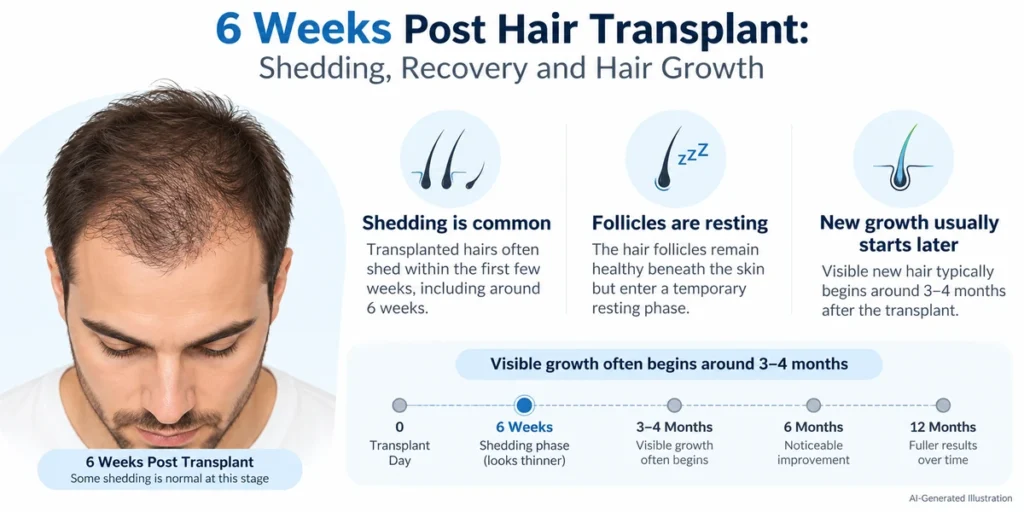
At 6 weeks post hair transplant, shedding of transplanted hair is common, and visible new hair growth may not have started yet. This is generally part of the early recovery process. The transplanted hair shafts may fall out while the underlying follicles remain in the scalp and enter a resting phase.
By this stage, most initial scabs and swelling should have resolved. However, some individuals may still experience mild redness, itching or changes in scalp sensation.
Hair transplant results cannot be reliably judged after six weeks. New growth usually becomes more noticeable over the following months, and the final appearance develops much later.
This article explains what happens six weeks after hair transplantation, why shedding occurs, what recovery symptoms may be expected and when medical assessment is necessary.
Six weeks after follicular unit extraction (FUE) or follicular unit transplantation (FUT), the scalp is usually beyond the initial wound-healing phase.
However, the hair follicles are still progressing through their growth cycle.
Many transplanted hair shafts fall out during the first several weeks.
This shedding does not necessarily indicate damage to the follicles beneath the skin.
Small crusts commonly form after transplantation but generally disappear during the first two weeks.
Persistent or newly developing crusting at six weeks should be assessed if accompanied by redness, pain or discharge.
The transplanted area may temporarily look thinner as transplanted shafts shed.
Some nearby natural hair may also undergo temporary shedding.
Some individuals continue experiencing mild itching, numbness or altered sensation.
Symptoms should generally improve rather than become progressively worse.

Yes. Shedding around six weeks is common.
After transplantation, the visible hair shafts may enter the shedding phase while the follicles temporarily rest.
This is often discussed in relation to postoperative telogen effluvium or shock loss.
Importantly, shedding of the hair shaft is different from permanent loss of the follicle.
No. The amount and timing vary.
Some people notice substantial shedding, while others retain more visible transplanted hair.
Neither pattern guarantees a better final result.
Not necessarily.
A transplant cannot be classified as successful or unsuccessful based only on shedding at six weeks.
For an explanation of why density may still be limited several months later, read 5 months after a hair transplant with little or no density.
Shock loss refers to temporary shedding that can affect transplanted hairs or existing hairs near the operated area.
Surgical stress may temporarily alter the growth cycle of affected follicles.
The transplanted hair shafts may fall out while the implanted follicles remain viable.
Some non-transplanted hairs surrounding the recipient area may also shed.
Recovery depends partly on the health of those original follicles.
Hair that was already significantly miniaturised by androgenetic alopecia may not recover as fully as healthier hair.
Shock loss is common, but it is not proof that new hair growth will definitely occur.
Hair growth after transplantation takes months rather than weeks.
| Time after surgery | Common observations |
|---|---|
| First 1–2 weeks | Healing, scabbing and temporary tenderness |
| Weeks 2–6 | Shedding of transplanted hair shafts may begin |
| Weeks 6–8 | Hair density may appear reduced during the shedding phase |
| Months 3–4 | Early new hair growth may become visible |
| Months 5–6 | Short, fine and uneven new hairs may develop |
| Months 6–9 | Hair coverage and thickness may improve |
| Months 10–18 | Further growth and maturation; timing varies |
These are approximate stages rather than guaranteed milestones.
The NHS guidance on hair transplantation explains that transplanted hair commonly sheds within weeks, new hair often begins appearing after several months, and the final results may take 10–18 months.
At six weeks, transplanted follicles may still be in a resting phase.
The visible transplanted hair may have shed, while new hair shafts have not yet emerged.
This can make the recipient area appear sparse or similar to its preoperative appearance.
Hair growth varies with individual follicle biology, surgical technique, scalp condition and the treatment area.
No visible growth at six weeks is not, by itself, evidence of transplant failure.
Some symptoms can continue beyond the initial healing period.
Temporary itching may occur as the scalp heals.
Persistent or worsening itching accompanied by redness or scaling should be evaluated.
Changes in scalp sensation can result from the surgical procedure.
Sensation may gradually improve over weeks or months.
Mild residual redness can occur in some individuals.
However, increasing redness, warmth, pain or discharge may indicate inflammation or infection.
Some individuals develop small inflamed bumps near hair follicles.
Repeated, painful or pus-filled lesions require medical assessment.
By six weeks, many people can resume ordinary hair washing and selected routine activities if healing has progressed appropriately.
However, the treating surgeon’s specific instructions remain important.
Wash gently: Use a suitable shampoo and avoid aggressive scratching.
Avoid unnecessary friction: Do not repeatedly rub or pull the transplanted area.
Protect against sunlight: Limit excessive exposure and use appropriate scalp protection.
Resume exercise gradually: Follow medical advice, especially if healing complications remain.
Avoid harsh chemicals: Be cautious with hair dyes and other irritating products.
Follow medication instructions: Use prescribed treatments as directed.
Attend follow-up reviews: Discuss unusual symptoms or concerns about healing.
Gentle care supports scalp health, but no shampoo or care routine guarantees faster graft growth.
Many individuals may be able to resume a broader range of physical activities by six weeks if recovery has been uncomplicated.
However, the appropriate timing varies.
Strenuous exercise, swimming, contact sports and activities involving pressure or trauma to the scalp should be resumed according to individual medical guidance.
People with ongoing redness, pain, wound problems or other complications may require additional restrictions.
The American Society of Plastic Surgeons’ hair transplant recovery guidance provides further general information about postoperative care and recovery.
Some individuals may be prescribed medication to manage ongoing androgenetic alopecia.
However, medications should not be started automatically simply because transplanted hair is shedding.
Minoxidil may be used for selected hair-loss conditions.
The timing of starting or restarting treatment after surgery should follow the treating professional’s instructions.
Finasteride may help manage male pattern hair loss in suitable individuals.
It has potential adverse effects and is not appropriate for everyone.
Neither medicine guarantees prevention of postoperative shedding or permanent graft survival.
For general information about ongoing pattern hair loss and treatment options, see treatment options for male hair loss at age 25.
Although shedding is often expected, certain symptoms should not be ignored.
Contact a qualified healthcare professional if you experience persistent or increasing pain, spreading redness, warmth, swelling, pus, discharge, fever or new wound breakdown.
Sudden patchy hair loss affecting areas outside the transplanted region may also require assessment.
Do not use unprescribed antibiotics, steroid creams or other treatments to manage unexplained scalp symptoms.
Six weeks is too early to evaluate the final density or appearance of a transplant.
New hair often begins emerging after three to four months, and growth may initially be fine or uneven.
Further improvement in coverage, length and thickness may occur over subsequent months.
Some individuals require 12–18 months for the final appearance to develop.
The final result depends on graft survival, donor hair characteristics, underlying hair loss and other individual factors.
For information about how transplanted hair and surrounding natural hair may change over the longer term, read hair transplant results after five years.
Yes. Shedding of transplanted hair shafts is common during the early weeks after transplantation. This does not necessarily indicate loss of the underlying follicles.
Many transplanted follicles are still in a resting phase. New hair growth commonly becomes visible after several months rather than within six weeks.
Some individuals shed much of the visible transplanted hair during the early recovery period. The extent varies, and shedding alone does not establish graft failure.
Mild itching may occur during healing. Persistent or worsening itching, especially with redness, pain or discharge, should be evaluated.
Many individuals can resume selected activities after uncomplicated healing. Strenuous exercise or contact sports should be resumed according to individualized medical advice.
No. Shock loss can involve temporary shedding after surgery. However, it is not a guarantee of successful regrowth, and final results require longer-term assessment.
New hair may begin appearing around three to four months. Visible coverage often improves over six to twelve months, while final maturation can take longer.
At six weeks after a hair transplant, shedding of transplanted hair shafts is common and visible new growth may still be limited.
Most initial surgical healing has usually occurred, although mild itching, redness or sensory changes can persist.
The appearance of the scalp at six weeks cannot reliably predict final transplant density.
Following appropriate postoperative guidance and recognising unusual symptoms are important during recovery.
Reference links:
https://www.webmd.com/skin-problems-and-treatments/hair-loss/hair-transplants
https://www.plasticsurgery.org/cosmetic-procedures/hair-transplantation-and-restoration/recovery
Disclaimer: All content and visuals on this website are for educational and informational purposes only. Images may be AI-generated or illustrative. Individual treatment results may vary. This information does not replace professional medical advice, diagnosis or consultation