
Buccal Fat Removal in Navi Mumbai: Who Is a Good Candidate?
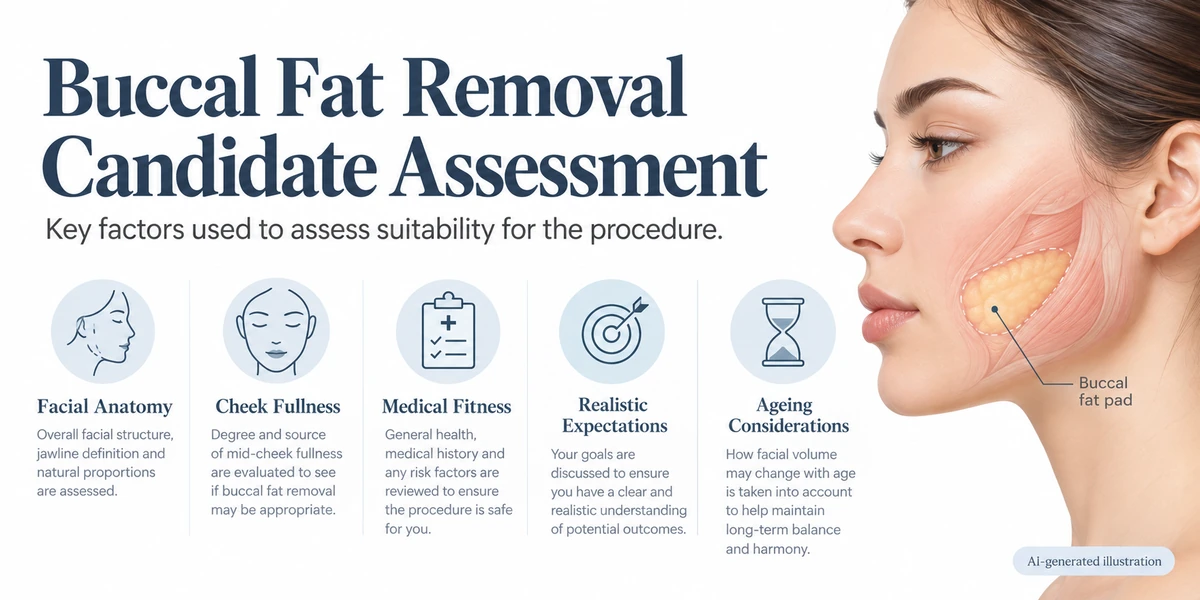
Buccal fat removal may be considered for selected healthy adults with persistent lower-cheek fullness caused by prominent buccal fat pads. However, not every person with a round or full face is suitable for this procedure. Facial fullness can also result from natural bone structure, superficial fat, enlarged jaw muscles or changes in skin and soft tissues.
Buccal fat removal is an elective cosmetic surgery that permanently removes a portion of the deep cheek fat pad. Because the change cannot be easily reversed, understanding facial anatomy, individual suitability, possible complications and long-term ageing is important.
This article explains who may be suitable for buccal fat removal, who may benefit from avoiding surgery, and what to consider before making a decision.
What Is Buccal Fat Removal?
Buccal fat removal, sometimes called cheek reduction surgery, involves surgically removing a selected portion of the buccal fat pad.
The buccal fat pad is a naturally occurring structure situated deep within the cheek, between surrounding facial muscles.
Everyone has buccal fat, but its size varies.
The procedure generally involves an incision inside the mouth, through which the surgeon accesses the fat pad and removes a selected amount.
Buccal fat removal is not a weight-loss treatment and does not remove all types of facial fat.
It also does not reliably treat loose skin, an enlarged jaw muscle or a double chin.
Why Do Some People Have Naturally Full or Chubby Cheeks?
Round or full cheeks are common facial characteristics and do not necessarily indicate a medical problem.
Several factors can contribute to facial fullness.
1. Prominent Buccal Fat Pads
Some individuals naturally have relatively large buccal fat pads, producing persistent fullness in the lower cheeks.
2. Genetics and Facial Bone Structure
Facial shape is influenced by inherited characteristics, including cheekbone projection, jaw width and the distribution of facial tissues.
3. General Facial Fat Distribution
Body-weight changes may influence superficial facial fat and overall facial fullness.
4. Enlarged Jaw Muscles
A prominent masseter muscle can create a wider or more square-shaped lower face.
Removing buccal fat does not reduce the size of this muscle.
5. Skin Laxity and Ageing
Changes in skin elasticity, fat distribution and tissue position can affect cheek contours over time.
6. Medical Causes of Facial Swelling
Persistent or sudden facial swelling may occasionally be associated with dental, salivary gland, inflammatory or other medical conditions.
These require appropriate medical assessment rather than cosmetic fat removal.
How Can You Tell Whether Cheek Fullness Comes From Buccal Fat?
A facial examination is more reliable than judging the cause of cheek fullness from photographs.
| Facial appearance or concern | Possible contributing factor | What should be assessed? |
|---|---|---|
| Persistent fullness in the lower cheeks | Prominent buccal fat pads | Depth and location of cheek fat |
| Generalised facial fullness | Overall fat distribution | Weight changes and superficial fat |
| Wide or square lower face | Masseter muscles or bone structure | Jaw anatomy |
| Fullness beneath the chin | Submental fat or skin laxity | Chin and neck anatomy |
| Drooping or sagging cheeks | Age-related tissue changes | Skin elasticity and soft-tissue position |
| New or uneven cheek swelling | Possible medical condition | Clinical examination and investigation when indicated |
The presence of full cheeks alone does not establish suitability for surgery.
For an explanation of different facial fat compartments, see Chubby Cheeks Treatment: Buccal Fat Removal vs Facial Liposuction.
Who May Be a Suitable Candidate for Buccal Fat Removal?
A suitable candidate is determined by medical and anatomical assessment rather than by age or appearance alone.
The following factors may support consideration of the procedure.
Persistent Lower-Cheek Fullness
Individuals with fullness clearly associated with prominent buccal fat pads may be evaluated for reduction.
Relatively Stable Body Weight
Stable body weight helps distinguish persistent facial anatomy from temporary changes related to weight fluctuations.
Good General Health
Medical conditions that increase bleeding, infection or wound-healing risks must be considered before elective surgery.
No Existing Significant Cheek Hollowing
Preserving adequate cheek volume is important because facial fat contributes to facial contour.
Realistic Understanding of Results
Candidates should understand that the procedure produces variable changes and cannot guarantee a particular cheek shape or facial symmetry.
Understanding of Permanent Tissue Removal
Once the selected fat has been removed, the original anatomy cannot simply be restored.
Willingness to Accept Surgical Risks
Informed consent requires an understanding of possible infection, nerve injury, salivary duct injury, asymmetry and unwanted changes in facial contour.
The American Society of Plastic Surgeons identifies physical health, stable weight, nonsmoking status and realistic expectations as relevant candidate considerations.
Buccal Fat Removal Candidate Assessment Checklist
| Assessment factor | Why it matters |
|---|---|
| Fullness caused by prominent buccal fat | Determines whether the procedure addresses the actual concern |
| Stable weight | Helps evaluate consistent facial proportions |
| General medical fitness | Supports safer surgical planning |
| Smoking and nicotine use | Can influence wound healing |
| Existing cheek volume | Helps identify the risk of hollowing |
| Age-related facial changes | Important for long-term appearance |
| Expectations | Helps establish the limitations of surgery |
| Medical and surgical history | Identifies potential risk factors |
| Understanding of complications | Necessary for informed consent |
Meeting several of these considerations does not automatically make someone suitable for surgery.
Who May Not Be a Suitable Candidate for Buccal Fat Removal?
Buccal fat removal may be inappropriate for certain individuals.
People With Naturally Thin or Narrow Faces
Removing deep cheek fat from an already narrow face may increase the appearance of hollowing.
Individuals With Existing Hollow Cheeks
Further volume reduction can accentuate existing hollows and may produce an undesirable contour.
People With Significant Facial Volume Loss
Age-related loss of facial volume may make additional fat removal less appropriate.
Individuals Whose Fullness Has Another Cause
If the apparent fullness is related to jaw muscles, bone structure, superficial fat or skin laxity, buccal fat removal may not address it.
People With Uncontrolled Medical Conditions
Conditions affecting bleeding, infection risk, anaesthesia safety or wound healing require evaluation and may warrant postponement or avoidance of elective surgery.
Individuals With Unrealistic Expectations
The procedure cannot create a completely different facial structure or reproduce another person’s facial appearance.
Younger Individuals Whose Facial Contours Are Still Changing
Facial maturation and future volume changes should be considered carefully. Elective removal is generally approached cautiously when facial development is incomplete.
Choosing not to undergo surgery is an appropriate option.
Does Buccal Fat Removal Suit Every Round Face?
No. A round face can result from multiple anatomical features.
For example, an individual with broad cheekbones and a rounded jawline may have relatively small buccal fat pads.
In that situation, removing buccal fat may produce little visible change or create unintended hollowing.
Similarly, fullness caused by enlarged jaw muscles or tissue beneath the chin will not be directly corrected by removing the buccal fat pad.
The cause of the fullness should be identified before considering a particular procedure.
Can Buccal Fat Removal Cause Hollow Cheeks?
Yes. Excessive removal may result in cheeks appearing unusually hollow or sunken.
The risk may be greater when:
The person already has limited cheek volume
A large proportion of fat is removed
There is existing age-related facial fat loss
Substantial weight loss occurs later
The facial proportions are not suitable for further volume reduction
Natural ageing also changes facial tissues over time.
Therefore, a procedure that creates one appearance shortly after recovery may look different years later.
Read Buccal Fat Removal: Results, Facial Ageing and Long-Term Risks for more information about these considerations.
How Is Buccal Fat Removal Surgery Performed?
The precise approach depends on individual anatomy and the surgical plan.
Step 1: Medical and Facial Assessment
The surgeon reviews medical history, medicines, allergies, facial structure and the reasons for considering surgery.
Step 2: Anaesthesia
The operation may be performed under local anaesthesia, sometimes with sedation, or using another suitable anaesthesia plan.
Step 3: Incision Inside the Mouth
A small incision is generally made on the inner surface of the cheek.
Step 4: Accessing the Buccal Fat Pad
The surgeon identifies the fat pad while protecting nearby anatomical structures.
Step 5: Removing Selected Fat
A portion of the pad is removed according to the individual surgical plan.
Step 6: Closing the Incision
The wound is generally closed with sutures, often absorbable ones.
Because the incision is inside the mouth, there is usually no external facial incision from this procedure.
However, wound-healing problems and other complications can still occur.
Buccal Fat Removal vs Other Facial Contouring Approaches
Different procedures address different anatomical concerns.
| Treatment or approach | Main area addressed | Important limitation |
|---|---|---|
| Buccal fat removal | Deep cheek fat pad | Does not address every cause of full cheeks |
| Facial liposuction | Selected superficial fat | Does not directly remove the deep buccal fat pad |
| Masseter-directed treatment | Enlarged jaw muscles in selected cases | Does not remove cheek fat |
| Skin-tightening or lifting procedures | Selected skin or tissue laxity | Do not directly address prominent buccal fat |
| No surgical intervention | Naturally full cheeks without a medical problem | Facial appearance remains subject to natural changes |
Treatment should not be selected based on social-media trends or comparisons with other people’s facial features.
The most appropriate option may be no treatment.
What Is the Recovery Time After Buccal Fat Removal?
Recovery depends on the surgical extent, individual healing and any associated procedures.
Swelling may temporarily make the cheeks appear fuller after surgery.
| Recovery stage | General expectations |
|---|---|
| First 1–3 days | Swelling, tenderness and possible bruising |
| Days 4–7 | Initial discomfort may gradually improve |
| Weeks 2–3 | Continued intraoral wound healing |
| Weeks 3–4 | Swelling may reduce further |
| Months 2–3 | Facial contours may become clearer |
| Months 3–6 | Additional settling and changes in appearance may occur |
These are approximate periods, not guaranteed milestones.
The Cleveland Clinic explains that healing commonly takes around three weeks, while the final facial appearance may take several months to become apparent.
What Precautions Are Important During Recovery?
Postoperative care varies with the surgical plan.
General precautions may include:
Following the prescribed mouth-rinse instructions
Maintaining appropriate oral hygiene
Following temporary liquid or soft-food recommendations
Avoiding smoking and nicotine exposure
Using prescribed medication as directed
Avoiding pressure or trauma to the cheeks
Resuming exercise according to medical clearance
Attending postoperative follow-up visits
Do not manipulate the surgical area or stop prescribed medicines without medical advice.
What Are the Possible Risks of Buccal Fat Removal?
Buccal fat removal is elective surgery and carries recognised complications.
Infection
Bacteria may enter the surgical wound and cause infection.
Bleeding and Hematoma
Bleeding or blood collection within the cheek tissues may occur.
Facial Nerve Injury
Nearby facial nerve branches can be injured, potentially causing temporary or permanent facial muscle weakness.
Salivary Duct Injury
The parotid duct is located near the surgical field and may be damaged.
Numbness and Sensory Changes
Altered sensation can develop following surgery and may sometimes persist.
Uneven Facial Contours
Differences in anatomy, swelling or the amount of tissue removed can contribute to asymmetry.
Excessive Hollowing
Removing too much fat may cause an unwanted gaunt appearance.
Prolonged Swelling or Pain
Swelling, discomfort or abnormal wound healing may persist longer than expected.
Need for Additional Surgery
Revision procedures may occasionally be considered, but further surgery carries risks and does not guarantee correction.
These complications should be discussed before informed consent.
Is Buccal Fat Removal Permanent?
The removed portion of the buccal fat pad does not simply regenerate.
However, surrounding facial tissues continue changing with:
Natural ageing
Weight fluctuations
Changes in skin elasticity
Redistribution or loss of other facial fat
Changes in underlying facial structures
The surgery creates a lasting anatomical change but cannot guarantee an unchanged facial appearance throughout life.
Can Buccal Fat Removal Be Reversed?
The operation itself cannot simply be reversed because removed tissue cannot be placed back in its original anatomical condition.
Selected reconstructive or volume-restoration approaches may be considered for unwanted hollowing.
However, procedures such as fat grafting or fillers have their own limitations and potential complications.
They do not guarantee restoration of the original facial anatomy or appearance.
Does Buccal Fat Removal Improve Jawline Definition?
Buccal fat removal may change the transition between the lower cheeks and surrounding facial contours.
However, it does not directly alter jawbone shape, chin projection or jaw-muscle size.
A person’s perceived jawline definition depends on several anatomical structures.
For a separate discussion of chin projection and long-term facial changes, see Chin Implant After 20 Years: Long-Term Changes and Safety.
Buccal fat removal and chin implant surgery are different procedures and should not be assumed to be interchangeable.
Buccal Fat Removal: Pre-Surgery Safety Checklist

Before considering surgery, review the following:
Identify the cause of cheek fullness: Confirm whether prominent buccal fat is present.
Assess the entire facial structure: Consider cheekbones, jaw, chin and skin quality.
Review medical history: Discuss medicines, allergies and existing health conditions.
Consider age-related changes: Understand how the face may lose volume over time.
Discuss permanent fat removal: Recognise that tissue removal cannot be easily reversed.
Understand possible complications: Include nerve injury, duct injury, infection and asymmetry.
Review non-surgical alternatives: Surgery may not be necessary or appropriate.
Plan recovery: Understand dietary advice, oral hygiene and activity restrictions.
Avoid unrealistic expectations: No particular facial shape or cosmetic result is guaranteed.
Allow informed decision-making: Consider the benefits, limitations and risks before proceeding.
This checklist supports informed decisions but does not replace a clinical assessment.
When Should You Seek Medical Attention After Surgery?
Prompt medical assessment is important if any of the following occur:
Increasing facial pain or swelling
Fever, spreading redness or pus
Persistent bleeding from the mouth
New facial weakness
Persistent or worsening numbness
Unusual fluid discharge
Wound-healing problems
Severe swelling affecting breathing or swallowing requires emergency medical attention.
Frequently Asked Questions
1. Who is a suitable candidate for buccal fat removal?
Selected healthy adults with persistent lower-cheek fullness caused by prominent buccal fat pads may be considered. Suitability depends on individual facial anatomy, medical fitness and realistic expectations.
2. Is buccal fat removal suitable for everyone with chubby cheeks?
No. Round cheeks may result from genetics, facial bone structure, superficial fat or enlarged jaw muscles. Buccal fat removal only addresses the deep buccal fat pad.
3. Who should avoid buccal fat removal?
People with naturally thin or hollow cheeks, significant facial volume loss, certain medical risk factors or unrealistic expectations may not be suitable candidates.
4. Does buccal fat removal make the face slimmer?
It may reduce selected lower-cheek fullness, but the degree of visible change varies. It does not produce overall weight loss or alter the underlying facial bone structure.
5. Can buccal fat removal cause premature facial ageing?
Removing excessive cheek fat may increase the appearance of hollowing as facial tissues naturally change with age. This outcome is possible but not inevitable.
6. How long does recovery take after buccal fat removal?
Early healing generally takes several weeks. Swelling and changes in facial contour may continue for several months.
7. Is buccal fat removal permanent?
The surgically removed portion of the fat pad does not simply return. However, facial appearance continues changing with ageing, weight fluctuations and other tissue changes.
Conclusion
Buccal fat removal may be considered for selected individuals whose persistent lower-cheek fullness is caused by prominent buccal fat pads.
However, not every round or full face is suitable for cheek fat removal.
Facial anatomy, general health, existing cheek volume, long-term ageing and possible complications must be evaluated before considering surgery.
Because fat removal is permanent and unwanted hollowing can be difficult to correct, an informed and individualised approach is essential.
Disclaimer: All content and visuals on this website are for educational and informational purposes only. Images may be AI-generated or illustrative. Individual treatment results may vary. This information does not replace professional medical advice, diagnosis or consultation.