
Hair Loss 5 Years After Chemo
 Hair loss 5 years after chemo is not the usual recovery pattern and may need medical evaluation. Most people begin regrowing hair within a few months after chemotherapy ends, but some experience persistent thinning or incomplete regrowth. Possible causes include long-term chemotherapy-related follicle changes, ongoing cancer treatment, hormonal conditions, nutritional deficiencies or another form of hair loss.
Persistent hair loss does not necessarily mean that the original chemotherapy is still damaging hair follicles. Understanding the underlying cause is essential before considering treatment.
Is Hair Loss Normal 5 Years After Chemotherapy?
Hair loss is a common side effect of certain chemotherapy medicines because these drugs affect rapidly dividing cells, including cells involved in hair production.
In most cases, hair begins growing again after treatment has finished. Regrowth may initially be finer, curlier, straighter or a different colour.
However, some people experience persistent hair thinning or incomplete regrowth.
This is sometimes described as persistent chemotherapy-induced alopecia (pCIA) when hair fails to recover adequately after treatment and other causes have been considered.
Five years after chemotherapy, continuing hair loss should be assessed rather than automatically regarded as temporary postoperative-style recovery.
How Long Does Hair Take to Grow Back After Chemotherapy?
The recovery timeline differs according to the chemotherapy medicines, doses, other cancer treatments and individual health factors.
| Time after chemotherapy | Possible hair changes |
|---|---|
| 0–3 months | Early hair regrowth may begin |
| 3–6 months | Short, fine hair may become more noticeable |
| 6–12 months | Hair coverage and length generally increase |
| Beyond 12 months | Persistent incomplete regrowth may require evaluation |
| 5 years | Ongoing thinning is unlikely to represent ordinary early recovery alone |
These are approximate timelines, not guarantees.
Some individuals have slower regrowth or permanent changes in hair density.
The pattern is especially important when hair loss continues years after cancer treatment.
What Causes Hair Loss 5 Years After Chemo?
Several factors may contribute to persistent hair thinning.
1. Persistent Chemotherapy-Induced Alopecia
Certain chemotherapy regimens can cause long-lasting changes in hair follicles.
Persistent thinning has been reported particularly with some taxane-containing treatments, including docetaxel.
However, not everyone receiving these medicines develops permanent hair loss.
2. Ongoing Hormone Therapy
Some cancer treatments continue for several years after chemotherapy.
Hormone therapies used for certain cancers can contribute to progressive thinning.
This should be distinguished from damage caused by chemotherapy itself.
3. Radiation Therapy
Radiation directed at the scalp can affect hair follicles.
Depending on the dose and treatment area, hair loss may be temporary or permanent.
Radiation elsewhere in the body does not usually cause localized scalp hair loss in the same way.
4. Hormonal and Thyroid Conditions
Thyroid disorders, menopause-related changes and other hormonal factors may influence hair growth.
5. Nutritional Deficiencies
Iron deficiency, inadequate protein intake or selected nutritional deficiencies can contribute to diffuse shedding.
6. Androgenetic Alopecia
Male or female pattern hair loss can develop independently of chemotherapy.
Cancer treatment may make an existing tendency toward thinning more noticeable.
7. Other Scalp Conditions
Alopecia areata, inflammatory scalp disease and scarring alopecia may also cause hair loss.
These conditions require different approaches from persistent chemotherapy-induced alopecia.
How Is Persistent Hair Loss After Chemo Diagnosed?
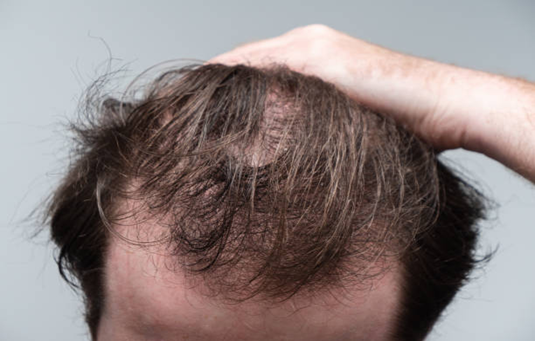 A healthcare professional may begin by reviewing the complete cancer-treatment history.
Important details include the chemotherapy medicines used, treatment dates, whether radiotherapy was directed at the scalp and whether hormone or other systemic treatment is ongoing.
Scalp Examination
The clinician may assess hair density, distribution, hair shaft thickness and the presence of inflammation or scarring.
Trichoscopy
Trichoscopy uses magnification to examine hair follicles and scalp structures.
It can help identify miniaturisation and certain other hair-loss patterns.
Blood Tests
Selected blood tests may be recommended, depending on symptoms and examination findings.
These may include a complete blood count, ferritin or iron studies and thyroid function.
Additional Investigation
A scalp biopsy may occasionally be considered when the diagnosis remains uncertain or scarring hair loss is suspected.
Not everyone requires every test.
Can Hair Grow Back After 5 Years?
Some improvement may still occur when a treatable contributing factor is identified.
For example, correcting a nutritional deficiency or appropriately managing a thyroid disorder may improve hair loss associated with that condition.
However, follicles permanently damaged by chemotherapy or scalp radiation may not recover fully.
There is no treatment that reliably guarantees regrowth of all hair lost after cancer therapy.
Individual expectations should depend on the diagnosis and the condition of the remaining follicles.
What Treatment Options Are Available?
 Treatment should be selected only after assessing the cause of the hair loss and reviewing the person’s cancer-treatment history.
Treating Underlying Medical Conditions
Correcting identified nutritional deficiencies or treating thyroid disease may help when those conditions contribute to hair loss.
Topical Minoxidil
Minoxidil may be considered for selected individuals with persistent thinning.
However, research specifically involving persistent chemotherapy-induced alopecia is limited, and results vary.
Use should be discussed with the treating healthcare team, particularly when cancer treatment is ongoing.
Hormonal Hair-Loss Medicines
Medicines such as finasteride may be appropriate for certain forms of pattern hair loss.
However, they are not routine treatments for every case of chemotherapy-related alopecia.
Their suitability requires particular caution in people with hormone-sensitive cancers.
Platelet-Rich Plasma (PRP)
PRP has been studied for selected hair-loss conditions, but evidence for persistent chemotherapy-induced alopecia remains limited.
It should not be described as a proven method of restoring hair lost after chemotherapy.
Low-Level Light Therapy
Certain light-based treatments have been studied for hair thinning.
Evidence for long-term chemotherapy-related alopecia is not sufficiently established to guarantee benefit.
Cosmetic Hair Options
Wigs, hairpieces, scarves and other scalp coverings can provide nonmedical options for managing changes in hair appearance.
These choices are personal and do not require a person to undergo further treatment.
Can Hair Transplantation Help After Chemotherapy?
Hair transplantation is not automatically suitable for someone experiencing hair loss after chemotherapy.
It involves moving existing follicles from a donor region to an area with reduced hair coverage.
Suitability depends on the cause of the hair loss, donor follicle quality, scalp health, medical fitness and cancer-treatment history.
When thinning is diffuse or the donor area is affected, transplantation may be unsuitable.
Any consideration of elective surgery after cancer treatment should include appropriate input from the oncology team.
Hair transplantation also carries risks, including infection, bleeding, scarring and failure of some grafts to survive.
For general information about transplant longevity and limitations, read hair transplant results after five years.
Can Hair Loss Be Caused by Something Other Than Chemotherapy?
Yes.
Hair thinning may develop years after chemotherapy for reasons unrelated to cancer treatment.
Examples include androgenetic alopecia, telogen effluvium, thyroid disorders and selected nutritional deficiencies.
Different hair-loss conditions can sometimes produce a similar appearance.
For a related explanation of hormonal and nutritional causes of persistent shedding, read postpartum hair loss after one year.
Male pattern hair loss can also develop independently of previous cancer treatment. See treatment options for male hair loss at age 25 for a general overview.
These conditions require different diagnostic and treatment approaches.
How Can Someone Care for Their Hair After Chemotherapy?
Gentle hair care may reduce breakage and scalp irritation, although it cannot reverse permanent follicle damage.
Hair and Scalp Care Checklist
