
Otoplasty for Adults vs Children: What Is Different?

Facial Contouring Surgery in Navi Mumbai | Dr. Vinod Vij
September 19, 2026
Otoplasty in Navi Mumbai: Scars, Recovery & Natural Results
September 22, 2026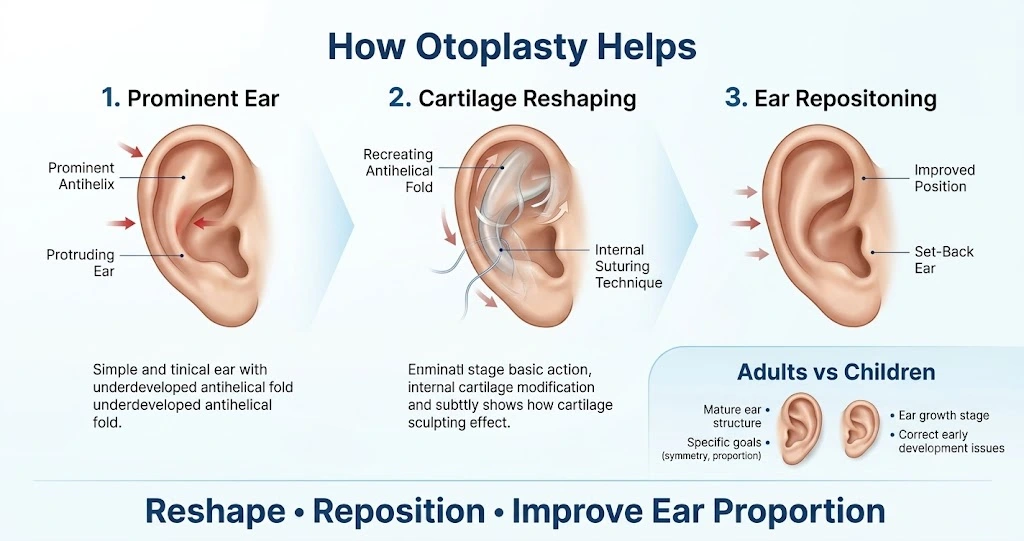
Otoplasty for adults and children uses similar principles to reshape, reposition or correct the appearance of the outer ear, but the consultation and treatment planning can differ according to age. Children are generally considered once the ears have developed sufficiently, often around 4–6 years of age, while adults can undergo otoplasty later in life when they have concerns about prominent ears, asymmetry, ear shape or previous ear surgery.
The main differences involve ear development, motivation, communication, anaesthesia, recovery and postoperative activity. Otoplasty is an individualised procedure, so the same surgical technique is not necessarily
Considering ear correction in Navi Mumbai? A consultation can help determine whether otoplasty is appropriate and which approach fits the patient’s age, ear anatomy and treatment goals. appropriate for every child or adult.
Quick Facts: Adult vs Child Otoplasty
| Factor | Children | Adults |
|---|---|---|
| Typical timing | Often after sufficient ear development | Can be performed later in life |
| Common concern | Prominent/protruding ears, ear shape | Prominent ears, asymmetry, shape or previous surgery |
| Anaesthesia | General anaesthesia is commonly used in younger children | Local anaesthesia with sedation or general anaesthesia may be considered |
| Cooperation | Ability to understand and follow instructions is important | Adult can generally participate directly in decision-making |
| Recovery | School and physical activity need planning | Work and physical activity need planning |
| Treatment planning | Involves child and parent/guardian | Direct discussion with adult patient |
| Main goal | Appropriate ear proportion and position | Appropriate ear proportion and position |
Cleveland Clinic notes that otoplasty is commonly performed in children over age 4, while adults may also undergo the procedure. Mayo Clinic similarly states that children may have otoplasty once the ears have reached sufficient size, generally around 4–6 years.
What Is Otoplasty?
Otoplasty is surgery that changes the shape, position, size or proportion of the outer ear. It is commonly used to correct prominent or protruding ears, but it may also address selected ear asymmetry, congenital differences or changes caused by injury.
For prominent ears, the surgeon may reshape the cartilage and reposition the ear closer to the head. The specific technique depends on the ear’s cartilage structure, shape, position and the correction required. Otoplasty generally changes the appearance of the external ear and does not improve hearing.
Why Is Otoplasty Commonly Considered for Children?
Children with prominent ears may be considered for otoplasty once the ears have developed sufficiently. Mayo Clinic states that otoplasty can generally be performed from around 4–6 years of age, while the American Society of Plastic Surgeons describes approximately age 5 as a common point when ear cartilage is sufficiently developed for correction.
The child’s own willingness is also important. ASPS guidance notes that suitable children should be able to communicate their feelings, cooperate and follow instructions. The decision should therefore involve both the child and parent or guardian rather than being based solely on an adult’s preference for a particular appearance.
Why Do Adults Choose Otoplasty?
Adults may consider otoplasty for concerns that have been present since childhood or for changes caused by injury or previous ear surgery.
Common reasons include:
- Prominent or protruding ears
- Uneven ear position
- Differences in ear shape
- Concerns about ear size or proportion
- Changes following an injury
- Dissatisfaction with previous ear surgery
Otoplasty remains an option after childhood because the operation can be performed in adulthood as well.
For adults, the consultation can also address work schedules, recovery planning, previous surgery and individual expectations.
Otoplasty for Children vs Adults: What Really Changes?
1. Ear Development
One of the main differences is ear development.
Children are generally considered after the external ear has reached sufficient development for correction. This is why otoplasty is often discussed from around age 4–6 onward rather than during infancy.
Adults have fully developed ears, so treatment planning focuses more directly on the existing cartilage, ear position, facial proportions and the specific concern being treated.
2. Decision-Making and Expectations
For children, the surgeon evaluates whether the child understands the procedure and is willing to participate in recovery. Parents or guardians are also involved in the decision-making process.
For adults, the patient can directly explain their concerns, desired changes and expectations. A consultation should still establish what surgery can realistically change.
3. Anaesthesia
The choice of anaesthesia depends on the patient and the procedure.
Younger children may undergo otoplasty under general anaesthesia, while older children and adults may sometimes receive local anaesthesia with sedation. The final choice depends on the surgical plan, age, medical considerations and the anaesthesia team.
4. Recovery and Daily Activities
Recovery is broadly similar in that both adults and children may experience swelling, bruising, tenderness and temporary changes in sensation.
However, daily restrictions are different. A child may need time away from school and restrictions on playground activities, sports and physical contact. Adults may instead need to plan time away from work, exercise and activities that could put pressure on the ears
Otoplasty Treatment Options
The technique is selected according to the patient’s ear anatomy rather than simply their age.
Possible approaches include:
- Ear pinning: bringing prominent ears closer to the head
- Ear reshaping: modifying cartilage to improve ear contour
- Ear reduction: reducing selected portions of an overly large ear
- Ear reconstruction: addressing more complex structural problems
- Revision otoplasty: correcting selected concerns following previous ear surgery
The current Dr. Vinod Vij otoplasty page describes treatment planning around the patient’s ear structure, facial proportions, concerns and desired outcome.
How Is Otoplasty Performed?
Otoplasty usually begins with an examination of the ears and discussion of the patient’s concerns and expectations.
For prominent-ear correction, incisions are commonly placed behind the ear or within natural creases. The surgeon may reshape, fold or modify cartilage and secure it in the planned position with sutures. The exact technique varies according to anatomy and the type of correction required.
The procedure is often performed as an outpatient surgery, although the details depend on the individual case.
Who Is a Good Candidate?
Children
A child being considered for otoplasty should generally:
- Have sufficiently developed ear cartilage
- Be in appropriate overall health
- Have no untreated chronic ear infection
- Be able to communicate concerns
- Be willing to cooperate with postoperative instructions
These factors are consistent with candidate guidance from the American Society of Plastic Surgeons.
Adults
Adults may be considered when they:
- Are in appropriate overall health
- Have a specific concern about ear appearance
- Understand the limitations of surgery
- Have realistic expectations
- Can follow postoperative instructions
Previous ear surgery, medical conditions and medications should be discussed during consultation.

Otoplasty Recovery and Aftercare
After surgery, the ears are usually protected with dressings or bandages. Patients may experience swelling, bruising, tenderness or temporary numbness during the early recovery period.
Cleveland Clinic reports that visual improvement may become noticeable within a few weeks, while complete recovery can take around 6–8 weeks, although individual healing varies.
General Recovery Timeline
| Period | Adults | Children |
|---|---|---|
| First few days | Swelling, bruising and soreness may occur | Similar early symptoms may occur |
| Around 1 week | Follow-up and gradual return to routine activities | Possible return to school depending on recovery |
| 2–3 weeks | Swelling continues to settle | Physical activity may still need restriction |
| 4–6 weeks | Healing progresses | Activity restrictions may gradually reduce |
| 6–8 weeks | More complete healing for many patients | More complete healing for many patients |
This is a general guide rather than an individual recovery schedule.
When Will Otoplasty Results Be Visible?
Changes in ear position and shape can become apparent relatively early, particularly after dressings are removed. However, swelling and tissue healing can temporarily affect the appearance.
Cleveland Clinic notes that visual improvements may be noticeable within two to three weeks, while recovery can continue for several weeks.
The final appearance should therefore be assessed after sufficient healing rather than immediately after surgery.
Risks, Side Effects and Safety
Otoplasty is surgery and carries potential risks. These may include:
- Bleeding or hematoma
- Infection
- Swelling
- Scarring
- Temporary or persistent changes in sensation
- Asymmetry
- Overcorrection
- Changes in the position or shape of the ear
Mayo Clinic and Cleveland Clinic both describe these potential complications and emphasise the importance of appropriate medical assessment and postoperative follow-up.
Children and adults should both receive clear instructions regarding dressings, sleeping position, activity restrictions and follow-up.
Who Is a Good Candidate?
Lorem ipsum dolor sit amet, consectetur adipiscing elit. Ut elit tellus, luctus nec ullamcorper mattis, pulvinar dapibus leo.
Who Is a Good Candidate?
Otoplasty Cost in Navi Mumbai
The cost of otoplasty depends on the procedure rather than age alone.
Factors can include:
- Type of ear correction
- Complexity of the procedure
- Anaesthesia
- Facility and operating-room charges
- Surgeon fees
- Postoperative care
- Whether revision or reconstructive surgery is required
The current Dr. Vinod Vij otoplasty page publishes estimated ranges for different forms of otoplasty, including comprehensive ear reshaping, ear reduction, earlobe repair, ear augmentation and complex reconstruction.
An exact quotation should be confirmed during consultation because the surgical plan and associated costs vary from patient to patient.
Choosing a Plastic & Cosmetic Surgeon for Otoplasty
Otoplasty requires careful assessment of ear cartilage, ear position, facial proportions and the patient’s expectations.
When choosing a surgeon, consider:
- Appropriate plastic-surgery qualifications
- Experience with ear surgery
- Individualised treatment planning
- Clear explanation of risks and recovery
- Appropriate surgical facilities
- Follow-up arrangements
- Realistic discussion of expected changes
Dr. Vinod Vij’s current profile lists MBBS, MS–General Surgery and MCh–Plastic Surgery, along with more than 30 years of experience in plastic, cosmetic and reconstructive surgery.
For more information, see Dr. Vinod Vij – Plastic & Cosmetic Surgeon in Navi Mumbai.
Otoplasty in Navi Mumbai / Vashi
Patients considering otoplasty in Navi Mumbai can begin with an individual examination of the ears and discussion of their concerns.
The treatment plan may differ for a child and an adult because age, cartilage development, expectations, anaesthesia and recovery requirements all need to be considered.
Dr. Vinod Vij’s Navi Mumbai otoplasty page explains that treatment is planned according to ear structure, facial proportions, patient concerns and desired outcome.
For patients visiting Vashi, Clinique Aesthetica lists its address as 415, Nirman Vyapar Kendra, above Navratna Restaurant, Sector 17, Vashi, Navi Mumbai, Maharashtra 400705.
Learn more about Otoplasty in Navi Mumbai.
Frequently Asked Questions
Otoplasty may be considered once the ears have developed sufficiently. Mayo Clinic states that children can generally undergo the procedure from around 4–6 years of age. Individual suitability should be assessed by a qualified surgeon.
Yes. Otoplasty can be performed in adults as well as children. Adults may seek correction of prominent ears, asymmetry, ear shape concerns or changes following injury or previous surgery.
Yes, selected teenagers may undergo otoplasty. Suitability depends on ear development, health, personal motivation, expectations and the ability to follow postoperative instructions.
Otoplasty is primarily an external-ear reshaping procedure. Mayo Clinic notes that it does not change hearing ability.
You can consult for Otoplasty in Navi Mumbai to discuss ear anatomy, treatment options, recovery, risks and cost.
Conclusion
Otoplasty for adults and children follows many of the same surgical principles, but the treatment journey is not identical. Children are generally considered after sufficient ear development and require attention to cooperation, parental involvement, school and activity restrictions. Adults can undergo otoplasty later in life, with treatment planning focused on their anatomy, concerns, expectations and recovery requirements.
A personalised consultation is the appropriate way to determine whether otoplasty is suitable and which technique should be considered.
Considering ear correction in Navi Mumbai?
Discuss your concerns with a qualified plastic surgeon and receive an individual assessment.
